
287(g): How Local Police Became Federal Immigration Officers
Congress funded the largest immigration-enforcement expansion in history. The mechanism that hands local officers federal immigration authority has grown twenty-fold in two years — and documented misuse arrived before the oversight did.
Opening Brief
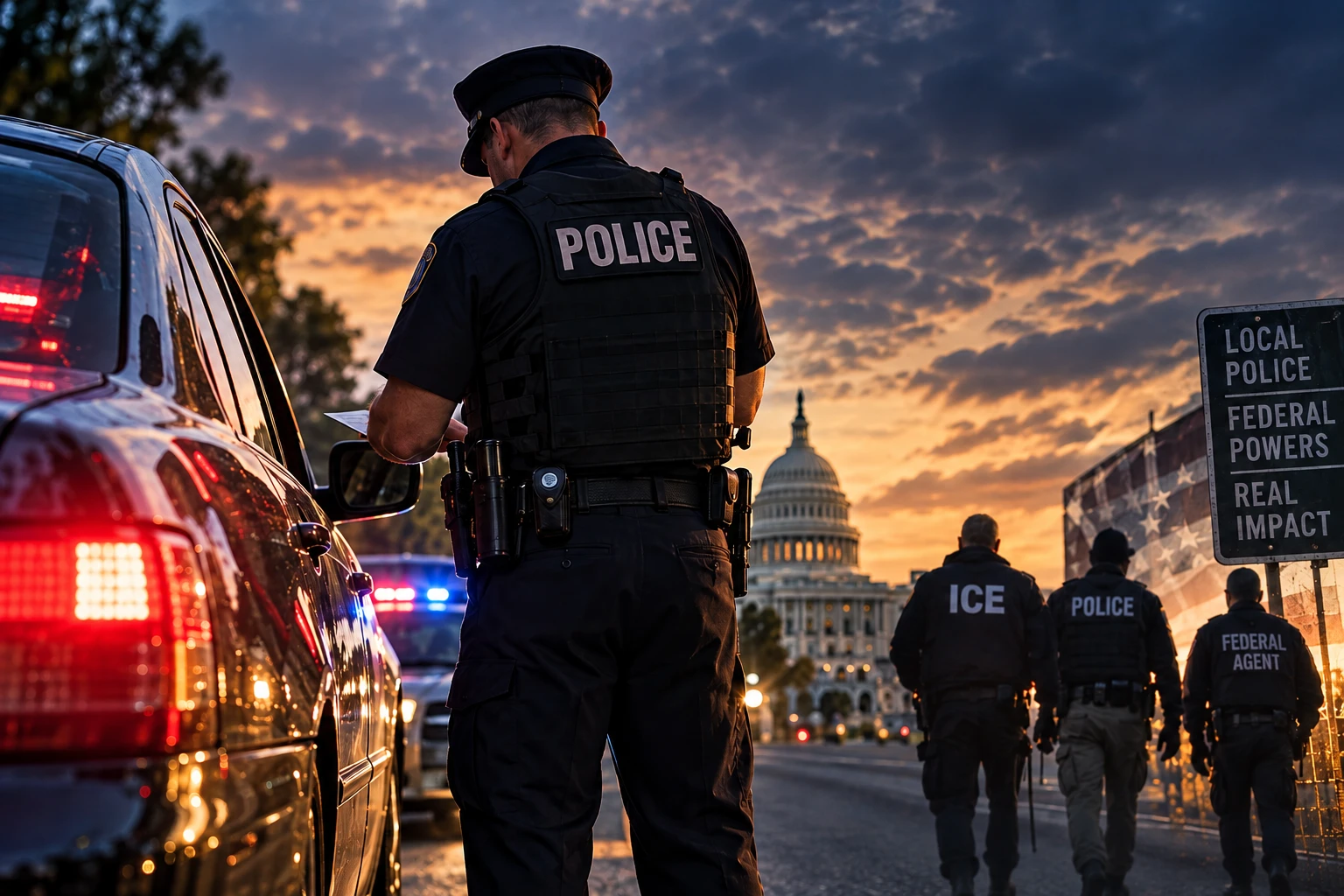
A patrol car pulls you over for a broken tail light. The officer wears a familiar local uniform. What you may not know at the moment of the stop is whether that department has signed a federal agreement making its officers, for immigration purposes, an extension of Immigration and Customs Enforcement.
That agreement is not rare anymore. Section 287(g) of the Immigration and Nationality Act, an authority that sat in the background for decades, has been used to sign 2,559 agreements with state and local agencies as of ICE's own count, current as of 21 September 2026 — a scale that did not exist eighteen months earlier.[1]
The question this file asks is not whether immigration should be enforced. It is a narrower, checkable one: when a local officer gains federal immigration authority, who approved it, what exactly can that officer now do, and what happens when it is used against the wrong person. The growth is documented. The funding is documented. Several uses of that authority are already documented as having gone wrong. Whether the oversight built to match that growth is adequate is the part still open.
What 287(g) actually authorizes
Section 287(g), added to the Immigration and Nationality Act in 1996, lets ICE delegate specified immigration-officer functions to state and local law enforcement, under what ICE describes as its own "direction and oversight." The word specified matters: 287(g) does not deputize an officer as a general-purpose immigration agent. It authorizes one of three distinct models, and each grants a different scope of power.[1]
Jail Enforcement Model: officers identify and process people already booked on state or local criminal charges who may be removable. As of ICE's current count, 185 agencies operate this model across 30 states and one territory.[1]
Warrant Service Officer: officers serve and execute administrative immigration warrants on people already in their custody. 562 agencies across 34 states currently hold this authority.[1]
Task Force Model: the broadest of the three. Officers can enforce limited immigration authority during routine patrol duty, not only against people already booked. This is also the largest model by far: 1,812 agencies across 33 states and two territories, more than the other two models combined.[1]
The distinction is not a technicality. A jail-based agreement affects someone already arrested on a separate charge. A task-force agreement can put federal immigration authority into an ordinary traffic stop. Knowing which model a department holds is the first fact a resident needs, and it is rarely the fact reported in a headline that just says "287(g) agreement."
The growth curve
In January 2025, 135 agencies held a 287(g) agreement. By September 2025, independent tracking of ICE's own published data put the count at 1,000 agreements across roughly 775 agencies in 40 states — a 7.5-times increase in nine months, with Florida and Texas accounting for the largest state totals at that point.[2] A year later, ICE's own page puts the total at 2,559 agreements across 39 states and 2 territories.[1]
These two counts come from different dates and different measurement methods — one an independent tracker reading ICE's public data, the other ICE's own current page — and should not be subtracted to produce a precise growth rate. What both agree on is the direction: this authority has expanded from a marginal tool to a mainstream one inside two years, faster than most state legislatures or city councils have had a chance to hold a hearing on whether their own police department should participate.
Ten states, according to the September 2025 tracking, had no participating agency at all: California, Connecticut, Delaware, Hawaii, Illinois, New Jersey, Oregon, Rhode Island, Vermont and Washington.[2] Participation is a state-and-local choice, not a uniform federal rollout — which means the accountability question in this file has a different local answer in every jurisdiction.
The money behind the surge
The 2025 "One Big Beautiful Bill Act" (OBBBA) directed the largest single immigration-enforcement appropriation in US history to the Department of Homeland Security. Two headline totals circulate for what looks like the same money, and the gap between them is a scope difference, not a contradiction. $170 billion is the border-security and immigration-enforcement title itself, running through fiscal year 2029: border wall construction $46.5 billion, ICE detention expansion (100,000 new beds) $45 billion, ICE agents, transport and deportations $29.9 billion, state and local law-enforcement support $17.3 billion, DHS discretionary/reimbursement funds $10 billion, Border Patrol agents and vehicles $7.8 billion, border technology $6.2 billion, and immigration courts and judges $3.3 billion.[8] A separate budget analyst's $191 billion figure is the same $170 billion plus the Coast Guard's $25 billion, which the act funds under a different, defense-related title — real money in the same law, but not immigration-enforcement-specific.[6]
The line this file's topic runs through directly is that $17.3 billion for state and local law-enforcement support — the funding stream 287(g) partnerships draw on. This figure comes from a secondary synthesis of the bill rather than the bill text itself, which returned an access error when checked directly for this file; it should be treated as reported, not independently confirmed against the primary appropriations document.[8]
Separately verified: $24.8 billion apportioned to ICE detention through February 2026 — described as nearly three times the annual budget of the entire federal Bureau of Prisons — and $40 billion apportioned to CBP border-wall construction.[6] The same analysis raises an oversight concern distinct from any policy argument about immigration itself: public spending trackers like USAspending.gov rely on agency-submitted data that is "often incomplete, delayed, or inaccurate," and Congress's own oversight tools have not scaled with the appropriation.[6] A number this large, moving this fast, through a tracking system already known to lag, is a standing invitation to ask where the money actually went.
Three questions before you assume it's just the local police
A single fact — "my town has a 287(g) agreement" — does not tell a resident what that means in practice. Three separate questions do.
Which model is it?
Jail Enforcement and Warrant Service Officer agreements apply to people already in custody on a separate charge. Task Force agreements can bring federal immigration authority into a routine stop. The same three words, "287(g) agreement," describe meaningfully different exposure depending on which model a department signed.[1]
Who is the officer accountable to, right now?
ICE describes its own oversight of delegated officers. But the FBI, by comparison, operates under publicly available Attorney General Guidelines and a Domestic Investigations and Operations Guide, is chained to the Attorney General, and its cases pass through Article III courts with lifetime-tenured judges and an exclusionary rule that punishes procedural abuse. Immigration enforcement runs through Article II executive-branch immigration judges instead, and ICE answers to the DHS Secretary, not the Attorney General — a structurally different, and by this comparison thinner, accountability chain.[4] That is one legal scholar's comparative analysis, not a finding that any specific department is unsupervised — but it is a concrete, checkable difference in the structure a resident can ask their own department about.
What happens if it goes wrong?
Growth in the number of agreements is not, on its own, evidence of individual misconduct. But it does raise the stakes attached to the answer, because misconduct inside this specific authority has already been documented in named cases, not hypothesized.
What has already gone wrong
The ACLU, tracking 287(g) since its expansion began, documents four specific incidents through early 2026. These are the organization's reporting on publicly known events, not court findings recorded here as adjudicated fact — and this file labels them accordingly.[3]
- In Florida, local police assisted in arresting the father of a 22-year-old cancer patient during a routine traffic stop.
- Also in Florida, police invited Border Patrol to conduct immigration checks at a concert venue; 13 arrests were reported.
- In the Florida Keys, immigration checkpoints led to more than 300 arrests.
- At an Idaho racetrack, roughly 200 federal, state and local agents arrested more than 100 people in a single operation; the ACLU reports that children and US citizens present were zip-tied during the sweep.
The ACLU characterizes the program as "abuse-prone" and its rapid expansion as "a recipe for further civil rights violations."[3] That is an advocacy organization's framing, and it is not neutral by design — civil-liberties groups exist to make exactly this argument. The standard this file applies is the same one it would apply to a government press release: read what is actually documented (named incidents, named locations, reported arrest counts) separately from the characterization built on top of it. The incidents are reported; the argument that they represent a pattern rather than isolated errors is the ACLU's case to make, not an established finding of this file.
77.2 million people — about 32% of the US population — now live in a county with a participating 287(g) agency, and more than 10,000 officers had been trained or were in training under the program as of September 2025.[3] Scale is the reason four documented incidents matter beyond the four counties where they happened: the same authority, at the same growth rate, now sits within reach of roughly a third of the country.
The trade at the federal level
The surge is not only local. As of August 2025, at least 6,700 federal employees had been reassigned or had duties shifted toward immigration enforcement across the Department of Justice and other agencies: roughly 900 FBI agents (6.6% of the bureau), about 2,050 ATF agents (roughly 80% of that agency), a quarter of DEA's operational focus, more than 250 IRS agents, 1,800 Homeland Security Investigations agents, and about 600 Diplomatic Security Service personnel.[5]
The FBI figure specifically kept rising after that count, across three separately reported snapshots that do not all measure the same thing. The Washington Post reported roughly 3,000 FBI agents reassigned as of October 2025, based on FBI data shared with Senator Mark Warner. The Intercept's May 2026 reporting put the number above 6,500 by September 2025 — a reported 23-times increase from 279 agents on immigration cases before January 2025 — and 9,161 total FBI personnel touching immigration-related work, just under a quarter of the bureau's roughly 38,000 employees.[7] That figure counts all personnel, not only special agents, which is likely why it reads much higher than Niskanen's narrower ~900-agent count from a similar period; this file has not independently reconciled the two measurement scopes beyond noting the difference.
The documented effects, as of the August 2025 accounting, are specific rather than speculative: white-collar prosecutions down 10%, weapons prosecutions down 5% (30.6% below the five-year average), drug prosecutions down 10.7% (35.4% below average), roughly a third of DOJ's counterintelligence and export-control section reassigned, and an estimated $313 billion in lost tax revenue over the coming decade tied to reduced IRS enforcement capacity under an IRS–ICE data-sharing arrangement.[5]
This is the same fact from a different angle than the 287(g) growth curve: expanding one enforcement priority this fast requires either new capacity or someone else's capacity. Here, some of that capacity came from agents who previously worked child-exploitation cases, counterterrorism leads and financial-crime investigations. Whether that trade was worth making is a policy judgment outside this file's scope. That the trade was made, and at this scale, is the documented part.
Follow the incentive without inventing the verdict
It is tempting to read four documented incidents and a 20-fold growth curve as proof that every one of 2,559 agreements is being misused. That would overreach the evidence in the same direction the program's defenders overreach when they treat a low incident count against a large agreement total as proof the program is safe. Neither inference is available from what is actually documented here.
What is available: a federal statute with three genuinely different scopes of power, deployed at a pace that outran most of the local hearings and state-level scrutiny that normally precede a police department taking on new legal authority; a funding surge whose own analysts flag as short on public accounting; and a small number of named, reported incidents severe enough — children and US citizens zip-tied in one operation — to establish that the risk is not theoretical.
The useful local question is not "is 287(g) good or bad." It is: which model did my department sign, when, under what public vote or announcement, and what happened the last time it was used against someone who turned out not to be removable. That question has a specific, checkable answer in every one of the participating counties, and it is the one this file recommends residents actually ask.
What real accountability would require
A comparably scaled federal program with a public accountability record already exists as a benchmark: the FBI's own Attorney General Guidelines and Domestic Investigations and Operations Guide are published, specific and reviewed. 287(g)'s current public documentation, by contrast, is largely ICE's own program description of its "direction and oversight," without an equivalent, independently reviewable guideline document identified in this research.[4]
A program operating at this scale, funded at this level, would need at minimum: a public, per-agency record of which model each department holds; a published incident and complaint log reviewable outside the agency itself; and a funding trail that reconciles to a single, agreed appropriation figure rather than two analysts' competing tallies of the same law. None of that is a claim that these safeguards are impossible to build. It is a description of what is not yet visible from the outside.
Evidence Ledger
The claim and the limit
135 agencies (Jan 2025) to 2,559 agreements (21 Sept 2026), per ICE's own program page and independent tracking of ICE's published data. [1,2]
ACLU-reported incidents in Florida and Idaho; reported allegations, not court-adjudicated findings verified in this file. [3]
Reassignment and prosecution-rate figures from a named federal-personnel analysis; later, larger reassignment figures are reported but not independently re-verified here. [5,7]
No public, independently reviewable ICE guideline document comparable to the FBI's Attorney General Guidelines was identified in this research. [4]
Final Assessment
The authority expanded faster than its public paperwork. A statute that covered 135 agencies twenty months ago now covers 2,559, funded by an appropriation whose own total is disputed among the analysts tracking it, and used at least four times in ways severe enough to draw documented, named complaints. None of that proves every agreement is misused. It does establish that the growth has outpaced the kind of public, per-agency accountability record a program operating at this scale and drawing this much federal money would need to earn public trust on the evidence, rather than on the badge alone.
The checkable local question survives every update to the national numbers: which 287(g) model does your own department hold, and what is the public record of how it has been used. Return to this file as the funding discrepancy is resolved, as the federal reassignment figures are confirmed against a primary source, and as more incident reporting accumulates or is contested.
Sources
Program data, funding analysis and documented incidents
- 01Page updated 21 September 2026U.S. Immigration and Customs Enforcement — Delegation of Immigration Authority Section 287(g)Agency program data
- 0211 September 2025Austin Kocher — ICE's 287(g) Enforcement Program Reaches 1,000 Active Agreements Across 40 StatesIndependent data tracking
- 0326 February 2026ACLU — ICE is Rapidly Expanding Dangerous 287(g) Agreements with Local PoliceAdvocacy-organization reporting
- 0421 July 2025Ryan Goodman (Just Security) — Understanding DHS's and ICE's New Powers in Comparative PerspectiveLegal analysis
- 055 August 2025Owen Tritt (Niskanen Center) — The Impact of Reassigning 6,700 Federal Workers to ImmigrationPolicy analysis
- 0630 March 2026Dominik Lett — Here's How the Administration Plans to Spend the Largest Immigration Enforcement Funding Surge in HistoryBudget analysis
- 071 May 2026The Intercept — FBI Redirected a Quarter of Staff to Target Immigrants Under Trump's Deportation PushReporting, read directly
- 08Checked 22 September 2026One Big Beautiful Bill Act — DHS/ICE/CBP appropriation breakdownSecondary synthesis of the bill text
Continue the Chain
American power, domestic and unaccountable