
When AI Recommends a Product, Why Should You Trust It?
A confident answer is only the beginning. Follow the evidence, separate ads from recommendations, and ask for a receipt before you buy.
Opening Brief
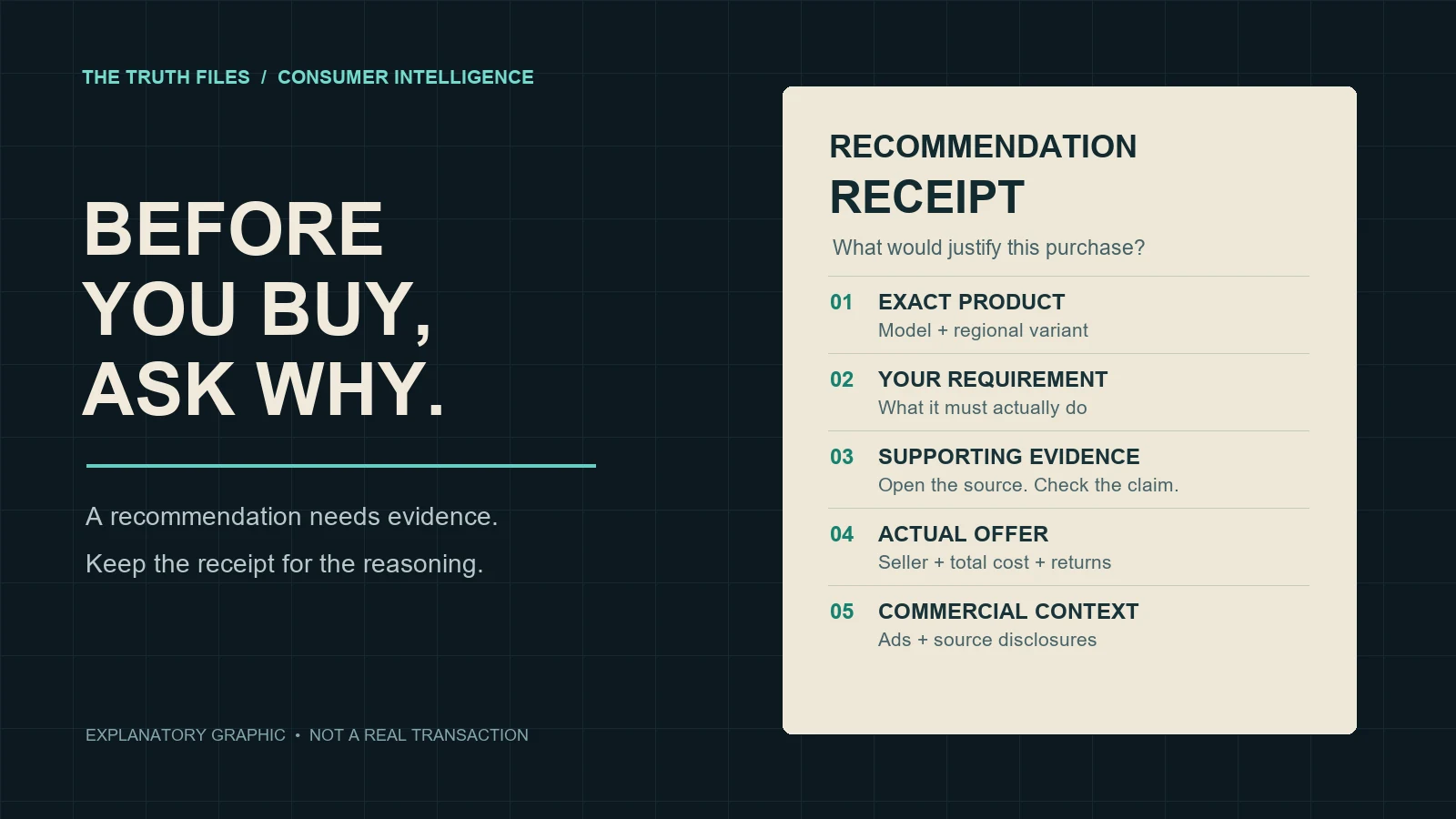
You ask an AI assistant for a good pair of headphones. It returns a neat shortlist, a persuasive explanation and a clear favourite. The difficult part of shopping appears to be over. But what, exactly, have you received: a comparison grounded in tests, a summary of retailer claims, a sponsored placement, or a plausible answer whose reasons you still need to check?
Trust should attach to the evidence for a particular purchase, not to the confidence of the voice delivering it. A useful recommendation lets you verify the exact product, the features that matter to you, the source of its claims and the actual offer. An answer that cannot survive those checks has not earned the sale.
The practical response is a recommendation receipt: a short record of what is being recommended, why, on whose evidence and under what commercial conditions. This file explains the latest research, the platforms' own disclosures and how to build that receipt without turning every purchase into a research project.
What the new audit establishes
A 16 September arXiv preprint by Lucas G. Uberti-Bona Marin and colleagues audited 117 broad physical-product queries, repeated three times across ChatGPT, Gemini, their APIs and Google AI Overviews. Of 1,755 observations, 1,536 yielded responses. ConsumerQ's 2,528 queries were the larger starting dataset, not the number audited.[1]
Among product-recommending answers, first-person preferences appeared in 79% for ChatGPT, 7% for Gemini and 2% for AI Overviews. Displayed domains in ChatGPT and Gemini had a mean overlap of 5.4%, measured against their combined sets. Their interface–API overlaps were 12.0% and 14.8%.[1]
These measure framing and overlap, not accuracy or paid influence. The study does not establish bought recommendations. Coding used LLM assistance. Limitations include predominantly English queries, Netherlands collection, logged-out chatbot sessions, three repetitions, and unverified ChatGPT interface model identity. Product-name variants depress measured overlap; source-type classification is exploratory. AI Overviews analysis covers only 134 recoverable answers from 351 searches. Sources displayed are not a complete causal explanation. No peer-reviewed venue is listed on the arXiv record checked for this file.[1]
Three questions a confident answer cannot settle
Imagine two assistants suggest different headphones. Both might be reasonable if one prioritises comfort and the other noise cancellation. Both might be wrong if they ignore the connector your device needs. Disagreement alone cannot decide between those possibilities.
Does it fit?
The first question is whether the product satisfies your requirements. A widely praised item that fails one essential requirement is a poor recommendation for you. Decide what is non-negotiable before reading the shortlist.
Is the claim supported?
The second is whether the supporting evidence says what the assistant implies. A manufacturer page can establish that a connector exists. It cannot independently establish that a microphone sounds clearer than a competitor's. That comparison needs an appropriate test or a clearly attributed opinion.
Why am I seeing this offer?
The third is commercial: whether you are looking at advice, an advertisement, a merchant listing or a source that earns commission. These can sit close together while having different selection rules. Keep those questions separate and the investigation becomes manageable.
What OpenAI currently discloses
OpenAI says ChatGPT Search product results are selected independently, are not ads and are not influenced by its partnerships. It describes selection using the query, context, product metadata and other content. It also says the available selection is incomplete, review information is not verified by OpenAI and an initial displayed price need not be the lowest. These are the company's disclosures, not an independent certification of every answer.[2]
Its separate advertising documentation says sponsored units are visually separated below answers and advertisers cannot shape, rank or alter the response. Ad selection can consider relevance and bids. That establishes a stated distinction between the answer and the advertising system; it does not make an advertised product a tested recommendation.[3]
Shopping research is another experience again: OpenAI describes an interactive comparison process, says its results are organic and warns that prices, availability and discounts can differ from the retailer's page. It may use memory to personalise suggestions.[4]
The consumer implication: record which experience produced your answer. A general chat, a product carousel and a shopping-research guide are not interchangeable labels. Check the current disclosure for the surface you actually used. A screenshot of one sponsored unit cannot, by itself, establish that a separate paragraph was purchased.
What Google currently discloses
Google's advertiser documentation allows ads above, below and, in specified markets, within AI Overviews. It says both the query and the overview's content can help select an ad. Availability varies by country and language. This is documentation about Google Search, not proof that the Gemini chatbot follows identical advertising rules.[5]
Google Shopping's consumer documentation says products are ranked using relevance and activity, and distinguishes results labelled Sponsored or Ad. It says it is not compensated for clicks on unlabelled Shopping results, including its top recommendations. It also identifies brand, shop and other provider data as inputs to AI-assisted product information and warns that quality can vary.[6]
Those disclosures matter because the word Google covers several experiences. A claim about Shopping should not silently become a claim about every Gemini answer. Look for the label on the actual result, open the linked seller and inspect the terms attached to that offer.
Follow the incentives without inventing a payment trail
An advertising business has commercial incentives. A retailer wants sales. A review publisher may earn a commission. None of those observations identifies the cause of a particular recommendation. To claim that a specific answer was bought, an investigation needs evidence connecting payment or another commercial arrangement to that answer's selection.
A useful way to inspect the chain is to ask who supplied each fact and who benefits if you act on it. A product feed supplies catalogue information. A test supplies comparative measurements. An affiliate disclosure explains a publisher's financial relationship. A sponsored label identifies a placement. Each answers a different question.
Do not treat an affiliate link as automatic proof that a review is false, or the absence of an ad label as proof that every upstream source is disinterested. Read the method, the disclosure and the actual evidence. The standard should be the same when a recommendation flatters your preferred brand.
The commercial relevance is already visible in researchers' own work: McKinsey describes AI as an influence during purchase evaluation while discussing consumers' scepticism and brands' attempts to improve their visibility.[7] That supports investigating the channel. It does not establish that any named consumer was deceived.
Build your recommendation receipt
This is The Truth Files' practical checking method. It is an editorial proposal, not a validated scoring system. Spend most of your effort on the few claims that could change your decision.
- Write the job. Set a total budget, country, intended use and two or three essential requirements. Make clear which preferences can be traded away. Ask the assistant to mark unknowns instead of filling gaps.
- Pin down the item. Record the exact model, generation, size or capacity and regional variant. Check the model number on the manufacturer's page and on the seller's listing. Similar names are not a match.
- Check the deciding claim. Open the source for the feature that wins the comparison. Find the actual passage, specification or test. If the source compares another model, another size or an older version, do not transfer the result automatically.
- Find a reason to reject it. Ask what would make the recommended item unsuitable. Seek an independently produced comparison or a documented limitation. Two pages repeating one press release provide less independent support than two genuinely separate tests.
- Read the offer. Confirm the seller, delivered price, stock, condition, included accessories and return terms on the merchant's current page. Check whether the recommendation, listing or review carries a commercial disclosure. Save the details that matter before purchase.
If a follow-up changes the shortlist, ask what changed in the criteria or evidence. Repetition can expose a weak explanation, but repeated agreement is not a substitute for checking the product.
A worked example: the headphones that fail the brief
Illustrative example, not an actual product test: you want headphones for a computer that requires a wired microphone connection. The assistant recommends a model because it is comfortable, well reviewed and can play audio through a cable.
The decisive question is whether its microphone also works through that cable. Wireless microphone support and wired audio support do not logically establish wired microphone support. Until the manual or a suitable test confirms the exact connection, the receipt should say unresolved.
Your next prompt can be simple:
For each option, give the exact model and a direct source for every essential requirement. Separate manufacturer specifications from independent tests. State what you could not verify. Explain one reason I should reject your first choice. Do not call an option suitable if an essential requirement remains unknown.
Then open the links. The assistant's revised explanation is another claim to inspect. If the required function is absent, reject that option even if it wins every general-purpose ranking. The point of the receipt is to keep the decision attached to your needs.
What a trustworthy shopping assistant should show
A better service would put the decisive evidence within reach of the recommendation: exact model, date checked, constraint failures, competing options, source type and commercial labels. It would make clear when an answer relies on seller data and when an independent comparison supports a performance claim.
It should also explain meaningful changes. If the recommendation changes after you add a requirement, the service should explain why. If it cannot verify a price or feature, uncertainty should remain visible all the way to the buying decision.
These are design standards proposed by this investigation. They are not a claim that every provider currently offers them. The same accountability question runs through our file on the algorithmic era: what becomes visible, by which rules, and with what ability to challenge the result?
Evidence Ledger
The claim and the limit
Bounded preprint findings, not universal accuracy estimates. [1]
Current published policy; this ledger verifies the disclosure, not every implementation. [3]
Platform documentation itself identifies incomplete selections, unverified reviews and changing prices. [2,4]
No transaction-to-answer causal evidence is established here.
Final Assessment
Use an AI recommendation to organise a decision; let inspectable evidence justify the purchase. The strongest answer is one that survives a check against your exact requirements and the seller's actual offer. Confidence, a familiar brand name and a row of citations do not complete that check.
Keep the recommendation receipt. It is useful the next time you compare products, question a changing answer or notice that a buying guide skips the one feature you need. Return to this file as platform disclosures and independent audits develop: the outstanding question is how clearly each service can account for the advice it puts in front of shoppers.
Sources
Research and current platform disclosures
- 0116 September 2026Uberti-Bona Marin et al. — Auditing AI-Generated Product RecommendationsResearch preprint
- 02Checked 20 September 2026OpenAI — Shopping with ChatGPT SearchPlatform disclosure
- 03Checked 20 September 2026OpenAI — Ads in ChatGPTPlatform disclosure
- 04Checked 20 September 2026OpenAI — Using shopping research in ChatGPTPlatform disclosure
- 05Checked 20 September 2026Google — About ads and AI OverviewsAdvertising documentation
- 06Checked 20 September 2026Google — Understand how Shopping results are generatedShopping disclosure
- 0727 August 2026McKinsey — Consumers don't trust AI advice. They turn to it anyway.Researcher interview
Continue the Chain
Recommendations and infrastructure