Jonestown: How the Exits Narrowed
Peoples Temple began as an integrated church that fed the poor. Twenty-four years later, 918 people were dead in Guyana. The records show how the ways out closed, one step at a time, and what can and cannot be proved about who died, how, and why.
Opening Brief
Jonestown from the air, photographed by FBI agents after 18 November 1978. FBI photograph released under the Freedom of Information Act; public domain.
On 18 November 1978, 918 people died in Guyana because of Peoples Temple. Five were shot at a jungle airstrip. Four died in the Temple's house in the capital. The other 909 died in Jonestown, the agricultural settlement the Temple had cut out of the forest, most of them after drinking or being given a fruit drink laced with cyanide and sedatives. [1] [2] At least 304 of the dead were under 18. [1]
Almost everything people think they know about that day comes from a few phrases: a "cult", "mass suicide", "brainwashing", "drinking the Kool-Aid". This file tests those phrases against the record that survives: a 1979 congressional investigation, the Guyanese inquest, the FBI's case file, sworn affidavits from people who left, the Temple's own written denials, a 44-minute recording of the final hour, the trial record of the only man convicted, and nearly fifty years of scholarship. The aim is not to retell a horror story. It is to show, document by document, how the ways out narrowed for about a thousand people, and what can and cannot be proved about how they died.
The file at a glance
- 918 dead: 909 in Jonestown, 5 at the Port Kaituma airstrip, 4 in Georgetown. Different totals in circulation count different places. [1] [3]
- Who they were: most residents were African American, and the largest single group was Black women. [4]
- Warnings came early: relatives, a sworn defector and a US Customs inquiry all raised alarms in 1977 and 1978. Congress later found the US Embassy and State Department slow to act on them. [2]
- The only finding on the deaths: a Guyanese coroner's jury held Jim Jones "and persons unknown" criminally responsible. [5]
- The convictions: Larry Layton, the only person tried in a US court, was convicted over the airstrip attack on Congressman Leo Ryan's party. In Guyana, a Temple member pleaded guilty to an attempted murder at the Georgetown house. Nobody was ever tried for the deaths in the settlement. [6] [7]
- The CIA: no released record shows the agency was involved, but a 58-page CIA folder given to congressional investigators is still withheld. [2] [8] [9]
- Kool-Aid: the drink was Flavor Aid, a cheaper brand on sale in Guyana. [10]
The Question and Its Limits
The central question: how did a church that began as a racially integrated congregation in 1950s Indianapolis end with 918 deaths in Guyana, and what do the primary records establish about how members were held, how they died and who was responsible?
To answer it, this file works through twelve supporting questions:
- Who joined, and why?
- How did the Temple's system of control develop?
- Why did it move to Guyana, and what was life like there?
- Could people leave?
- What warnings reached officials, and why did nobody act?
- What happened on 17 and 18 November 1978?
- How many died, and who were they?
- Was it murder or suicide?
- Who was held legally responsible?
- Was the CIA involved?
- Where does "drinking the Kool-Aid" come from?
- What does Jonestown teach about coercive groups, and what does it not?
Scope. This is an investigation of Peoples Temple and the events of 1977 and 1978, not a biography of Jim Jones and not a survey of other groups. Jones appears where his decisions shaped what happened to others. He is not quoted for effect, and his portrait is not reproduced. The file uses the word "cult" only when someone else used it or as the common name for the subject. A label is not evidence: what matters here is documented conduct.
Cut-off and grades. Sources were checked up to 25 October 2026. Each claim in the Evidence Ledger is graded:
- Verified: supported by primary records or by several independent sources.
- Contested: credible sources disagree.
- Unresolved: the record cannot settle it.
Allegations, denials, charges, acquittals and convictions are kept apart. The Method and Limits section explains what we could and could not read.
Who Joined, and Why
Peoples Temple did not begin as a closed community. Jim Jones started a small church in Indianapolis in 1954. He incorporated it as Wings of Deliverance in 1955 and renamed it Peoples Temple in 1956. By 1960 it was a member congregation of the Disciples of Christ, a mainstream Protestant denomination. [11] In segregated 1950s Indiana, it stood out because Black and white members worshipped together. Jones briefly chaired the city's Human Rights Commission in 1961. [11]
When the House Foreign Affairs Committee's investigators interviewed survivors, relatives and former members in 1979, they found no single type of recruit. [2] They described four broad groups:
- some idealistic young adults from comfortable, often college-educated families;
- a larger number of young Black people from poor neighbourhoods, some of whom had struggled with drugs or the streets;
- "an even greater percentage" of elderly, mostly Black residents of San Francisco, who found in the Temple "an abiding and protective concern" and "a warm sense of family";
- middle-class Black and white members from strongly religious backgrounds, drawn by the evangelical worship.
The investigators added that many younger members "had little if any religious motivation". They joined for the Temple's social causes and political seriousness. [2]
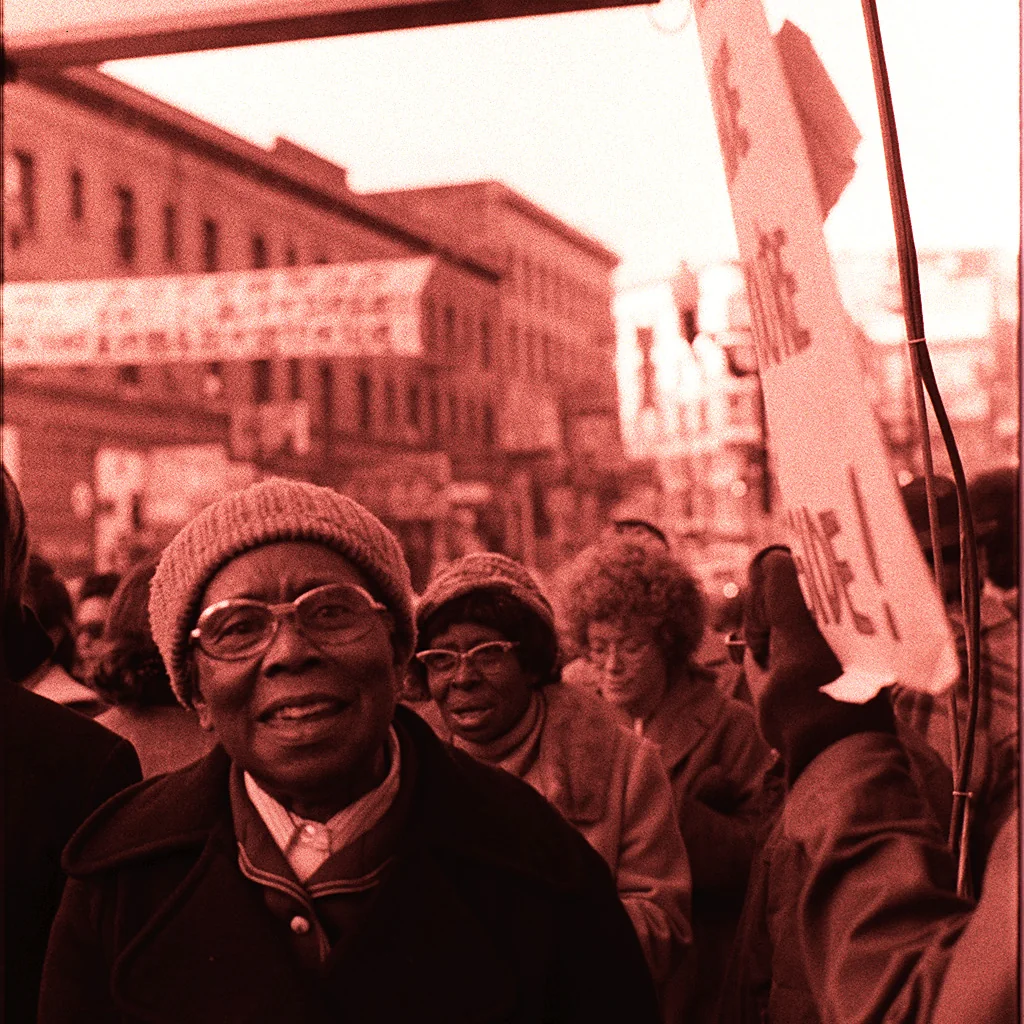
Peoples Temple members at a January 1977 rally against the eviction of the International Hotel's mostly elderly Filipino tenants, San Francisco. Photo: Nancy Wong (cropped), CC BY-SA 4.0, via Wikimedia Commons.
The membership data bear this out. Rebecca Moore's demographic study, revised in 2017, is built from Temple records recovered by the FBI and from years of work by former members. It finds that Jonestown was "overwhelmingly African American" and mostly female. Black women made up 46 per cent of residents, Black men 23 per cent, white women 14 per cent and white men 11 per cent. [4] The leadership looked very different. Black residents were about 70 per cent of the community, but held 81 of the 184 supervisory and department-head posts listed after October 1977, or 44 per cent. [4] Moore is the leading demographer of the community. She also co-directs the Jonestown Institute archive, and two of her sisters, Carolyn Layton and Annie Moore, died in Jonestown. [12] That is an interest readers should know about, though her figures rest on documents anyone can inspect. Her 2022 study for Cambridge University Press reads the Temple through its three settings, Indiana, California and Guyana, and its largely Black membership, rather than through the figure of its leader. [13]
Members described joining in ordinary human terms:
- Deborah Layton joined at 18. In her later affidavit, sworn after she left, she wrote that she "hoped to help others and in the process to bring structure and self-discipline to my own life". [14]
- Laura Johnston Kohl, who survived because she was working in Georgetown that day, wrote that before she joined she was "cycling down into the abyss". She added that many former drug users, disabled and disillusioned people "were given their lives back". [15]
The sociology of conversion fits these accounts better than any picture of instant capture. Lofland and Stark's classic 1965 study found that people moved into a demanding movement through a sense of strain and a turning point in their lives. Close personal bonds with members then grew stronger than their ties outside. [16]
Answer: people joined a church that offered integration, care, political purpose and family. Nothing in the record suggests anyone joined a plan to die. That is the starting point for understanding everything that followed. Verified.
From Indianapolis to Guyana
The Temple moved three times, and each move cut more ties with the world outside:
- 1965: Jones and about 140 members moved to Redwood Valley in northern California. [11] The House investigators reported one reason he gave: he had read that the area was one of the few places in the world thought safe from nuclear war. [2]
- 1972: the Temple bought church buildings in Los Angeles and San Francisco. [11]
- 1977: most of the membership moved to the settlement in Guyana. [11] [2]

Peoples Temple, 1954-2002. Designed by The Truth Files from the sources named on the graphic.
San Francisco gave the Temple political reach. Jones could turn out hundreds of followers for rallies, leafleting and phone banks. Mayor George Moscone appointed him to the city's Housing Authority. When newspapers prepared critical stories, the Temple organised letter-writing campaigns, threatened lawsuits and picketed. In 1972 the San Francisco Examiner cancelled an eight-part series after only half had run. [2] The House report found the evidence "mixed" on whether officials had actually been compromised. But it was "indisputably clear" that people trying to leave the Temple believed officials were on Jones's side, and so did not trust them. [2]
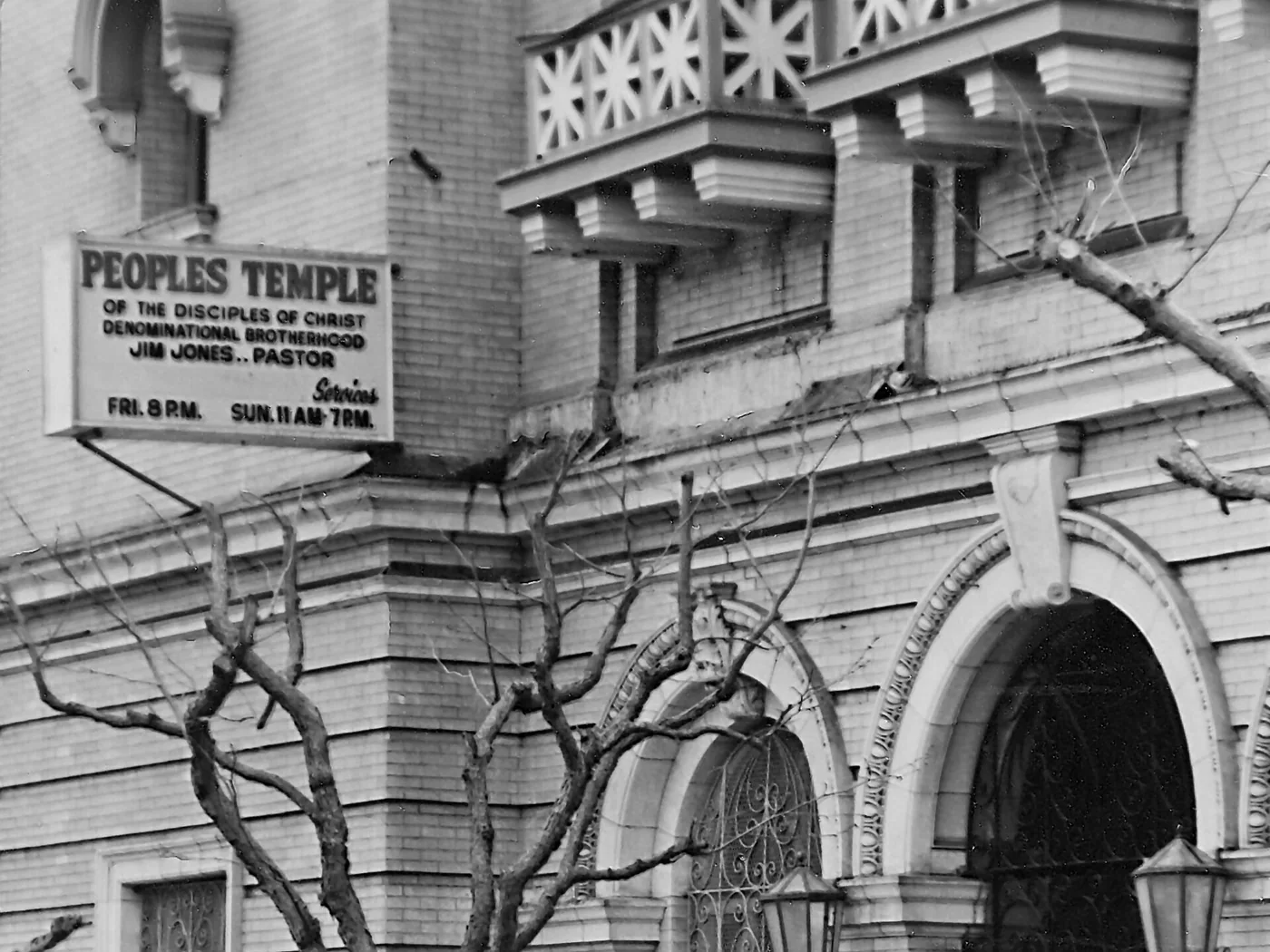
Peoples Temple headquarters, 1859 Geary Boulevard, San Francisco, December 1978. Photo: Nicolas Martin (cropped), CC BY-SA 4.0, via Wikimedia Commons.
The move to Guyana began quietly. Temple pioneers started clearing land in the country's remote Northwest District in the summer of 1974. In February 1976 the Temple signed a lease with the Government of Guyana covering 3,852 acres. [11] The large migration came in the summer of 1977. New West magazine was preparing an exposé built on former members' accounts, and about 600 members moved to Jonestown in three months. [11] The House report says this article "finally drove" Jones and most of his followers to Guyana, a move he presented as escape from a conspiracy. [2] Deborah Layton's affidavit records what Jones told the people left behind in June 1977: that he would be "imprisoned for life if he did not leave immediately". [14]
The Machinery of Control
The House investigators did not mince words. "We have concluded that he was first and foremost a master of mind control," they wrote of Jones, listing what they called "recognized strategies of brainwashing". [2] That is their characterisation, and the appendix said to support it is in the report's classified version only. Whether "brainwashing" is a useful explanation is a live dispute, examined later in this file. The practices the investigators described, however, are documented in sources that do not depend on that label: affidavits from former members, the Temple's own records, and later scholarship.
What the records show
- Confession and punishment. "Catharsis" sessions, which took root in Redwood Valley, required public confession and communal punishment for offences against the group. [11] The House report describes interrogations that "more often" involved "harassment, humiliation, revilement, and degradation". [2]
- Signed statements. As a sign of trust, members signed statements admitting homosexuality, theft and other self-incriminating acts. They also signed blank pages "which could be filled in later". The Temple used such papers against people who left. [2]
- Surveillance and informing. The Temple kept detailed card files on members. Trusted aides tested others by voicing doubts about Jones to see whether they would report it. The investigators wrote that children turned in their own parents. [2]
- Money and property. Members gave as much as 25 per cent of their income and signed over property. People who lived communally signed over their pay and received cramped quarters, communal meals and a small allowance. [2] [11] The House report estimated the Temple's wealth at $12 million. It concluded that Jones sought power and control rather than luxury. [2]
- Staged signs. Moore's scholarly profile records that some faith healings in the San Francisco Temple were faked by a group of insiders. [11] In Ukiah, police found no substance in any of the attacks Jones reported, including a shooting from which he claimed to have "miraculously" recovered. [2]
- A named enemy. Deborah Layton swore that Jones called anyone who left a "traitor" and "fair game", and that "the punishment for defection was death". [14] The identity of the conspirators changed from day to day. She said Black members were told they would be put in concentration camps if they stayed in the United States. White members were told their names were on a CIA list of enemies of the state. [14]

How the exits narrowed. Each panel summarises the cited record; allegations and denials are set out in the text.
Inside the leadership, a Planning Commission of about 100 people discussed major decisions, while Jones kept final authority. Within it were smaller circles: people who helped fake healings, arranged questionable property transfers, went through opponents' rubbish, or carried cash to foreign banks. [11]
The Temple's answer. In 1978 the Temple disputed these accounts in writing. Its handwritten rebuttal of Layton's affidavit insisted there had been no corporal punishment "for many months". It said Jones never spoke for more than four hours and that his healings were genuine. [17] These rebuttals were written by Temple staff under Jones's leadership, at a time when he controlled what members could say to outsiders, so they carry that limitation. They are still part of the record, and they show the community's official self-image.
Answer: confession, financial dependence, informing, staged threats and a shifting outside enemy are documented by multiple independent sources, from the 1960s to 1978. Verified. Whether these practices amount to "brainwashing" is a matter of interpretation. Contested.
Inside Jonestown, 1977-78
By 1978 about a thousand people lived at the Peoples Temple Agricultural Project. [2] They worked the fields and lived in cottages and dormitories. Children were often raised apart from their parents. In the evenings there were meetings, classes and Russian lessons, because many residents believed a move to the Soviet Union was coming. [11]
Two accounts of the same place
Deborah Layton arrived in December 1977 and left in May 1978. Her sworn account is bleak:
- armed guards, and no one allowed to leave without a special assignment;
- field work from 7 a.m. to 6 p.m., six days a week;
- rice, rice-water soup, and rice and beans, while Jones "dined separately and ate meat regularly";
- an outbreak in February 1978 that left half the settlement ill;
- Jones's voice on the loudspeakers for "an average of six hours per day". [14]
The food improved, she said, "on the few occasions when there were outside visitors". [14]
The Temple's account is the opposite. Its statement to the United Nations human rights commission, dated 17 May 1978, called the allegations "lies". It said: "Anyone is free to leave Jonestown who wants to." It pointed out that "only four out of over 1000 people have chosen to leave". [18]
Survivors' later writing shows that both things could be true for different people at different times. Some found real community in Jonestown. Others felt exhausted and afraid. [15] [19]
Could people leave?
The evidence on leaving comes in four parts.
- The allegation. The Concerned Relatives, a group of former members and families, accused Jones in April 1978 of confiscating passports and money, posting guards and censoring mail. They also said there were no telephones or exit roads. [20]
- The denial. The Temple flatly denied it, adding that there were "no fences, no security, no gate or guards". [18]
- Outside visits. US consular officers did visit, but the House investigators found it was "proven beyond doubt that Jones staged a show for selective visitors". Officers spent "an average of 5-6 hours on four different occasions" between August 1977 and November 1978. The Embassy gave the Temple most of the names of people it wished to interview in advance, which "allowed Jones to rehearse those people on what to say". [2]
- What happened when the chance came. When Congressman Ryan arrived, people asked secretly to leave, and about 15 boarded the truck to the airstrip. [2] After the deaths, Guyanese police reported finding passports in the settlement. [21] That fits the relatives' account but does not prove confiscation.
The custody fight that became a crisis
One dispute shaped the whole story. Grace Stoen, a former senior member, and later her husband Tim Stoen, once one of Jones's closest legal advisers, sued for custody of their young son, John Victor Stoen, who was living in Jonestown. Jones claimed the child as his own, and Tim Stoen had earlier signed an affidavit naming Jones as the father. [14] [17] [11]
In September 1977, when the mother's lawyer arrived in Guyana, Deborah Layton and another aide were told to telephone a senior Guyanese official. Their message: unless the court case was stalled, "the entire population of Jonestown would extinguish itself in a mass suicide by 3:30 p.m. that day". [14] Moore describes this period as a "six-day siege" that Jones staged, in which residents believed they were under attack. [11]
The House investigators found "incomplete and inconclusive" evidence that unknown Guyanese officials may have acted to influence the custody proceedings. [2] The case kept the Concerned Relatives organised. In the end it brought Leo Ryan to Jonestown. John Victor Stoen died there. [11]
Rehearsals
Layton described "white nights": emergencies called at least once a week, with sirens, about fifty armed guards going cabin to cabin, and warnings that mercenaries were in the jungle. [14] On one such night, she swore, everyone, "including the children", lined up and drank a small glass of red liquid they were told was poison. When nobody died, Jones called it a loyalty test. [14] Moore's profile, drawing on Layton, the diary of resident Edith Roller and other accounts, concludes there were "at least six suicide rehearsals in Jonestown in 1978". [11] The Temple's handwritten rebuttal answered that white nights followed shots fired at Jones, denied the "blaring sirens", and said of the poison drill: "that is not true". [17]
The leader's condition
Moore's profile records that Jones began using barbiturates in San Francisco. It says his drug abuse "became apparent in Jonestown", and that US Embassy officials who visited on 7 November 1978 found his speech "markedly slurred". [11] His condition is part of the context for the final night.
Money
The Temple relied heavily on members' pensions and benefits, but the two main sources disagree on how much they brought in:
- The House report found that 199 Social Security recipients lived in Jonestown, receiving about $37,000 a month. A US consul who checked in 1978 judged that recipients controlled their own payments, though some were "heavily influenced" to hand them over. [2]
- Layton, who had been the Temple's financial secretary, swore the figure was "over $65,000" a month. [14]
The report and the affidavit may be counting different things or different periods. We could not reconcile them. After the deaths, 656 uncashed Social Security cheques were found in Jonestown. [2]
Answer: life in Jonestown was hard, closely controlled and staged for visitors, and rehearsals for mass death took place. Verified, by sworn testimony, congressional findings and scholarship. Exactly how far members were physically prevented from leaving is Contested: the relatives' allegations and the Temple's denials both survive. Distance, dependence and fear did more than fences.
The Warnings Before the Visit
Leo Ryan's interest began with one story. On 13 November 1977 the San Francisco Examiner reported on Sam Houston, a constituent and old friend of Ryan's. Houston's son Bob had died under a train a day after announcing he would leave the Temple, and his granddaughters had ended up in Jonestown. [2] Houston believed his son had been murdered; police investigated at the time and again after Jonestown, and Moore notes there is no evidence to support the claim. [11] Over the next year the warnings multiplied:
- 1977: a Customs inquiry into guns. The US Customs Service investigated reports that more than 170 weapons had been moved from Ukiah towards Jonestown. Its report was negative. Even so, investigators were uneasy enough to send it to Interpol and the State Department, noting allegations that Jones might hold "several hundred firearms" in Guyana. There is no indication a copy was ever sent to the US Embassy in Guyana, and none of the more than 26 State Department officials interviewed had seen it before 18 November 1978. [2]
- 14 March 1978: "better even to die". A Temple letter to members of Congress complained of harassment. It ended: "I can say without hesitation that we are devoted to a decision that it is better even to die than to be constantly harassed from one continent to the next." [20]
- 11 April 1978: the relatives' accusation. The Concerned Relatives quoted that letter in a formal accusation of human rights violations. They sent it to the Temple, the press, Congress and the State Department. [20]
- May and June 1978: a defector's affidavit. Deborah Layton left Guyana with help from Embassy officers. She gave the Embassy a written warning of possible mass suicide, then swore her affidavit in June. [2] [14]
- June 1978: the Embassy's request. The US Embassy cabled Washington (Log 126) asking permission to urge Guyana to exercise "normal administrative jurisdiction" over the settlement. The State Department refused (Log 130), because the step "could be construed by some as U.S. Government interference". [2]
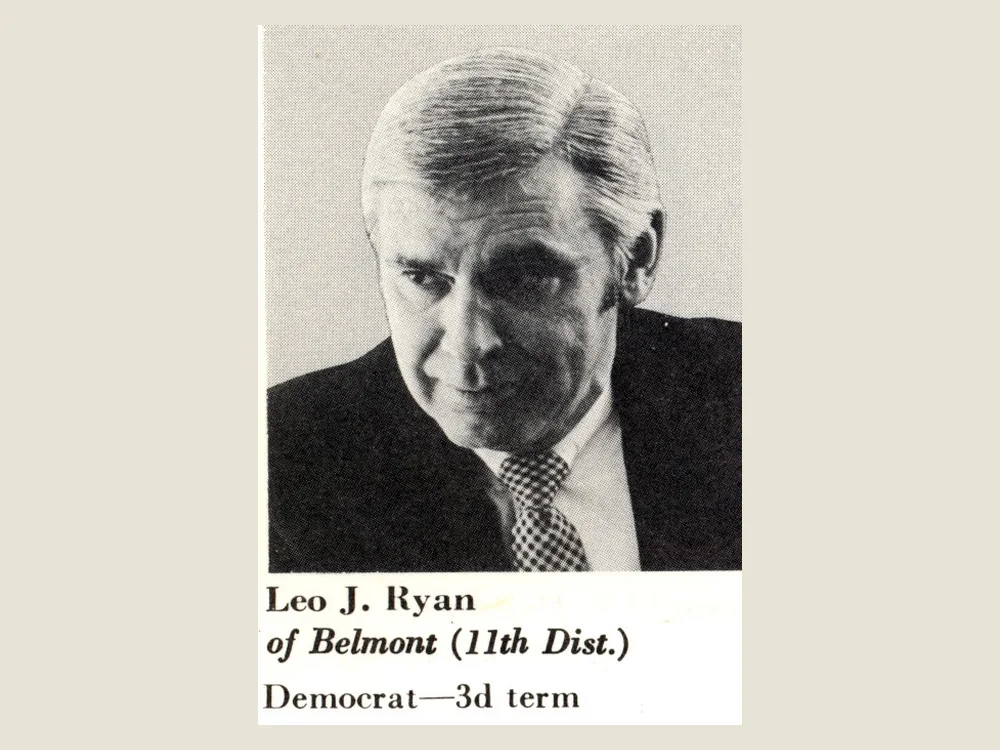
Leo J. Ryan in the 1977 Congressional Pictorial Directory (portrait set on a plain panel). US Government Printing Office; public domain.
What Congress found about the failures
The House investigators found that the Embassy "did not demonstrate adequate initiative" in the face of "progressively mounting indications of highly irregular and illegal activities in Jonestown". They found that "the vital elements of common sense and an honest and healthy skepticism" were missing. [2] They also recorded genuine constraints:
- the Embassy had no investigative powers;
- it had to respect Guyana's sovereignty;
- it was dealing with two opposing groups of Americans telling contradictory stories.
The Privacy Act weighed heavily. The Temple had filed 26 requests under the Act, and officials became "doubly cautious" because they feared personal legal liability. The investigators thought Jones may have used legal claims for exactly that effect. [2] Several State Department officials told them that Ryan "knew more about People's Temple and Jonestown than we did". [2]
Guyana's part
The investigators found "evidence of a strong working relationship" between the Temple and some Guyanese officials, especially in customs and immigration. They concluded it was "likely" that money and guns were brought in through lax inspection. [2] The Government of Guyana declined to meet them, which, they said, left "a conspicuous void" in their report. [2]
Answer: there were repeated, specific warnings, including of mass suicide. Officials in Washington and Georgetown did not connect them or act on them. Verified, on the findings of the House investigation. What Guyanese officials knew is Unresolved, because Guyana did not cooperate.
17-18 November 1978
Leo Ryan flew to Guyana on 14 November 1978. With him were two staff members, nine journalists and a group from the Concerned Relatives. Neither the media nor the relatives were part of his official delegation. [2] The Temple first tried to set conditions:
- a "balanced" delegation;
- no media coverage;
- the presence of its lawyer, Mark Lane.
The negotiations failed. On 17 November Ryan told the Temple's lawyers he was going to Jonestown that afternoon whether or not Jones agreed. [2]
Friday evening
The party reached Jonestown after dark. Over dinner and a musical performance, Ryan addressed about 900 residents. He drew "an extended, standing ovation" when he said that "for a lot of you that I talked to, Jonestown is the best thing that ever happened to you in your lives". [2] That same evening a resident slipped a note to NBC's Don Harris asking to leave, and another asked Deputy Chief of Mission Richard Dwyer the same thing. The journalists were sent back to Port Kaituma for the night. [2]
Saturday
On Saturday more families asked to go. About 15 people boarded the Temple truck for the airstrip. As the party prepared to leave, a resident, identified in the House report as Don Sly, attacked Ryan with a knife and was fended off. Dwyer then all but ordered Ryan to leave. [2]
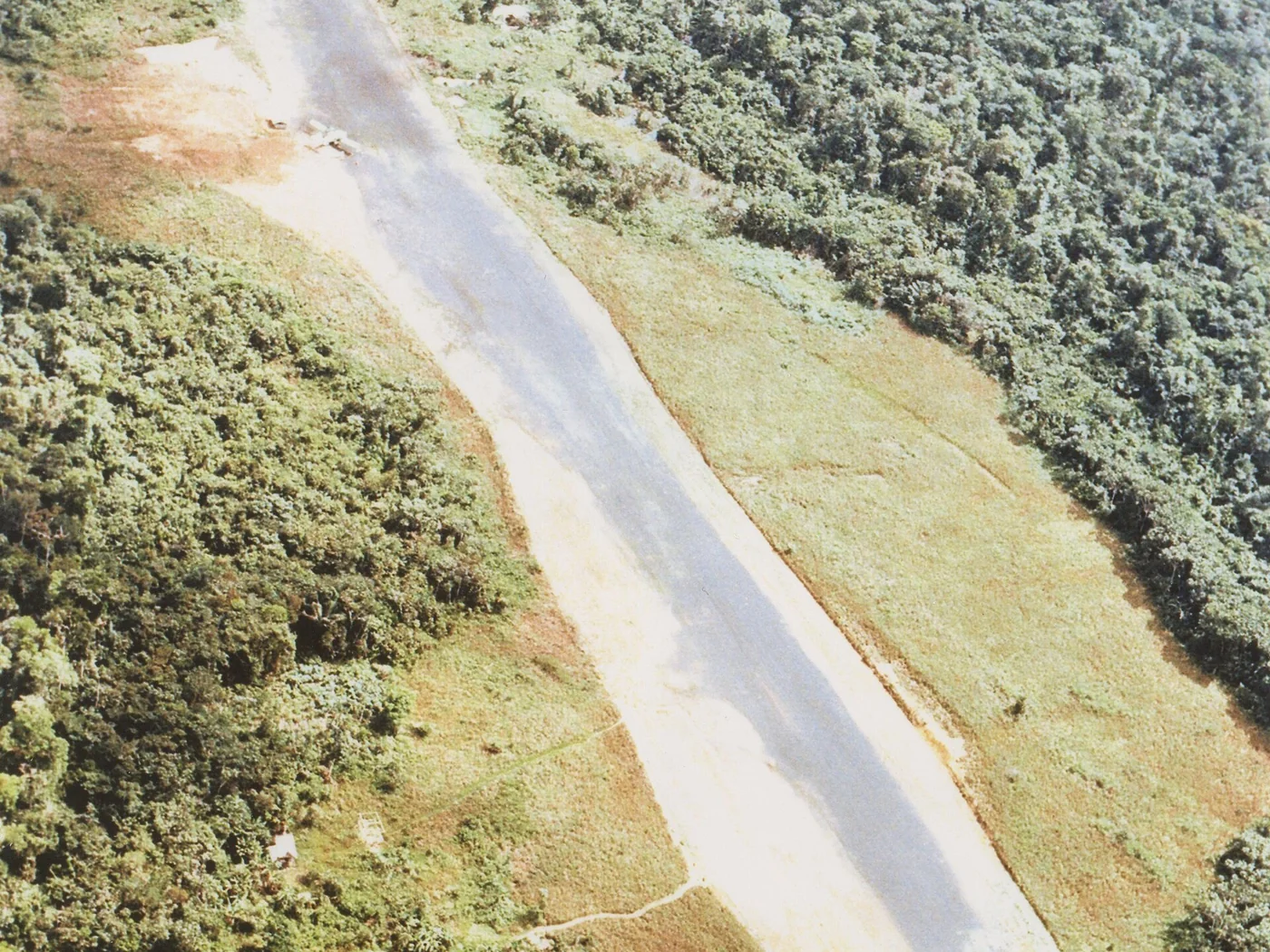
The Port Kaituma airstrip. FBI photograph taken after 18 November 1978, released under the Freedom of Information Act; public domain.
Two planes, a 19-seat Otter and a six-seat Cessna, landed at Port Kaituma about 20 minutes after the party's truck arrived. A Temple tractor and trailer drove up, and the men on it opened fire on the Otter. [6] The House investigators put the start of the shooting at 5.20 p.m. and its length at four to five minutes. [2] Five people were killed:
- Leo Ryan;
- NBC correspondent Don Harris;
- NBC cameraman Bob Brown;
- San Francisco Examiner photographer Greg Robinson;
- Patricia Parks, a Temple member who was leaving.
Jackie Speier, Ryan's aide, and nine others were wounded, five of them seriously. [2] [1] Inside the Cessna, Larry Layton, who had joined the party claiming to be a defector, pulled a hidden gun. He shot two people near him and tried to shoot a third, but the gun misfired. Passengers disarmed him, and Guyanese civilians took him to the local police. [6]
The pavilion
In Jonestown, the House investigators estimated that the "mass suicide/murder ritual" began at about 5 p.m., before the gunmen had returned to report what had happened at the airstrip. The same report puts the start of the airstrip shooting at 5.20 p.m.; neither time is exact, and the two estimates sit awkwardly together. The investigators treated this timing as "moderate credence" for the idea of a contingency plan, but said they had found no "hard evidence" of a prior plot to kill Ryan. [2] They also recorded:
- unconfirmed reports that a large shipment of cyanide had arrived two days before Ryan's visit;
- a survivor's account that Jones had said the congressman's plane "might fall from the sky". [2]
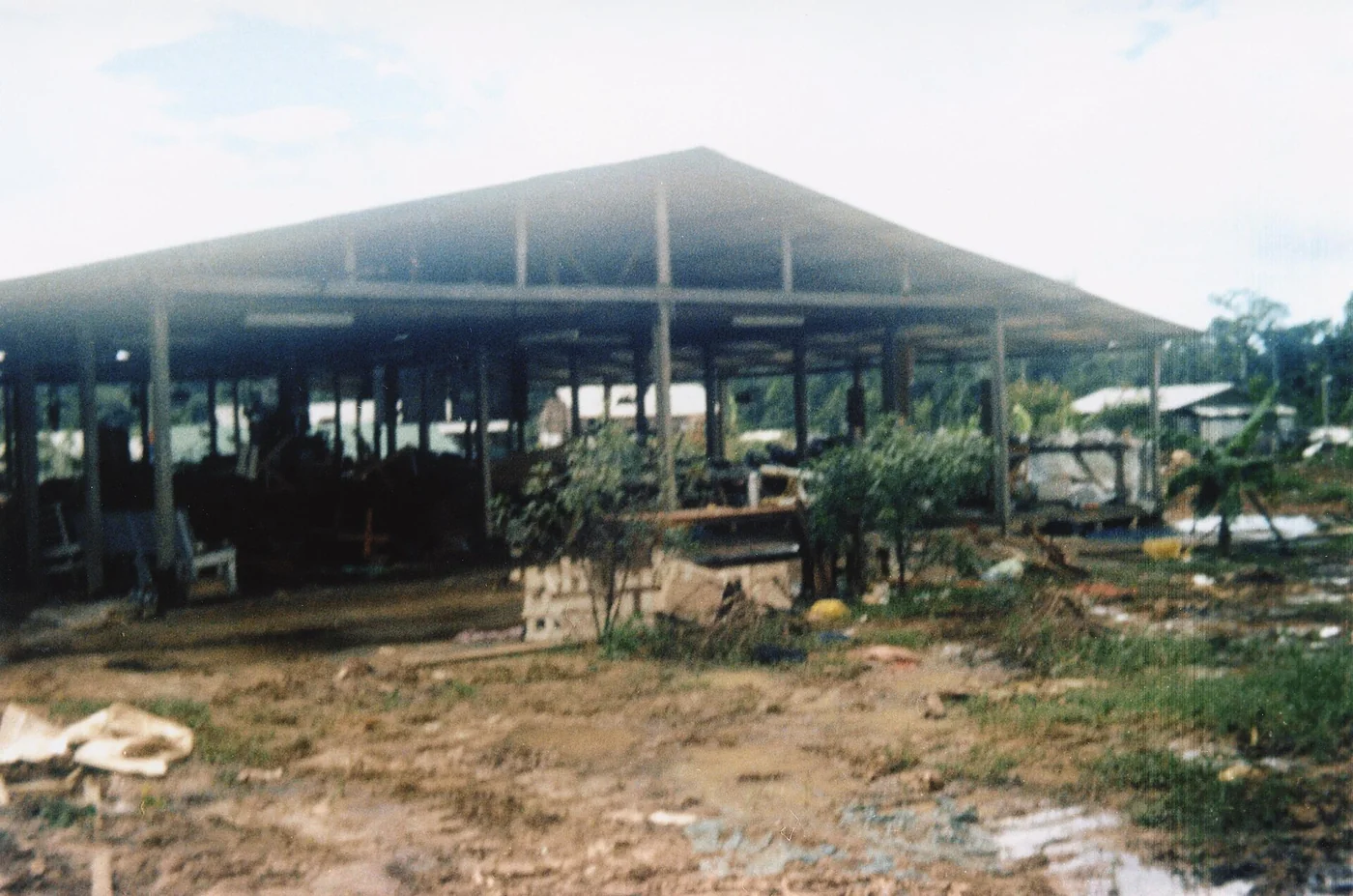
The pavilion at Jonestown. FBI photograph taken after 18 November 1978, released under the Freedom of Information Act; public domain.
What was said in the pavilion survives on a 44-minute recording, catalogued by the FBI as Q042. The Jonestown Institute lists several independent transcripts. It notes that edits are audible. It concludes the tape was very likely recorded on 18 November 1978, because it refers to events specific to that day. [22] We checked the passages quoted here against three transcripts: the November 18 Project's, Fielding McGehee's and the FBI's. [23] [24]
Jones told the crowd it was too late. He urged them to "take the potion like they used to take in ancient Greece, and step over quietly, because we are not committing suicide". [23] [24]
One resident, Christine Miller, argued back:
- she asked whether it was "too late for Russia";
- she said that "as long as there's life, there's hope";
- she said that "we all have a right to our own destiny as individuals". [23] [24]
The crowd shouted her down. As children began to die, Jones told adults to stop "exciting your children". His last recorded claim was: "We didn't commit suicide; we committed an act of revolutionary suicide protesting the conditions of an inhumane world." [23] [24]
Those who lived
About 100 members survived. [11]
- Two families and some young adults had walked out that morning along the railway towards Matthews Ridge. [11]
- Tim and Mike Carter and Michael Prokes were sent off with money towards the Soviet Embassy. [4]
- Stanley Clayton and Odell Rhodes slipped away. They reached Port Kaituma at about 2 a.m. with the first news. [4] [2]
- Grover Davis hid in a ditch, and Hyacinth Thrash slept through it. [4]
- About 80 members were in Georgetown, some 150 miles away. [11]
At the Temple house there, four people died: Sharon Amos and three of her children. The Jonestown Institute's account is that Amos killed the two younger children and that she and her older daughter, Liane Harris, then died together. A Temple member, Charles Beikman, was first charged with the murders; in April 1980 he pleaded guilty instead to the attempted murder of an eight-year-old girl in the house, a plea some critics doubt. [1] [2] [7]
Answer: the sequence of events is documented by the House investigation, the Layton trial record and the recording. Verified. Whether the killing of Ryan was planned in advance is Unresolved: the House found circumstantial support for a contingency plan but no hard evidence.
Counting the Dead
The total is 918. [1] [3] The House report's own account adds up to the same figure: 909 in Jonestown, five killed at the airstrip, and Sharon Amos with three of her children in Georgetown. [2] Other totals in circulation count different things:
- 909 counts Jonestown alone.
- 914 is either the number of Temple members who died or the number of bodies removed from Jonestown and the airstrip.
- Most other figures, such as 913, rely on reports from the first days, before the toll was set at 918. [3]

Counting the dead. Figures from the Jonestown Institute, Rebecca Moore (2017) and the House report.
| Figure | What it counts | Source |
|---|---|---|
| 918 | All deaths in Guyana on 18 November 1978 | Jonestown Institute; House report |
| 909 | Jonestown: 907 by cyanide, 2 by gunshot (Jim Jones, Annie Moore) | Jonestown Institute |
| 5 | Port Kaituma airstrip | House report; Layton opinion |
| 4 | Georgetown (Lamaha Gardens) | House report; Jonestown Institute |
| 304 | Dead who were under 18 (the Institute's count) | Jonestown Institute |
| 916 | Dead identified by name | Moore (2017) |
| 408 | Unidentified or unclaimed, buried in a mass grave at Evergreen Cemetery, Oakland | Jonestown Institute |
No government ever published an official list of the dead. Moore's team was able to identify 916 of the 918. [4]
The FBI's own history page says "more than 200 children" died. [25] That is consistent with, but less precise than, the Institute's count of 304 under 18. [1] Of the dead, 71 per cent were Black, 22.5 per cent white, and 6 per cent of mixed or other background. [4] Eight were Guyanese-born children, about half of them adopted or being adopted by Jonestown families. [26]
The remains were flown to Dover Air Force Base in Delaware. Only seven bodies were autopsied in the United States, and the Jonestown Institute notes that the delay and embalming left those examinations "almost meaningless". Many bodies, especially those of children, were never identified. Some families were too poor, or too ashamed, to claim their relatives. [27] [11]
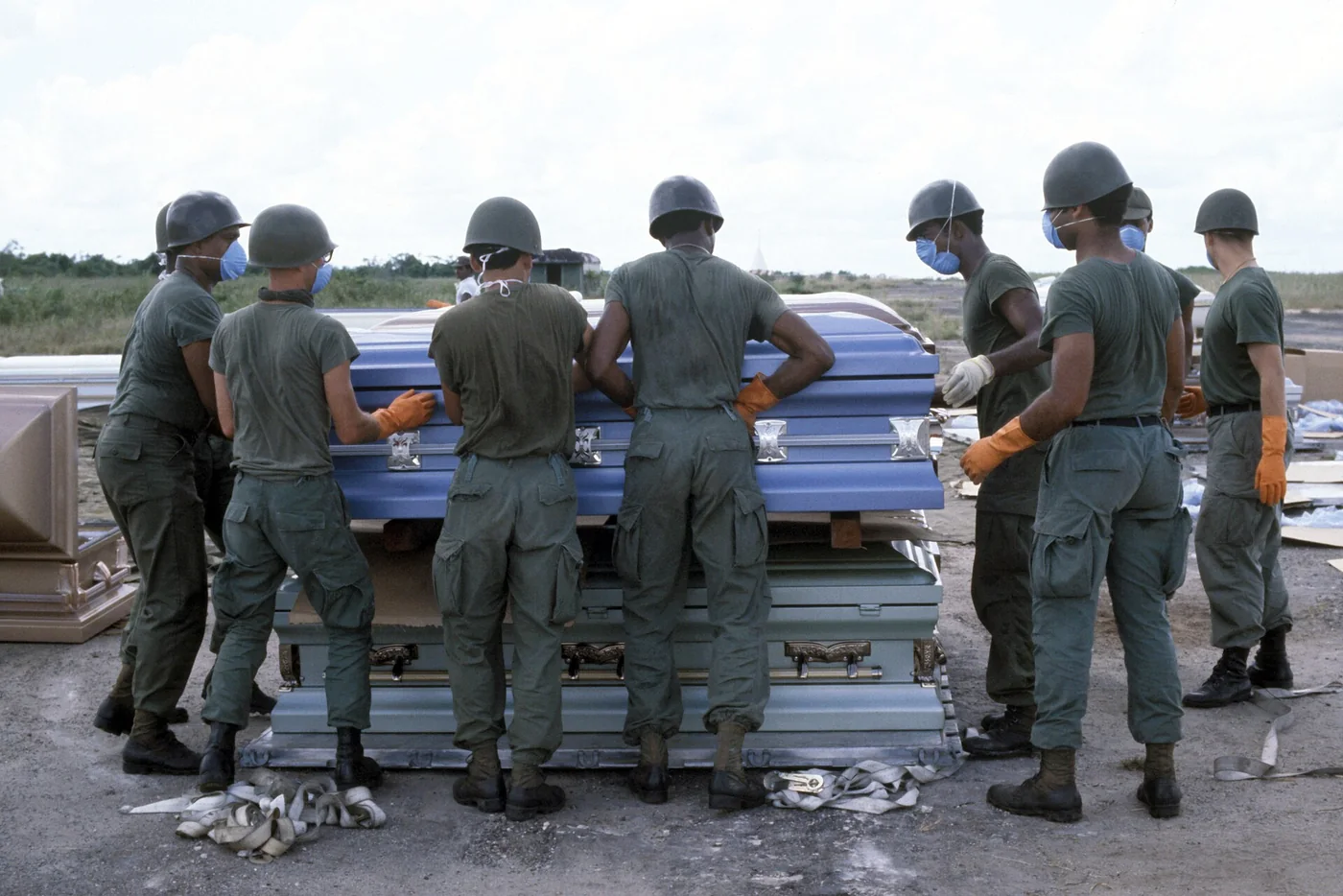
US service members at Georgetown, Guyana, 20 November 1978, preparing coffins described in the National Archives record as being for transport to Dover Air Force Base. Department of Defense photograph by Staff Sgt Pedro J. Gonzalez; public domain.
Answer: 918 dead, 909 of them in Jonestown, at least 304 of them minors; most were Black, and most were women. Verified, with the caveat that the count rests on archival reconstruction, not an official list.
Murder or Suicide?
"Mass suicide" was the phrase that went round the world. It is also the phrase survivors most often reject. The Jonestown Institute calls this "the most existential question arising from Jonestown". It observes that writers use "murder" and "suicide" as shorthand "without examining what they mean". [28]
The legal finding
The only legal ruling on the deaths came from the Guyanese coroner's inquest at Matthews Ridge in December 1978. The jury found that 914 people died of acute cyanide poisoning, and that "Jim Warren Jones and persons unknown" were "criminally responsible for the deaths of the 910 persons". It named two deaths as suicides: Annie Moore, who died of a gunshot wound, and Maria Katsaris. It held "persons unknown" responsible for Jones's own death. [5] The jury's arithmetic does not match the final toll exactly, and the transcript carries FBI deletions and a missing page. [5]

Murder or suicide? Grades are this file's reading of the cited evidence.
The evidence, group by group
- Children. At least 304 were under 18; many were very young. [1] Moore writes that "the children were murdered, as they were below the age of consent". She adds that eyewitnesses describe the medical team and some parents forcing the poison on them. [29] Survivors who disagree about the adults agree on this. [15] [19]
- The injected. Guyana's chief pathologist, Dr Leslie Mootoo, told the inquest he found unused syringes on a desk on the rostrum, with vials of Valium and bottles of potassium cyanide. [30] Survivor Tim Carter, who helped identify bodies, says he saw "at least two dozen" with "huge protruding abscesses". [19] Mootoo's numbers kept moving:
- At the inquest he described toxicology tests on 64 bodies and said nothing about injections.
- Three months later he told a forensic science meeting that another 83 people had been injected.
- Adults under guard. Sociologist John R. Hall, in a passage quoted by the Jonestown Institute, wrote: "The presence of armed guards shows at least implicit coercion, though the guards themselves reported their intentions to visitors in glorious terms and then took the poison." He added that only one woman offered extended opposition, and that "No one rushed up to tip over the vat of Flavor Aid." [28] The recording bears out both points: Christine Miller argued, and the crowd overrode her. [23]
- The old and the frail. Many lived in dormitories and could neither resist nor leave. Carter counts about 180 people over 65 among those he regards as murdered. [19] That figure is his estimate. There are no case-by-case findings.
- Adults who drank. Here the survivors split.
- Tim Carter argues that "the vast majority of those who perished in Jonestown were murdered". He recalls that when Jones put "revolutionary suicide" to a vote during the September 1977 siege, only two or three people supported it. [19]
- Laura Johnston Kohl wrote: "I do believe that most of the adults did commit suicide", because "they would rather die than go back". She added: "they killed the children". [15]
- Jim Jones and Annie Moore. Both died of gunshot wounds. Mootoo testified that Moore's wound "could not have been self inflicted". The jury nevertheless recorded her death as suicide. [30] [5] Mootoo placed Jones's wound in one of the "suicide areas" for a right-handed person, but said he could not tell whether it was self-inflicted. [21]
Answer:
- Children could not consent, and their deaths were killings. Verified.
- Some adults were injected or held under guard. Verified as a fact; the numbers are Unresolved.
- How many adults chose death, and under what pressure, is Contested. The people who were there disagree.
- Taken as a whole, the event is best described as it was legally found to be: mass deaths for which Jim Jones and others bear criminal responsibility. That includes some deaths that were, in a narrow sense, chosen.
Who Was Held Responsible
Most of the people who directed the deaths died with them. The Guyanese inquest named Jim Jones "and persons unknown". [5] No one was ever tried for the deaths in the settlement.
Two people were convicted of anything. In Guyana, Charles Beikman pleaded guilty in April 1980 to an attempted murder at the Georgetown house (see 17-18 November 1978). [7] The other is Larry Layton, the only person tried in a US court, over the airstrip attack. He is often described as Ryan's killer. The court record says otherwise. Ryan was shot from the tractor-trailer while Layton was inside the Cessna. [6] The record runs as follows.
- Guyana. He was first charged with Ryan's murder; the charge was reduced to attempted murder, and in May 1980 a Guyanese jury acquitted him. [7] [31]
- The US indictment, 9 October 1980. Four counts [6]:
- conspiring to kill a member of Congress;
- aiding and abetting the killing of Ryan;
- conspiring to murder an internationally protected person (Richard Dwyer);
- aiding and abetting the attempted murder of Dwyer.
- Return to the US. According to the appeals court, he "returned to the United States, in the company of FBI agents" on or about 20 November 1980. [6] The FBI's own history page calls it extradition. [25]
- Trials. The first trial ended in a hung jury in September 1981. A second jury convicted him on all counts on 1 December 1986. [6]
- Sentence, 3 March 1987. Fifteen years on the two conspiracy counts and the attempted-murder count, and life on the count of aiding and abetting Ryan's killing. [6] A campaign for his release later noted that the sentencing judge had recommended he serve five years. [31]
- Appeal. The Ninth Circuit affirmed the conviction in 1988. [6]
- Release. He was paroled in April 2002, after 18 years in Guyanese jails and US federal prisons. According to the campaign's own account, one of the people he shot, Vern Gosney, travelled to the hearing to ask for his release. [31]
The House report's findings do not name the men on the trailer who killed Ryan and four others, and none of them was convicted. [2] [25] The appeals court records that Joe Wilson, a leader of Jonestown's security force, boarded the truck to the airstrip armed and was seen with Layton before the attack. [6] Layton was the brother of Deborah Layton Blakey, whose affidavit had warned of mass suicide. [2]
Answer: legal responsibility for the deaths in Jonestown was assigned only by an inquest, to Jones and "persons unknown". Verified. The only US conviction concerns the airstrip, not the settlement. Verified. The sources we read do not establish who fired the shots that killed Ryan. Unresolved.
The CIA Question
The idea that the CIA was behind Jonestown began with Jim Jones. The House investigators traced how his fear of a US government plot "took full bloom" after the move to Guyana. He blamed the agency for the Concerned Relatives' campaign and for imagined mercenaries in the jungle. [2] Deborah Layton swore that white members were told their names were on a CIA list of enemies of the state. [14]
After the deaths, the theories multiplied. Rebecca Moore's 2002 study of Jonestown conspiracy literature sorts them into types. [32] The best known claim that:
- Jonestown was a CIA mind-control experiment linked to MK-Ultra;
- hundreds of residents were killed in the jungle by foreign troops;
- Ryan was targeted because he had co-sponsored the Hughes-Ryan Amendment requiring presidential sign-off for covert operations.
Moore found that several of these theories trace back to a small number of writers who cite one another. [32]
What each official finding actually covers
- House Foreign Affairs staff, 1979: "No conclusive evidence is available to indicate that the CIA was acquiring information on Mr. Jones or People's Temple." The investigators noted that executive orders then barred the CIA from gathering intelligence on US citizens. [2] That finding is about information-gathering, not about any role in the deaths. The detailed appendix behind it is in the classified version only.
- The Temple's own lawyers disagreed. Mark Lane told the investigators that "people in various government agencies manipulated Jones". Charles Garry said: "I found no evidence to support any of the charges that were made by People's Temple." [2]
- FBI, 21 November 1980. At the House Intelligence Committee's request, Director William Webster reported that a review of FBI files found "nothing in these files which could substantiate these allegations". It also found no "involvement of the CIA from within the People's Temple". [8] [33] That review covered the FBI's files only. It cannot show what the CIA's own files hold.
- House Intelligence Committee. Moore records that the committee announced it had found no evidence of CIA involvement, but published no report of its findings. [7]
- What is still withheld. Among the House Foreign Affairs investigators' records at the National Archives is a 58-page folder titled "CIA Intelligence on Peoples Temple". It is withdrawn as national-security classified. [9] When Fielding McGehee, a relative of three of the dead, sued the CIA for its records, the court of appeals in 1983 found the agency had applied an undisclosed cut-off date to its search. It sent the case back, saying the agency "will have to do better than it has thus far". [34] [35]
Some writers read Jones's words about Richard Dwyer on the recording as a hint that the diplomat was an intelligence officer. The Jonestown Institute hosts commentary on those passages. No released record establishes it. [22]
Answer: no released document shows CIA involvement in Peoples Temple or in the deaths, and none links Jonestown to MK-Ultra. The "experiment" and "jungle massacre" theories have no documentary support. Verified, as a statement about the released record. What the CIA knew about the Temple in Guyana is Unresolved while its folder stays closed. The existence of that folder is not, by itself, evidence of involvement.
Kool-Aid and Other Myths
"Drinking the Kool-Aid" has become a byword for blind obedience. The drink in Jonestown's vats was Flavor Aid, a cheaper brand on sale in Guyana. The Jonestown Institute notes that Kool-Aid packets do appear in earlier films of the settlement's stores. [10] The poison was potassium cyanide mixed with sedatives, including Valium and chloral hydrate. [10] [30]
Some survivors object to the phrase for a deeper reason than the brand. Tim Carter writes that Jonestown has become "a punch line, a catch phrase, an icon for 'mindless or blind loyalty'". He turns the phrase round: the public, he argues, is "drinking the Kool-Aid" when it accepts the "mass suicide" story without question. [19]
Other common errors, checked against the record
- "909 died." That counts Jonestown only. The toll in Guyana that day was 918. [3]
- "Larry Layton shot Leo Ryan." Ryan was killed by the gunmen on the trailer. Layton was convicted of conspiracy and of aiding and abetting. [6]
- "They were white hippies." About seven in ten of the dead were Black, and most were women. [4]
- "Nobody warned anyone." Relatives, a defector and a customs inquiry did, months in advance. [2] [20] [14]
- "It was all a CIA operation." No released record supports it (see The CIA Question). [8] [2]
What Jonestown Does and Does Not Teach
Jonestown is the case on which popular ideas about "cults" were built. That makes it important to be precise about what it shows.
The brainwashing dispute
The House investigators called Jones a "master of mind control" and urged a national research programme on cults, observing that the mental-health literature was "almost nonexistent". [2] Psychology has not settled the question since.
- In 1987 the American Psychological Association's ethics board declined to accept a task-force report on "deceptive and indirect methods of persuasion and control". It said the report "lacks the scientific rigor and evenhanded critical approach necessary for APA imprimatur". [36] That was a judgement about one report's quality, not a finding that coercive persuasion does not exist.
- The sociologist Eileen Barker's long study of the Unification Church argued that "brainwashing" cannot explain why most people who attended recruitment events never joined, or why many members left. [37]
- Benjamin Zablocki answered that the concept had been dismissed without proper testing. [38]
- Janja Lalich proposed "bounded choice": members' decisions are real but made inside a closed system of belief and control. [39]
Robert Jay Lifton's 1961 study of thought reform described eight features of a "totalist" environment, among them control of communication, a "cult of confession" and the "dispensing of existence" to outsiders. [40] Lifton did not write about Jonestown. Reading the documented practices of Peoples Temple through his categories is this file's interpretation: the control of information, catharsis sessions and the treatment of defectors as traitors fit closely. It is a lens, not a diagnosis.
Research on former members of demanding groups is mostly small and self-selected. One qualitative study found their difficulties after leaving resembled those of other extreme life transitions. [41] Such studies cannot say how many members are harmed, or whether harm came from the group or from what brought people to it.
What the record supports
The record supports a narrower and more useful lesson than "beware of cults". At Jonestown, the danger grew as the ways out closed. The practical questions that would have mattered are the ones the Concerned Relatives and Deborah Layton raised in 1978:
- Can a member leave without losing their money, documents or children?
- Can they speak to outsiders in private, and receive mail unopened?
- Can they disagree in public without punishment?
- Do outside visitors see ordinary life, or a performance?
[20] [14] [2] Those are questions about conduct, and they apply to any group, religious or not. They are also the questions the US Embassy failed to press. [2]
Answer: Jonestown shows how isolation, dependence and fear can be built step by step around people who joined for good reasons. Verified, from the record. It does not show that a label such as "cult" predicts violence, or that "brainwashing" is an agreed scientific mechanism. Contested in the research.
Method and Limits
What we read. Research ran up to 25 October 2026. We read in full or in the relevant parts:
- the findings section of the 1979 House report (pages 1 to 37), checking key quotations against the page images;
- the Guyana inquest transcript and jury finding;
- the US Embassy's cable on the inquest;
- the Ninth Circuit opinion in the Layton case;
- the 1980 FBI and House Intelligence Committee correspondence;
- the National Archives withdrawal notice;
- the McGehee v. CIA appeal;
- Deborah Layton Blakey's affidavit and the Temple's rebuttal;
- the Concerned Relatives' accusation and the Temple's reply;
- three transcripts of the Q042 recording;
- the scholarship cited.
What we could not read:
- the classified appendices of the House report;
- the 58-page CIA folder;
- most of the hundreds of recordings and tens of thousands of pages in the FBI's case file, part of which is public in the FBI's online Vault; [42]
- Guyanese government records;
- the full text of the books by Hall, Chidester, Maaga, Reiterman and Guinn, which we cite only where we read the quoted passage.
Where one voice carries a lot. Much of the accessible primary record is hosted and indexed by the Jonestown Institute at San Diego State University. It is edited by Rebecca Moore and Fielding McGehee, who lost family members in Jonestown, and who also wrote several of the analyses cited here. We treat the documents the archive hosts as primary records. We treat its editors' analyses as scholarship from interested parties, and say so where it matters.
Living people and allegations. Living people are named only where they had a documented public role, and their words are attributed to the dated source in which they appear. Affidavits and petitions are presented as sworn or formal allegations. The Temple's denials are reported alongside them.
Images. The photographs are documentary images from the FBI, the Department of Defense and the US Congress (public domain), and two photographs published under Creative Commons licences, credited where they appear. No image shows the dead, and none shows Jim Jones. The graphics were designed for this file from the sources named on them, and their key figures are repeated in the text. No image is AI-generated.
Evidence Ledger
What the record supports
The Jonestown Institute's breakdown matches the House report's account of the day. Sources 1, 3, 2
Jonestown Institute count; the FBI's history page says more than 200 children. No official list of the dead was published. Sources 1, 25, 4
Moore's 2017 demographic study from Temple and FBI records: 46% of residents were Black women; 71% of the dead were Black. Source 4
House staff findings, a sworn affidavit and scholarship agree; the Temple denied some practices in 1978. Sources 2, 14, 11, 17
The House staff's characterisation (supporting appendix classified). Researchers dispute whether brainwashing is a valid explanation. Sources 2, 36, 37, 38
Moore counts at least six in 1978 from several accounts; the poison drill itself rests on Deborah Layton Blakey's sworn affidavit, and the Temple denied it. Sources 14, 11, 17
Alleged by relatives in April 1978, denied by the Temple in May 1978; passports were found in Jonestown afterwards. Sources 20, 18, 21
House staff findings: four visits averaging 5-6 hours, 1977-78. Source 2
Customs report 1977, Concerned Relatives accusation April 1978, Blakey's statement and affidavit, Embassy Log 126 refused by the State Department. Sources 2, 20, 14
House report figure (199 recipients); Blakey's affidavit says over $65,000. Not reconciled. Sources 2, 14
House staff found circumstantial support for a contingency plan but no hard evidence. Source 2
Moore's analysis of eyewitness accounts; survivors who disagree about adults agree on this. Sources 29, 15, 19
Syringes were found; a survivor saw at least two dozen marked bodies; the pathologist's figures changed and no autopsies were done in Guyana on Jonestown victims. Sources 30, 19, 29
Survivors disagree: Laura Johnston Kohl believed most adults did; Tim Carter believes the vast majority were murdered. Armed guards were present. Sources 15, 19, 28
Inquest record, December 1978; it named two deaths as suicides. Source 5
The pathologist said Moore was murdered; the jury recorded suicide. The jury held 'persons unknown' responsible for Jones's death. Sources 30, 5, 21
Ninth Circuit opinion: four counts, life on aiding and abetting Ryan's killing; paroled April 2002. In Guyana, Charles Beikman pleaded guilty to an attempted murder at the Georgetown house. Sources 6, 31, 7
The sources we read do not establish it: the House findings do not name the trailer gunmen and none was convicted. Sources 2, 6
House staff (1979), FBI file review (1980), House Intelligence Committee announcement. Each covers a limited scope. Sources 2, 8, 7
A 58-page folder, 'CIA Intelligence on Peoples Temple', remains withheld as classified. Sources 9, 34
Jonestown Institute; Kool-Aid packets appear in earlier films of the stores. Source 10
Final Assessment
The central question was how an integrated church in Indianapolis ended with 918 dead in Guyana, and what the records establish about how members were held, how they died and who was responsible.
The answer the record supports runs as follows.
- People joined Peoples Temple for community, racial justice, care and purpose.
- Over two decades its leader built a system of confession, financial dependence, informing, staged threats and fear of an outside enemy.
- In 1977 that system was moved to a remote settlement where it could be closed more tightly, and where visitors saw a performance.
- Rehearsals for mass death took place there.
- Warnings reached US officials, who did not connect them.
- When a congressman came and people began to leave, Jones's followers killed five people at the airstrip, and Jones led the community into death.
- Children, the injected and the coerced were killed. How many adults chose to die is disputed by the people who were there.
- The only legal finding places criminal responsibility on Jones "and persons unknown".
Confidence. High on the sequence, the count, the control practices and the legal outcomes. Moderate on conditions inside Jonestown, where sworn accusations and Temple denials both survive. Low on the exact number injected and the precise balance of choice and coercion among adults.
What remains open, and what would settle it:
- who fired the shots that killed Ryan: the sources we read do not establish it, and only trial or investigative records naming the gunmen would;
- how many people were injected: forensic records that no longer exist in usable form;
- what the CIA knew about the Temple: release of the 58-page folder and the classified House appendices.
None of these open questions changes the central answer. No record shows the deaths came from a sudden collective madness or a secret experiment. They were the end point of a documented process in which the ways out narrowed, one step at a time, for people who had joined in hope.
Sources
References and further reading
- 01Updated 25 August 2024Jonestown Institute, 'How many people died on November 18?'Archive reference page
- 0215 May 1979US House Committee on Foreign Affairs, Staff Investigative Group, The Assassination of Representative Leo J. Ryan and the Jonestown, Guyana Tragedy (House Document 96-223)Congressional report (findings pp.1-37)
- 03Updated 22 November 2023Jonestown Institute, 'Why are there differences in the final death toll?'Archive reference page
- 042017Rebecca Moore, 'Demographics of Jonestown' (2017 update)Scholarly analysis
- 05December 1978Guyana coroner's inquest into the deaths of James Warren Jones et al., Matthews Ridge (RYMUR 89-4286-1840), transcript and jury findingInquest record
- 0616 August 1988United States v. Layton, 855 F.2d 1388 (9th Cir. 1988)Federal appeals court opinion
- 071985Rebecca Moore, A Sympathetic History of Jonestown (Edwin Mellen, 1985), chapter 14, 'Residual Suspicion'Book chapter
- 0821 November 1980FBI Director William H. Webster to Rep. Edward P. Boland, chairman, House Permanent Select Committee on Intelligence (RYMUR serial 2588)FBI correspondence
- 09UndatedNational Archives, RG 233, House Committee on Foreign Affairs, Staff Investigative Group records: withdrawal notice for 'CIA Intelligence on Peoples Temple' (58 pages)Archival withdrawal notice
- 109 November 2018Jonestown Institute, 'Was it Kool-Aid?'Archive reference page
- 1122 June 2012, updated 9 May 2021Rebecca Moore, 'Peoples Temple', World Religions and Spirituality ProjectScholarly profile
- 1216 November 2018Rebecca Moore, Religion Dispatches essay (16 November 2018), reprinted by the Jonestown InstituteEssay by a relative and scholar
- 132022Rebecca Moore, Peoples Temple and Jonestown in the Twenty-First Century (Cambridge University Press, Elements in New Religious Movements)Scholarly book
- 14June 1978Affidavit of Deborah Layton Blakey, 'Re the threat and possibility of mass suicide by members of the People's Temple'Sworn affidavit
- 152006 (posted 2013)Laura Johnston Kohl, 'Was It Murder Or Was It Suicide?', the jonestown reportSurvivor account
- 16December 1965John Lofland and Rodney Stark, 'Becoming a World-Saver: A Theory of Conversion to a Deviant Perspective', American Sociological Review 30:6, p. 862Peer-reviewed article
- 171978Peoples Temple, handwritten refutation of the Blakey affidavitTemple document
- 1817 May 1978Peoples Temple, open statement to the United Nations human rights commission, answering the Concerned RelativesTemple document
- 192006 (posted 2013)Tim Carter, 'Murder or Suicide: What I Saw', the jonestown reportSurvivor account
- 2011 April 1978Concerned Relatives, 'Accusation of Human Rights Violations by Rev. James Warren Jones'Relatives' petition
- 2114 December 1978US Embassy Georgetown cable, 'Coroner's inquest into Jonestown mass death' (RYMUR 89-4286-1232)Diplomatic cable
- 22Updated 25 February 2026Jonestown Institute, 'The Death Tape': transcripts, provenance and editorial note on authenticityArchive page
- 2318 November 1978 (transcript 2025)Q042 ('the death tape'), transcript by the November 18 Project (Shannon Howard, Adrian Whicker, Joel X. Thomas, Brian Holtz)Audio transcript
- 2418 November 1978Q042, transcript prepared by the Federal Bureau of InvestigationAudio transcript
- 25Undated (checked 25 October 2026)Federal Bureau of Investigation, 'Jonestown' (FBI History: Cases and Criminals)Official history page
- 2622 December 2014Jonestown Institute, 'How many Guyanese died in Jonestown?'Archive reference page
- 2725 July 2013Jonestown Institute, 'What happened to the bodies?' (autopsies and burial)Archive reference page
- 28Updated 22 November 2023Jonestown Institute, 'Should the deaths in Jonestown be considered as suicides or murders?', quoting John R. Hall, Gone from the Promised Land, 2nd ed. (2004), p. xviiiArchive reference page
- 292018Rebecca Moore, 'The Forensic Investigation of Jonestown Conducted by Dr. Leslie Mootoo: A Critical Analysis'Scholarly analysis
- 30December 1978Testimony of Dr Leslie Mootoo at the Guyana inquest (extract)Inquest record
- 31UndatedJonestown Institute, 'The Campaign to Release Larry Layton from Federal Prison'Archive page
- 32Fall 2002Rebecca Moore, 'Reconstructing Reality: Conspiracy Theories About Jonestown', Journal of Popular Culture 36:2, pp. 200-220Peer-reviewed article
- 3320 June 1980Rep. Edward P. Boland to FBI Director William H. Webster (RYMUR serial 2468x)Congressional correspondence
- 344 January 1983McGehee v. Central Intelligence Agency, 697 F.2d 1095 (D.C. Cir. 1983)Federal appeals court opinion
- 3511 June 2025Jonestown Institute, 'The CIA and Peoples Temple'Archive page
- 3611 May 1987American Psychological Association, Board of Social and Ethical Responsibility for Psychology, memorandum to the DIMPAC task force (as reproduced by CESNUR)Professional body memorandum
- 371984Eileen Barker, The Making of a Moonie: Choice or Brainwashing? (Blackwell, 1984)Scholarly book
- 38October 1997Benjamin Zablocki, 'The Blacklisting of a Concept: The Strange History of the Brainwashing Conjecture in the Sociology of Religion', Nova Religio 1:1, pp. 96-121Peer-reviewed article
- 392004Janja Lalich, Bounded Choice: True Believers and Charismatic Cults (University of California Press)Scholarly book
- 401961Robert Jay Lifton, Thought Reform and the Psychology of Totalism: A Study of 'Brainwashing' in China (1961; UNC Press reprint 1989)Scholarly book
- 412010 (online 2009)Dominiek D. Coates, 'Post-Involvement Difficulties Experienced by Former Members of Charismatic Groups', Journal of Religion and Health 49, pp. 296-310Peer-reviewed article
- 42Undated (checked 25 October 2026)FBI Records: The Vault, 'Jonestown'Released FBI file
Continue the Chain
Records-first investigations into control, coercion and the claims built on them.