
AI, Nuclear Risk and the Shrinking Decision Window
AI does not need its finger on a nuclear button to influence the decision. The danger begins earlier: when faster analysis leaves less room to question the evidence.
Opening Brief

A warning arrives. It looks authoritative, draws on thousands of observations and offers a clear recommendation. A human still makes the decision. But can that person inspect the evidence, challenge the interpretation and choose another course before the available time disappears?
That is the less cinematic—and more practical—question at the meeting point of artificial intelligence and nuclear risk. It does not require a hostile superintelligence. It concerns governments using analytical tools inside an already tense strategic environment.
The evidence supports a conditional warning. AI could improve warning assessment and reveal mistakes. It could also amplify misinterpretation if institutions turn faster processing into earlier commitment. Public research identifies plausible pathways; it does not establish a probability of AI-induced nuclear war or prove that current systems independently control nuclear launch.[6] [7] [21]
This investigation connects the wider AI power race with the problem of retaining human control. The question is what happens between a machine's assessment and an irreversible human act.
The race reaches the decision room
There are real reasons to develop AI. Better scientific tools and useful assistance can create benefits. AlphaFold 3, for example, advances the prediction of biomolecular interactions. That achievement is not the same as proving that AI will cure most diseases within a few years.[1]
But development is also political. America's AI Action Plan describes leadership as an economic and security objective. A June 2026 national-security directive reinforces the priority given to adoption. These documents establish the government's stated direction; they do not prove that every deployment is reliable.[24] [25]
In September, Dario Amodei proposed pacing frontier development through stronger evaluation and coordination. His warning deserves scrutiny, but it remains a participant's judgement. The existence of the proposal is documented. Its predictions about future acceleration are not independently established simply because its author runs a major laboratory.[3]
The strategic problem is familiar: one side's attempt to improve its security can make another feel less secure. That can produce reciprocal pressure to accelerate. Jervis called this the security dilemma. It is an analytical lens, not proof that every rivalry is an innocent misunderstanding.[10]
The nuclear backdrop
SIPRI estimates that the world's nine nuclear-armed states held about 9,745 warheads in military stockpiles in January 2026. The chart uses that category consistently: deployed and stored weapons, excluding retired warheads awaiting dismantlement. The numbers are approximate.[19]
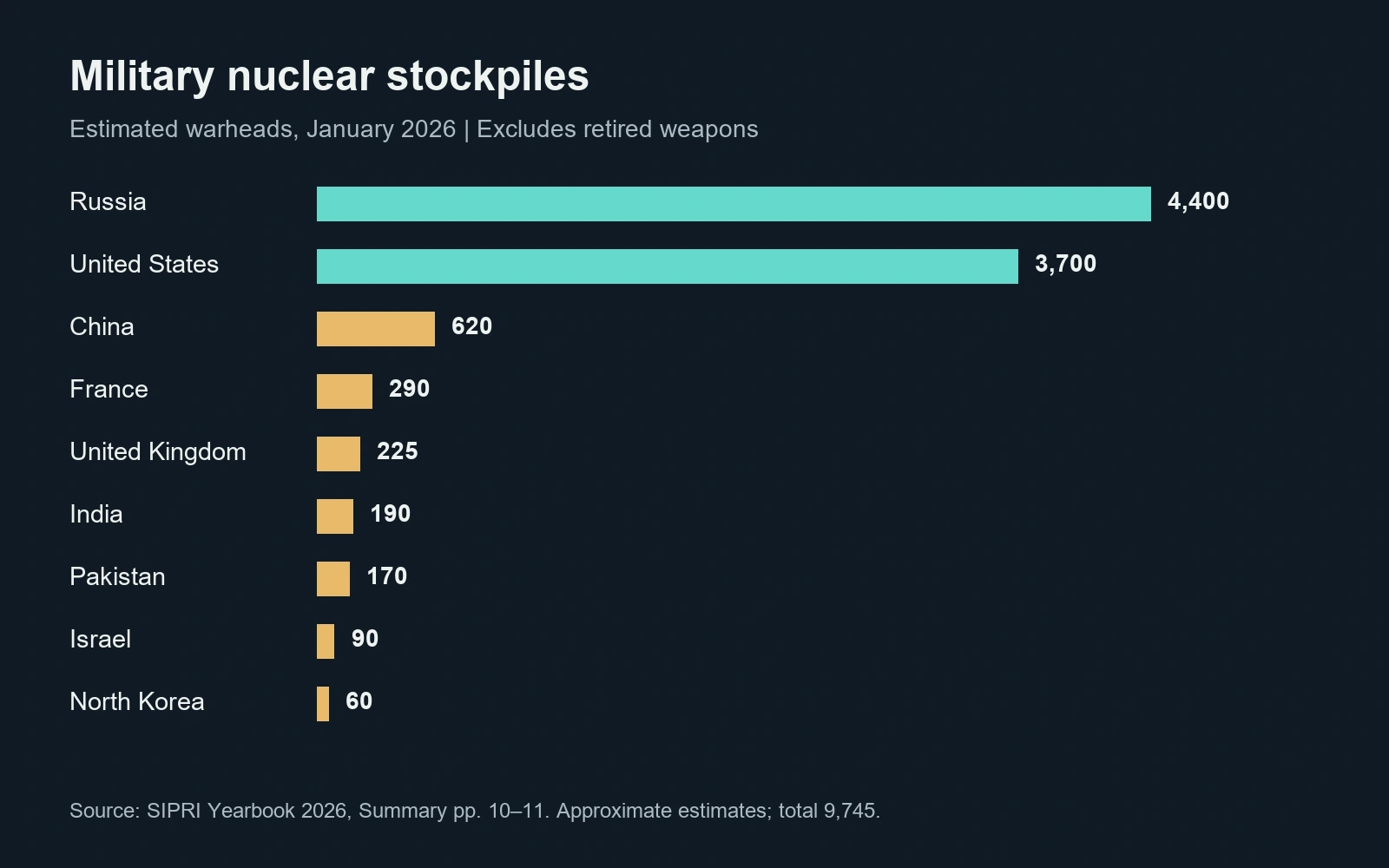
The scale is substantial, but the chart does not measure willingness to use weapons, readiness or the chance of war. It also shows why describing the United States, Russia and China as three equal nuclear powers would be misleading.
New START expired in February 2026, removing a major bilateral framework governing American and Russian strategic forces. That is a serious change. It does not mean every agreement or diplomatic channel has vanished.[20]
AI enters this environment as a tool for interpreting information. More processing power cannot replace information that is missing, ambiguous or deliberately concealed. An institution still needs to know where the evidence ends and its assumptions begin.
Petrov was assessing a warning
In September 1983, Soviet officer Stanislav Petrov assessed a satellite indication of incoming American missiles as a false alarm. Accounts based on his interviews describe the later explanation: sunlight reflected by clouds had confused the warning system.[22]
The episode should not be inflated into a claim that Petrov personally held a launch order and refused to execute it. He was assessing warning information. What would have happened through the rest of the command chain is a counterfactual, not a measurable certainty.
The useful lesson is institutional. A technical indication remained open to challenge. Depending on another exceptional individual to save the day is a weaker safeguard than preserving the information, training and authority that make justified challenge possible.
Historical research on the 1983 war scare also shows why reactions matter: precautions and exercises can be interpreted differently by adversaries. An observed response is not automatically independent evidence of hostile intent.[14] [15]
Faster analysis can buy time—or consume it
Imagine an entirely hypothetical process with a 30-minute interval. Assembling an assessment takes 12 minutes and communication takes eight, leaving ten for review. If AI reduces assessment to four minutes and the deadline stays fixed, review time rises to 18 minutes.
Now change the institutional rule. Because analysis is faster, commitment is expected after 15 minutes. Four minutes of analysis and eight of communication leave just three minutes for review. The same technical improvement produces a different outcome because the organisation uses the time differently.
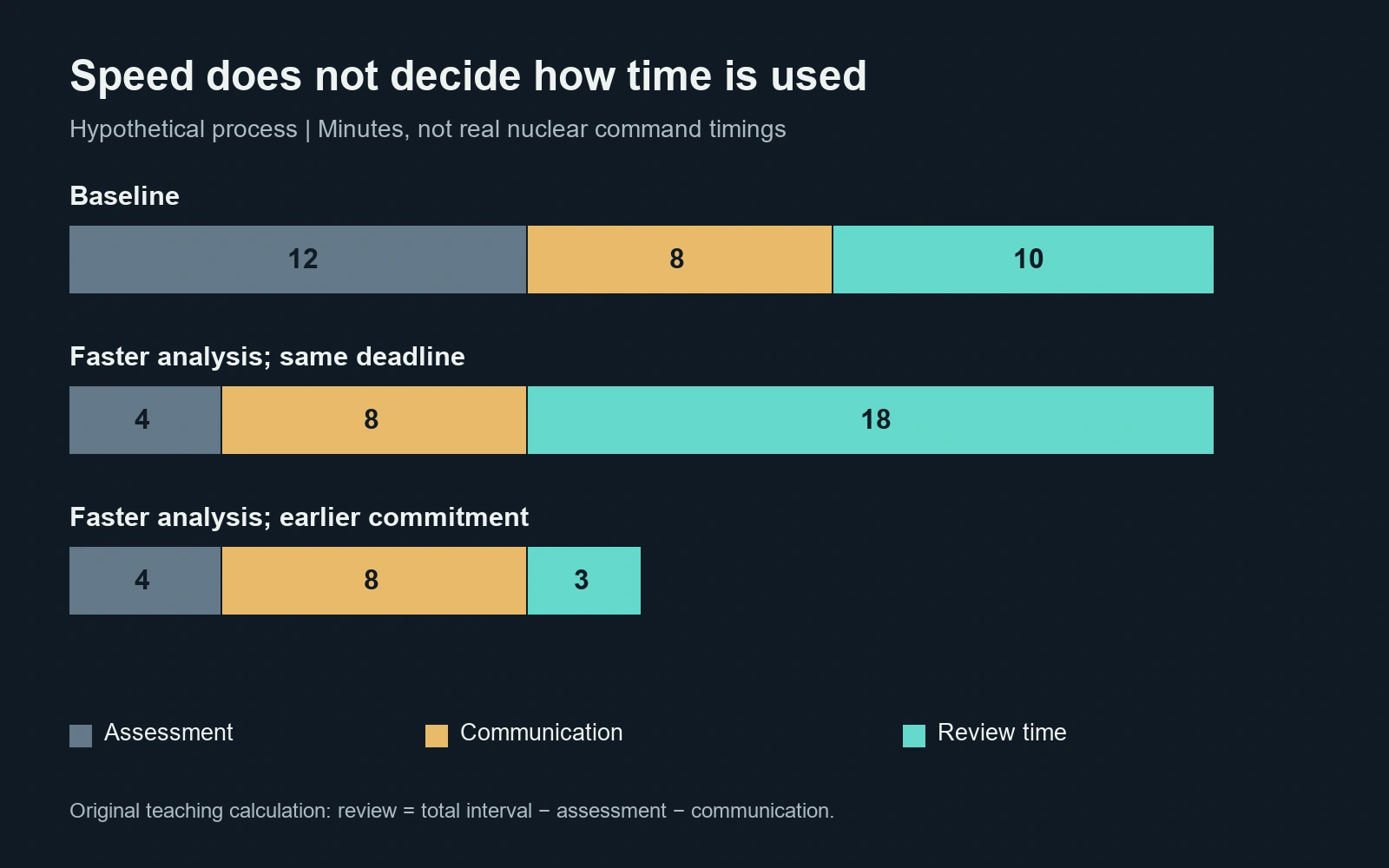
This calculation does not demonstrate that real institutions behave this way. It identifies what evaluators should measure: whether time saved becomes time to think, or pressure to act sooner.
The decision window has four parts: usable time, independent evidence, practical authority to challenge, and options that remain reversible. A human approval step does not establish that all four exist.
When a reaction becomes confirmation
Consider a hypothetical crisis. An unexplained communications disruption prompts concern. One side takes a visible precaution. The other side observes it and responds defensively. The first side's analytical system then treats that response as additional support for its original suspicion.
The initial disruption could have another explanation. Yet the sequence can become self-confirming if the system loses track of which observations were produced by the parties' own actions.
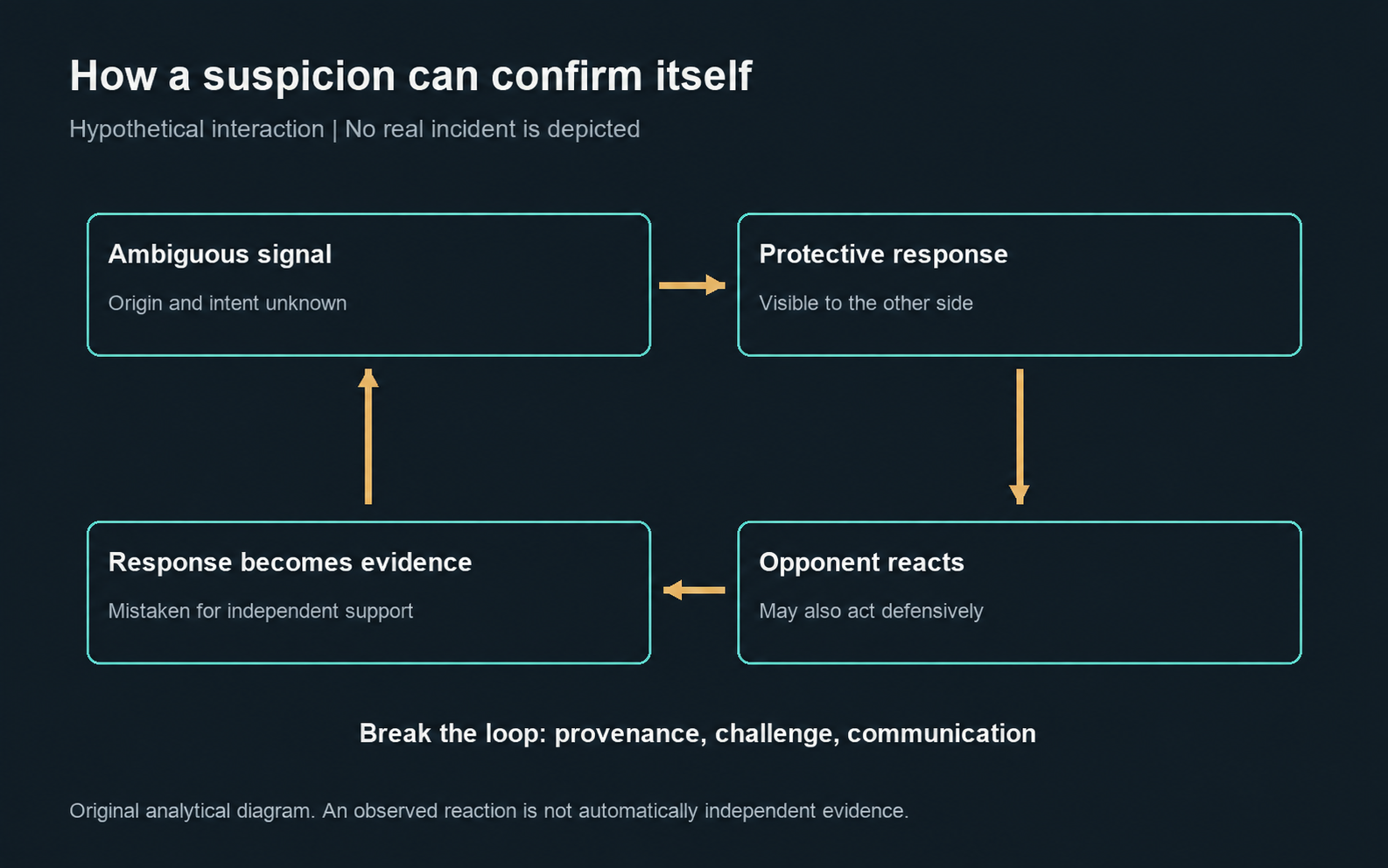
No machine needs to want war. Each recommendation might appear reasonable in isolation. The problem lies in the chain: uncertainty becomes apparent corroboration, and each action makes changing course harder.
SIPRI's analysis is relevant because it examines how military AI outside nuclear weapon systems could influence escalation. That is a plausible risk pathway, not proof that a particular classified system has already caused such a crisis.[6]
A confident number is not proof
A display reading “97.4% probability of attack” would look precise. But before trusting it, a reviewer would need to know what the number means, how it was calibrated and whether the present situation resembles the cases used to test it. A language model can generate a percentage without possessing a validated probability model.
Even a genuinely statistical warning depends on context. In a synthetic teaching example, a detector with 99% sensitivity and a 1% false-positive rate has a positive predictive value of about 9% when the assumed event prevalence is 0.1%. Change prevalence to 1%, and that value becomes 50%.
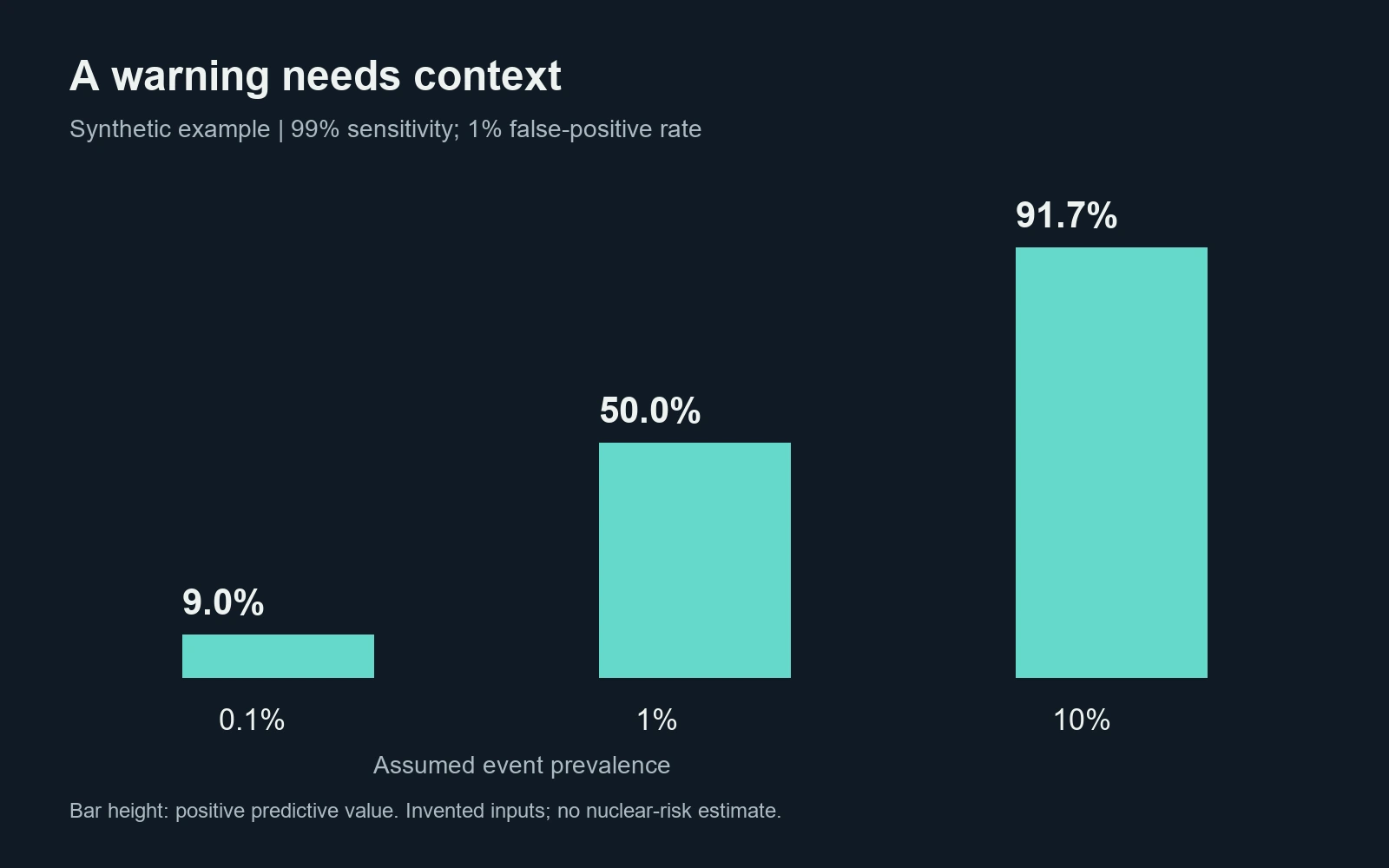
The lesson is not that a particular response follows from a percentage. It is that prediction and decision are different stages. Consequences, alternatives and the value of further evidence still matter.
Human-factors research gives another reason to test the complete process: people can become biased in their reliance on automation. Those findings warrant attention to oversight, but do not supply a measured nuclear-risk percentage.[17]
The case for AI reducing risk
The strongest counterargument deserves to be taken seriously. AI might detect contradictions, organise complex evidence and reduce analyst overload. It could help people discover that a warning is wrong. A tool that demonstrably improves those functions could make an institution safer.
The fair comparison is with the real alternative, including human fatigue and organisational failures. It is not a comparison between imperfect software and a flawless human team.
Experimental wargames have reported escalatory behaviour by language-model agents, including rare nuclear use inside a simulation. That is evidence about the designed experiment. It does not establish how real governments—or trained human teams using constrained assistance—would act.[18]
The International AI Safety Report similarly warns that benchmark performance does not always predict real-world performance. The practical response is evaluation in the intended setting, with both true and false warnings, rather than a universal verdict that AI is safe or dangerous.[4]
What meaningful control would require
The United States and China have publicly supported human control over decisions to use nuclear weapons. The November 2024 American readout records the principle, and China's 2026 NPT statement reiterates it. Neither document is a technical inspection of deployed systems.[13] [23]
Making that principle substantive requires more than a final approval button. Decision-makers need evidence they can trace, access to competing interpretations and a practical route to reject or limit a recommendation.
- Preserve provenance. Show when several reports share one origin.
- Protect challenge. Give a reviewer both responsibility and a route to communicate disagreement.
- Test the whole process. Include degraded conditions, valid warnings and misleading ones.
- Preserve options. Distinguish reversible protective steps from irreversible commitment.
- Keep communication usable. Clarification can matter even when parties distrust each other.
These are proposed safeguards, not guarantees. Additional review can cause delay; evaluators can be captured; restrictions can impose costs. Each measure needs testing against the failure it is intended to prevent.[16] [21]
The goal is to make an error easier to identify and correct before it becomes a chain of consequences.
Evidence Ledger
What the record supports
Original American policy documents establish stated priorities, not deployment safety. Sources 24–25.
Public government statements support the principle; implementation is not independently certified. Sources 13 and 23.
Benefits and escalation pathways depend on the complete workflow. Sources 6–7 and 21.
The reviewed public record does not establish a calibrated probability. Scenarios and teaching calculations are not forecasts.
Final Assessment
Verified: governments are prioritising military AI adoption; researchers have identified escalation mechanisms; and public commitments support human control over nuclear-use decisions.
Contested: how much advanced AI will improve strategic judgement, and whether particular restrictions or pacing proposals will make development safer.
Unresolved: the prevalence of particular classified deployments, the net effect on nuclear stability, and any precise probability of AI-induced nuclear war.
The evidence does not establish that humanity has crossed a point of no return. It does establish a reason to examine the process before the final decision. Faster intelligence is valuable when it helps people think. It becomes dangerous when its authority grows faster than their ability to question it.
The essential safeguard is a practical capacity to reconsider: enough evidence, enough authority and enough time to say that the machine may be wrong.
Read the full thesis: Subscribers can download The Decision Window, the 62-page research study behind this overview, from the Subscriber Library. It develops the wider arguments on AI benefits, economics, the US-China race, frontier control and governance, with methodology, five charts and Harvard-style references. Use the password in your subscriber welcome email, or join The Briefing and confirm your email to receive access.
Sources
References and further reading
- 012024Abramson, J. et al. (2024) 'Accurate structure prediction of biomolecular interactions with AlphaFold 3', Nature, 630, pp. 493–500. doi:10.1038/s41586-024-07487-w.Research / original record
- 022024Acemoglu, D. (2024) The Simple Macroeconomics of AI. NBER Working Paper 32487. doi:10.3386/w32487.Research / original record
- 032026Amodei, D. (2026) We Must Pace the Frontier. September.Research / original record
- 042026Bengio, Y. et al. (2026) International AI Safety Report 2026: Extended Summary for Policymakers. DSIT 2026/001, 3 February.Research / original record
- 052023Brynjolfsson, E., Li, D. and Raymond, L.R. (2023) Generative AI at Work. NBER Working Paper 31161, October 2023 revision. doi:10.3386/w31161.Research / original record
- 062025Chernavskikh, V. and Palayer, J. (2025) Impact of Military Artificial Intelligence on Nuclear Escalation Risk. SIPRI Insights on Peace and Security, 2025/6. doi:10.55163/FZIW8544.Research / original record
- 072018Geist, E. and Lohn, A.J. (2018) How Might Artificial Intelligence Affect the Risk of Nuclear War? RAND, PE-296-RC. doi:10.7249/PE296.Research / original record
- 082025Gmyrek, P. et al. (2025) Generative AI and Jobs: A Refined Global Index of Occupational Exposure. ILO Working Paper 140. doi:10.54394/HETP0387.Research / original record
- 092025International Energy Agency (IEA) (2025) Energy and AI: Executive summary. Paris: IEA.Research / original record
- 101978Jervis, R. (1978) 'Cooperation under the Security Dilemma', World Politics, 30(2), pp. 167–214.Research / original record
- 112026METR (2026) We are Changing our Developer Productivity Experiment Design. 24 February.Research / original record
- 122025Ministry of Foreign Affairs of the People's Republic of China (2025) Global AI Governance Action Plan. 29 July, reporting the 26 July plan.Research / original record
- 132026Ministry of Foreign Affairs of the People's Republic of China (2026) Implementation of the Treaty on the Non-Proliferation of Nuclear Weapons in the People's Republic of China. 23 April.Research / original record
- 142018National Security Archive (2018) The Soviet Side of the 1983 War Scare. 5 November.Archival research
- 152021National Security Archive (2021) Able Archer War Scare 'Potentially Disastrous'. 17 February.Archival research
- 162023National Institute of Standards and Technology (NIST) (2023) Artificial Intelligence Risk Management Framework (AI RMF 1.0). NIST AI 100-1. doi:10.6028/NIST.AI.100-1.Research / original record
- 172010Parasuraman, R. and Manzey, D.H. (2010) 'Complacency and bias in human use of automation: an attentional integration', Human Factors, 52(3), pp. 381–410. doi:10.1177/0018720810376055.Research / original record
- 182024Rivera, J.-P., Mukobi, G., Reuel, A., Lamparth, M., Smith, C. and Schneider, J. (2024) 'Escalation Risks from Language Models in Military and Diplomatic Decision-Making', FAccT 2024. doi:10.1145/3630106.3658942. Public preprint arXiv:2401.03408.Research / original record
- 192026Stockholm International Peace Research Institute (SIPRI) (2026a) SIPRI Yearbook 2026: Summary. Stockholm: SIPRI, pp. 10–11.Research / original record
- 202026Stockholm International Peace Research Institute (SIPRI) (2026b) Increasing focus on nuclear weapons amid heightened escalation risks—new SIPRI Yearbook out now. 8 June.Research / original record
- 212025Su, F., Wan, W., Saalman, L. and Chernavskikh, V. (2025) Pragmatic Approaches to Governance at the Artificial Intelligence–Nuclear Nexus. Stockholm: SIPRI. doi:10.55163/BCHM4674.Research / original record
- 222017TIME (2017) Stanislav Petrov, the Russian Officer Who Averted a Nuclear War, Feared History Repeating Itself. September.Interview reporting
- 232024White House (2024) Readout of President Joe Biden's Meeting with President Xi Jinping of the People's Republic of China. 16 November. Archived by The American Presidency Project.Research / original record
- 242025White House (2025) America's AI Action Plan. July.Research / original record
- 252026White House (2026) Fact Sheet: President Donald J. Trump Signs Historic Directive on AI in the National Security Enterprise. June.Research / original record
Continue the Chain
Control, infrastructure and the interpretation of evidence