Dossiers
Svalbard, Seabeds, and Grey-Zone Claims

Svalbard combines treaty rights, Norwegian sovereignty and distinct maritime-law disputes. Those layers cannot be collapsed into one ownership claim.
Greenland’s Security Deal: What Changes—and Who Keeps Control?

What Greenland’s security deal changes, what remains unsigned, and how US defence access differs from sovereignty and Greenlandic self-determination.
The Northern Frontier

Arctic military attention and infrastructure are documented. Activity does not make escalation inevitable or erase environmental and civilian context.
Security Bloc Pressure Points

Security blocs rarely break through one dramatic fracture. They slow, harden, and misfire through accumulated stress at the seams between movement, production, politics, and public endurance. This file asks a narrower question than summit language usually allows: which pressure points inside a security bloc begin to matter first when a fast external crisis meets a slower collective machine?
Internal Fractures

Official records show common commitments alongside uneven burdens and political negotiation. Friction is evidence of pressure, not proof of collapse.
Eastern Flank Posture

NATO’s eastern flank is where deterrence stops being a statement of intent and becomes a timed transport, protection, and sustainment problem. The alliance has built real forward posture. The contested question is whether forward presence, air defence, mobility corridors, and follow-on force can combine quickly enough to turn exposure into staying power.
Deterrence Credibility
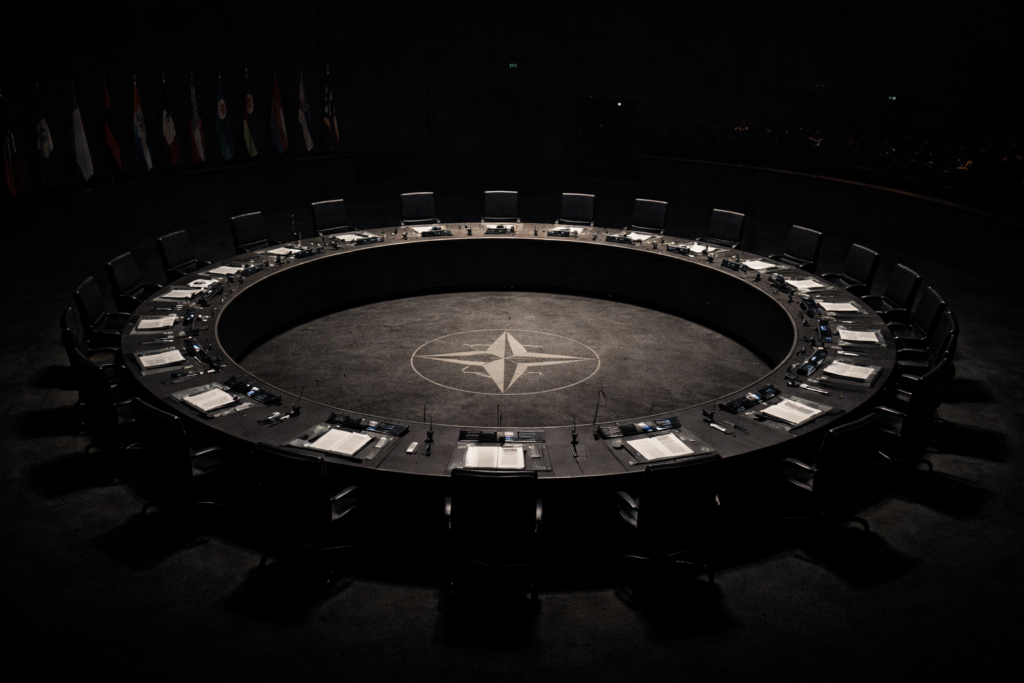
Doctrine and capability programmes are documented. Whether deterrence succeeds in a future crisis cannot be guaranteed by policy text.
Alliance Strain

NATO records show binding political commitments and uneven implementation pressures. Strain is real; collapse is not established.
Strait Of Hormuz Brief (Retired — merged into Iran: Live Dossier)

Traffic and supply can adjust while maritime risk remains material. Partial recovery is not proof of normal conditions or durable political settlement.
Regional Spillover: Lebanon’s fragile framework deal, Gulf alarm, Iraq corridor pressure, and the systems war around Iran

Spillover is visible in health, maritime and corridor records. Connection does not establish central direction, settled causation or a closed end state.
Iran Nuclear Brief (Retired — merged into Iran: Live Dossier)

Public reporting and institutional records leave material uncertainty about stocks, access, negotiations and political intent.
Iran: Live Dossier — Six Months Under Mojtaba

Iran’s live status through 4 September 2026: Mojtaba’s opaque leadership, a stronger IRGC role, renewed U.S. strikes, and no durable settlement.