
China–Pakistan Fibre: Who Controls the Khunjerab–Rawalpindi Link?
The Khunjerab–Rawalpindi link added an international route in 2018. Trace its documented financing, construction and operating roles, then examine what the records can tell users about resilience and control.
Opening Brief
Pakistan built a route through the mountains to gain another way onto the international internet. The question for users is what that additional path delivers—and who must keep it working.
The Khunjerab–Rawalpindi fibre project was completed and inaugurated in July 2018, according to Pakistan's CPEC Secretariat. Its Pakistani segment is listed at 820 kilometres, with an estimated cost of US$44 million. This is an investigation of an existing link, not an announcement of a new 2026 cable. CPEC project record
Verified: the route, July 2018 inauguration, announced financing and implementation, and a later audit describing a leased circuit. Contested: the audit and SCO management disagree over maintenance charges in that circuit's agreement. Unresolved: differing completion dates, later settlement of audit findings, current traffic use and communications-access safeguards. These are distinct questions; none establishes Chinese interception.
Why Pakistan wanted another way out
For a Pakistani business, an international connection matters when customers, suppliers or services sit overseas. For northern communities, the question also concerns the infrastructure that supports local mobile connectivity.
Pakistan's project record gives both rationales: ICT infrastructure for northern 3G/4G services, tourism and trading opportunities, and an alternative fibre route intended to improve communications security. Those are the government's stated purposes. The record does not show how much a household's bill fell, how many outages were avoided or which businesses gained reliable access. CPEC project record
An additional path can increase a network's options. Whether an internet provider can use it during a disruption also depends on the capacity it has purchased, connections to that path and arrangements with upstream networks. A completed cable does not answer those commercial questions by itself.
Three milestones, three different claims
| Date | What the record establishes |
|---|---|
| October 2015 | Pakistan's CPEC record says work commenced. |
| July 2018 | The same record says the project was completed and inaugurated. China Telecom's contemporary announcement describes the 13 July opening and cross-border testing. |
| 31 August 2018 | A Chinese-language Xinhua account attributes commercial commencement to a China Telecom International executive. |
The first two entries come from the Pakistan project record. The China Telecom announcement and original Chinese report distinguish opening/testing from the later commercial-service announcement. The latter is an attributed operator account, not an independent service audit. A later Auditor-General report, however, gives 1 March 2020 as the project's completion date. The record reviewed does not explain the difference; an inauguration date must not silently become a reconciled financial or contractual completion date. AGP audit, paragraph 8.5.3
There is another distinction hidden in the numbers. The 820-kilometre figure describes the Pakistani project. China Telecom describes a 2,950-kilometre Urumqi–Rawalpindi connection. A CAICT presentation separates that total into 2,130 kilometres in China and 820 in Pakistan. They describe different scopes, not automatically contradictory measurements. CAICT cross-border cable case study, slide 3
Even official pages need date checks. An embassy-hosted brief dated October 2018 retains progress figures from March 2017 and an old November 2017 completion forecast. Its value is the project description; that forecast is not the final completion date. Chinese Embassy project brief
Follow the roles, not the flag
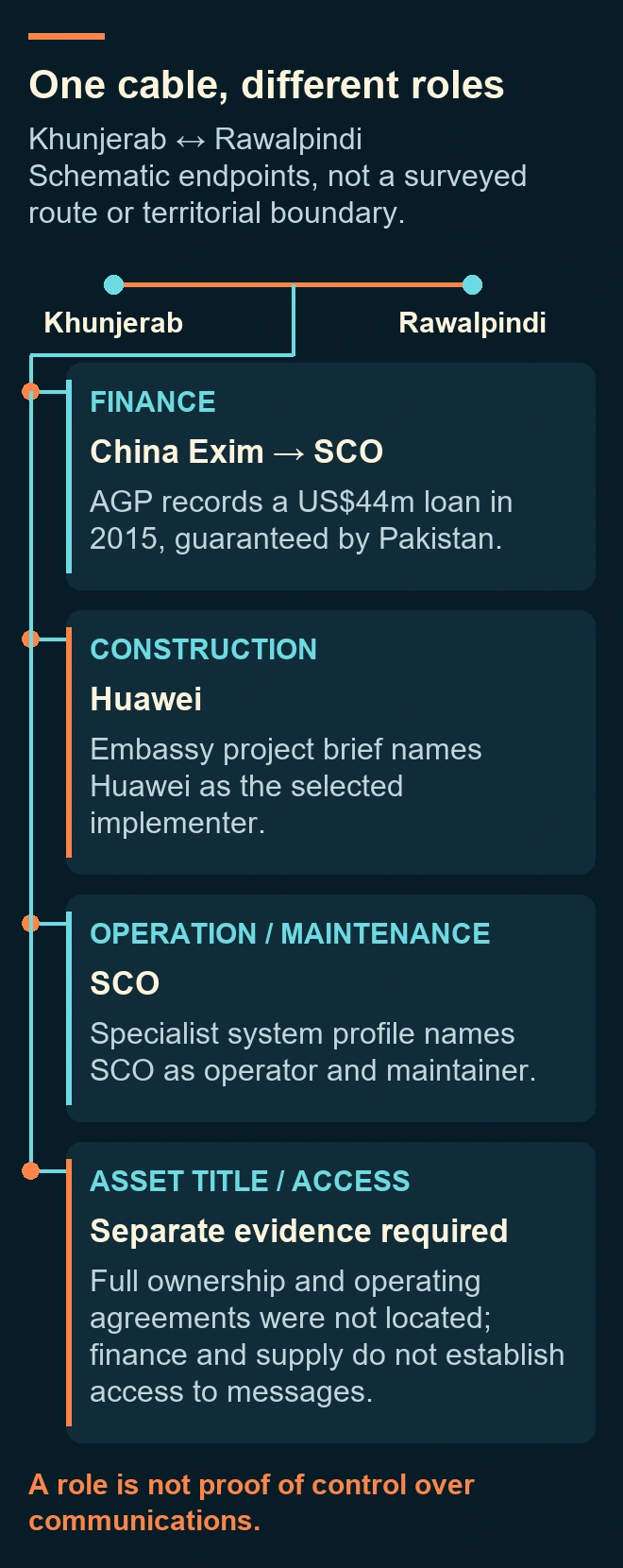
“Who controls the cable?” bundles several questions together. Paying for construction, owning an asset, repairing equipment, selling capacity and authorising access to communications are different roles.
| Role | Public evidence | What remains unknown |
|---|---|---|
| Finance | The embassy brief announces a concessional loan. AGP records a US$44m China Exim loan acquired by SCO in 2015, guaranteed by Pakistan. | Full signed terms and current repayment position; audit findings are historical. |
| Build | The same brief names Huawei as selected implementer. | Procurement terms, continuing supplier support and any remote-administration permissions. |
| Pakistan operating institution | SCO describes its public-sector position under Pakistan's Ministry of IT and Telecom. A specialist cable profile names SCO as operator and maintainer of this link. | The project's asset-title, transfer and operating agreements. |
| Capacity rights | AGP describes a December 2019 SCO–CM Pak–China Mobile International (UK) agreement for 100G and 20G Khunjerab–Rawalpindi circuits. | Current rights/usage and the complete contract; purchased capacity is not measured traffic. |
| Maintenance | The trade profile names SCO; AGP quotes annual O&M charges in the circuit contract and records management's disagreement. | Later resolution, repair deadlines, spare parts and current backup performance. |
| Access to communications | No project-specific access agreement or substantiated interception finding was located in these records. | Applicable operational access procedures, audit rights and evidence of their use. |
Sources: embassy project brief, SCO institutional record, specialist system profile, AGP audit, paragraphs 8.5.3 and 8.5.5.
A concessional loan establishes a financing relationship. The US$44 million estimated project cost and reported loan are overlapping headline amounts, not two sums to add together. Huawei's implementation role establishes supplier involvement. Neither establishes that a lender or supplier can inspect people's messages, direct Pakistani traffic or take over the asset. Those claims require their own evidence.
The converse also matters: an unavailable full contract is not reassurance that every safeguard exists. Audit extracts provide some terms, not the whole bargain.
The audit makes accountability concrete
Pakistan's Auditor-General report for Audit Year 2023–24 raises three project-specific issues. They are findings and responses from that audit period, not a certified account of their position today.
First, paragraph 8.5.3 reports Rs358.407 million in unpaid loan-related liabilities. SCO management accepted the audit contention but said revenue had been deposited with government and payment arrangements were being pursued through the responsible ministries. The Departmental Accounts Committee directed coordination and audit verification in January 2024. Later settlement was not established here.
Second, paragraph 8.5.5 quotes annual circuit-maintenance charges of US$460,800 and US$109,440 and reports their non-recovery. Management said CMI had paid US$11.405 million for a 15-year right of use and denied that the agreement included O&M charges. Audit rejected that reply by reference to the schedule; the committee requested records of recovered O&M amounts for audit verification within one week. This is a Contested contractual-payment finding, not proof of current traffic volume or a final adjudication.
Third, paragraph 8.5.2 labels its finding “LI/Web monitoring” and records a Rs414.643 million Web Monitoring Solution contract with SNSKIES for the Dassu–Danyore Pak-China OFC protection/upgradation project. Its project-budget description uses “LI/WMS”; the contract description calls the system WMS. Audit says the contract lacked Project Management Board approval and the system stopped after its one-year licence was not renewed. Management accepted the contention, saying approval for excess payment had been accorded but minutes were awaited. The committee requested documentation. The reported stoppage concerns the monitoring system; it does not establish that the fibre link stopped carrying traffic. The report does not establish the system's data-access capabilities or Chinese access to communications.
These findings make Pakistan-side financial responsibility, contract enforcement and operating sustainability evidence-based questions. They do not prove geopolitical capture. AGP audit, printed pages 116–121, paragraphs 8.5.2, 8.5.3 and 8.5.5
Resilience has to survive the mountain
The build brief describes high-altitude working conditions and backup microwave links. That makes maintenance a practical issue, not an abstract sovereignty debate. Chinese Embassy project brief
The useful test is whether the route remains available when another path fails, with enough usable capacity and a workable restoration process. No current route-specific availability series, repair performance or customer comparison was established in this investigation. Historical construction and service announcements cannot supply those measurements.
For users, the missing evidence is concrete: which providers offer capacity over the link, what happens during a failure and whether the extra path improves service at the point they actually connect. These questions are more useful than treating every foreign supplier as a security verdict.
Alternatives are part of the bargain
The choice is not simply this cable or isolation. Pakistan also invests in submarine connectivity. PTCL's February 2025 stock-exchange disclosure records its Africa-1 investment and projected service date. That historical forecast does not certify Africa-1's present operational status, but it demonstrates a separate investment route. PTCL disclosure
SCO's Phase II page describes a planned extension toward Karachi and Gwadar, approved in January 2021 and soft-launched that April, with execution tied to government funding. A plan to extend the network is not evidence that the extension is complete. SCO Phase II record
More routes can improve bargaining options when they are genuinely usable substitutes. Dependence still needs to be assessed through actual capacity, support and connection terms. The existence of borrowing alone does not establish geopolitical capture.
Lahore Safe City is a separate project. Its camera systems, contracts or allegations cannot establish how this fibre link handles traffic without a documented connection between the two. This investigation makes no such connection.
Evidence Ledger
What the reviewed record establishes
Government and operator records document the project, inauguration and cross-border participation.
Audit and SCO management disagree over charges in the quoted agreement; no final adjudication is established.
Completion-date differences, later audit resolution, traffic use and communications-access safeguards remain unresolved.
Final Assessment
The strongest supported conclusion is that Pakistan developed an additional international fibre path, alongside a stated ambition to improve northern connectivity. China supplied financing and a named vendor implemented the build; China Telecom documented cross-border participation.
The audit supplies concrete reasons to examine repayment arrangements, maintenance charges and sustainable operation. Their later resolution remains unknown. The wider public-interest test is whether the bargain delivers reliable, affordable connectivity with accountable maintenance and clear access safeguards. That still needs current terms and measurements. It does not justify either an espionage verdict or a blanket assurance of independence.
For Pakistani readers, the lasting test is straightforward: who keeps the route working, who can use it, and what evidence shows it helps when another route fails? New operating disclosures or audited outcomes would change the assessment. Repeating the 2018 inauguration would not.
Sources
Inspect the records behind the claims
- 01Pakistan CPEC Secretariat: Khunjerab–Rawalpindi projectofficial purpose, scope and chronology
- 02Chinese Embassy: project brief, 1 October 2018announced loan and implementation; retains stale progress text
- 03China Telecom: opening and testing announcement, 20 July 2018attributed international-system account
- 04Xinhua Chinese-language report hosted by CAC, 2 September 2018attributed commercial-service announcement
- 05CAICT presentation hosted by ESCAPinternational versus Pakistani segment lengths
- 06SCO: institutional recordand — institutional remit and planned extension
- 07Phase II recordand — institutional remit and planned extension
- 08Submarine Networks: Pak-China system profilesecondary operator/maintainer description
- 09PTCL stock-exchange disclosure, 21 February 2025separate submarine investment and historical forecast
- 10Auditor-General of Pakistan, telecom audit 2023–24printed pages 116–121; financing, monitoring-system and disputed circuit-maintenance findings with management responses
Continue the Chain
Follow the evidence into the next investigation