Dangerous Pathogen Research: Who Checks the Labs?
National regulators inspect dangerous pathogen laboratories. The harder question is who verifies the findings—and checks that the problems were fixed.
Opening Brief
A laboratory worker is dead. The diagnosis is uncertain. The international health agency asking for evidence said on 7 October that it could not complete its assessment. That is the starting point of the Irkutsk case, not proof that a pathogen escaped.
On 7 October 2026, WHO described a death after severe pneumonia at Russia’s Irkutsk Anti-Plague Research Institute and an incomplete risk assessment. Allegations of plague and occupational exposure were unconfirmed. Russia’s response, WHO said, reported no recent plague cases and about 200 quarantined contacts. [1]
Who checks dangerous pathogen laboratories? Usually national regulators, supported by institutional safety officers and committees. WHO supplies standards, requests outbreak information and sometimes conducts agreed inspections. It is not a worldwide laboratory inspector with a general right to enter any facility. [3] [4] [48] [49]
The harder question is whether the checking can be independently verified. This investigation follows five historical incidents, compares eight countries and examines the evidence for research benefits, risks and international oversight. Its central test is simple: can the public follow a concern from report, to investigation, to corrective action, to verified closure?
The Irkutsk incident is Unresolved. National regulatory powers and documented historical accidents are Verified. The sufficiency of particular safeguards is a separate question; it cannot be inferred from a building’s containment label or from an inaccessible report.
Irkutsk: the dated record and the missing evidence
The chronology follows WHO’s account, not an independently obtained Russian investigation file. None of these dates is presented as the worker’s death date.
- 2 October: initial media allegations; WHO says a government meeting addressed a suspected dangerous infection.
- 3 October: WHO requested information under the IHR.
- 6 October: Russia responded, according to WHO.
- 7 October: WHO sought further evidence and said its full assessment remained incomplete.
This does not establish a late IHR acknowledgement: request-receipt and acknowledgement records were unavailable. [1] [48]
Official statement: Russia’s reported answer is relayed by WHO. WHO receipt: some information received; tests, precaution rationale, contact outcomes and another pneumonia report still sought. Public evidence: WHO’s account; no first-party Russian incident file located. Unresolved: diagnosis, exposure and transmission. Protected diagnostic and investigation records would distinguish these questions.
What “dangerous pathogen research” means
A pathogen is an agent capable of causing disease. “High containment” describes facilities and practices intended to protect workers, the public and the environment during work with serious biological hazards. The commonly used biosafety levels run from BSL-1 to BSL-4; UK regulators use containment-level terminology. These classifications are not league tables of how frightening a laboratory is. The activity, material, exposure route and available countermeasures matter. Hazard group and containment level are related, but not interchangeable. [3] [4]
Biosafety concerns accidental infection or escape. Biosecurity concerns theft, misuse and unauthorized access. Research oversight adds a third question: even if a laboratory can contain an activity, is that particular experiment justified? An internal committee, workplace inspector and national-security reviewer may address different parts of the problem. Passing one assessment does not settle all three.
The field also includes work that is easy to overlook: identifying an unfamiliar infection, validating a diagnostic test, maintaining a reference collection or checking whether a countermeasure works. Those tasks are not equivalent to modifying an organism to explore a hazardous trait. Neither are ordinary sample testing and every activity with a live pathogen interchangeable. A 2021 specialist perspective describes how high-containment expertise supported COVID-19 response while much diagnostic work used lower-containment networks. [5]
Plague illustrates why precise language matters. It is a bacterial infection with natural animal reservoirs; pneumonic plague can spread through respiratory droplets, and timely treatment matters. A pneumonia diagnosis alone does not establish plague. Nor does employment at an anti-plague institute establish that an infection was acquired there. [2]
For people living near a laboratory, the meaningful distinction is not between a frightening name and a reassuring one. It is between a defined activity with enforceable conditions and a claim of safety that nobody outside the operator can test.
How oversight acquired its present shape
The system did not begin as a single global inspectorate. Its separate strands developed around different problems: worker infection, disease surveillance, retained pathogen stocks and deliberate misuse. The result is overlapping responsibilities rather than one universal permit.
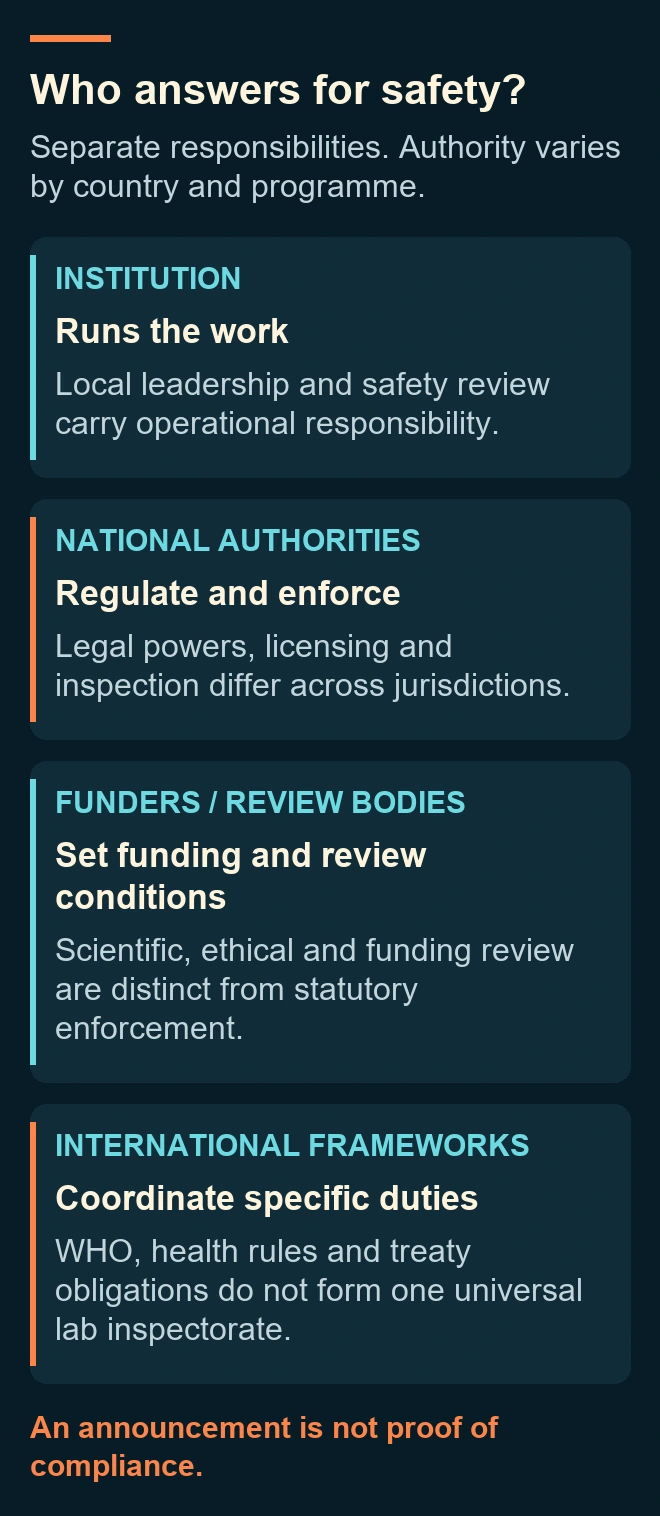
1970s–1980s: accidents and eradication. Birmingham helped drive UK notification and licensing proposals after 1978; the 1981 regulations enacted prior notification. Smallpox eradication brought another problem: retaining dangerous material after naturally circulating disease was eliminated. After the World Health Assembly confirmed eradication in 1980, WHO’s post-eradication programme included stock supervision, laboratory safety monitoring, surveillance and preservation of expertise. An orthopoxvirus committee followed in 1981, and an ad hoc committee in 1990. Those controls were attached to a specific eradication settlement, not a mandate covering every pathogen. [15] [16] [55]
Pathogen collections and natural-reservoir surveillance serve a different, continuing purpose. Rospotrebnadzor’s 2008 order describes its anti-plague system’s role in surveillance and prevention of plague and other natural-focus infections, including Irkutsk. An institute’s name reflects that protective remit; it does not establish the cause of a contemporary worker’s illness. Collections can support reference identification and outbreak comparison, while retaining material also creates obligations for safe custody and review. [63]
1990s–2000s: access control and deliberate misuse. FSAP’s history traces US transfer controls to 1996 legislation after illicit acquisition of a dangerous agent. Following the 2001 anthrax attacks, Congress extended controls to possession, use and transfer; implementing regulations took effect in 2003. Further rules in 2012 designated a higher-security tier. This helps explain why the programme’s listed-agent scope differs from a general occupational-safety framework. [56]
International health and weapons rules remained separate. The 1972 Biological Weapons Convention addressed prohibited purposes; the IHR framework addresses international public-health events and information exchange. Neither became a universal civilian-laboratory compliance agency. National employment, health, animal-health and environmental law continued to carry much of the practical burden. [48] [52] [53]
These histories do not prove that a modern design works. They explain what it was built to do, and why comparing a select-agent licence with an occupational-safety inspection can miss significant differences. Better oversight can follow an accident—but only if recommendations become enforceable practice and completion can be checked.
Why keep studying dangerous organisms?
The strongest case for this research is concrete: some threats already exist in nature, and developing reliable tests, treatments and vaccines requires understanding them. But “research saves lives” is too broad to justify every project. Benefits should be traced to a product, a measured outcome or an identifiable public-health capability.
An example is the Ebola vaccine that became ERVEBO. The FDA’s regulatory history traces its development to the Public Health Agency of Canada, followed by commercial development and manufacture. The 2019 decision reviewed clinical, statistical, manufacturing and safety evidence. This is a countermeasure with a documented development chain, not merely an institutional promise. The decision’s limitations also matter: protection against other ebolavirus species or Marburg virus was not established, and duration of protection was then unknown. [6]
In the Guinea ring-vaccination trial, clusters of contacts and contacts of contacts were assigned to immediate or delayed vaccination. The randomized analysis found no qualifying cases from day 10 among immediately vaccinated participants, against 16 among eligible people in delayed clusters: estimated efficacy 100%, with a 95% confidence interval of 68.9–100%. The interval, open-label design and outbreak setting prevent rewriting the result as guaranteed protection for everyone. The final paper and two correction notices were checked; corrections included presentation, references, a reported percentage and funding acknowledgement. [7] [8] [9]
That chain supports a real benefit from pathogen science. It does not prove that one containment category alone caused the benefit, or that every more hazardous experiment is necessary. The authors’ funders included WHO, public agencies and charities; declared advisory roles and related vaccine-research support remain relevant when assessing the evidence. Regulatory review offers a separate assessment, although it uses overlapping trial data rather than a new independent efficacy experiment. [6] [7]
Yeh and colleagues’ four laboratory case histories offer a different kind of evidence: trained staff, reference capacity and diagnostic networks helped institutions respond to COVID-19. Several authors were affiliated with institutions discussed; the work was an unfunded perspective, not a controlled comparison of high-containment investment against alternatives. Its examples show capability, not a universal benefit-to-risk ratio. [5]
The appropriate question for an individual project is therefore: what decision or countermeasure will this produce, what evidence links the experiment to that outcome, and could a less hazardous approach answer the same question?
The strongest case for the narrower category of potential-pandemic-pathogen experiments comes from investigators such as Fouchier, García-Sastre and Kawaoka. Their 2012 commentary argued that transmission research could reveal adaptation risks, focus surveillance and help identify vaccine candidates; they accepted that practical applications might not be immediate and required government and institutional permission. They were proponents, not independent evaluators of net benefit. [59]
The disagreement is about the value added by the hazardous activity. Critics question translation from animal models to human risk and whether a few experimental pathways predict the next natural pandemic. Proponents value mechanistic knowledge before a deployable product results. The sources assessed here do not settle a universal quantitative balance. Project review should make that uncertainty explicit: a broad success such as an Ebola vaccine cannot by itself justify a different, higher-risk influenza experiment. [10] [59]
What the risk evidence can—and cannot—measure
A laboratory-acquired infection, a possible exposure and a release beyond the facility are different events. Counting them together exaggerates some harms and conceals others. Comparing countries without accounting for reporting requirements can reward the country that publishes the least.
Blacksell and colleagues’ scoping review found 94 reports covering 309 laboratory-acquired infections involving 51 pathogens, eight deaths, and 16 accidental pathogen-escape events during 2000–2021. The 16 span internal and external releases under the review’s definitions; they are not 16 community releases. It searched scientific and incident-reporting sources, used multiple reviewers and included several languages. These are documented events assembled from uneven records, not a census or a global escape probability. They cover varied diagnostic, teaching and research settings—not only BSL-4 facilities. The missing denominator of comparable experiments or worker-hours prevents an annual high-containment failure-rate calculation. [11]
Canada’s 2024 surveillance report demonstrates what a reporting system adds. It recorded 71 confirmed exposure incidents affecting 132 people, one confirmed laboratory-acquired infection and two suspected infections. Its rate of 67.5 exposure incidents per 1,000 active licences uses licences as the denominator: it is not a risk per worker or per experiment. The system excludes several categories outside mandatory reporting, and its aggregated data cannot establish the National Microbiology Laboratory’s individual performance. [12]
The US Federal Select Agent Program reported 273 releases in 2024, but its definition includes occupational exposures and breaches of primary containment; the figure must not be presented as 273 pathogens escaping into communities. Its report recorded no resulting illness, death or community transmission. These national select-agent figures have a different scope from Canada’s licensed-pathogen surveillance. A numerical safety ranking between the two would be misleading. [13]
The evidence establishes that laboratory accidents occur and that reporting can expose patterns. It does not supply a defensible global catastrophe forecast. An event’s probability and its possible consequence are different questions; rare but severe outcomes still warrant scrutiny, while unsupported worst-case numbers can distort it.
Lipsitch and Galvani’s ethical critique makes a narrower argument about experiments creating novel potential pandemic pathogens: claimed benefits should be tested against less hazardous alternatives, including surveillance, modelling and work on components. Their analysis does not propose stopping all characterization of naturally occurring pathogens. It is an argumentative risk-benefit assessment, with assumptions and declared professional interests, rather than an observed global accident rate. [10]
Five incidents, five accountability trails
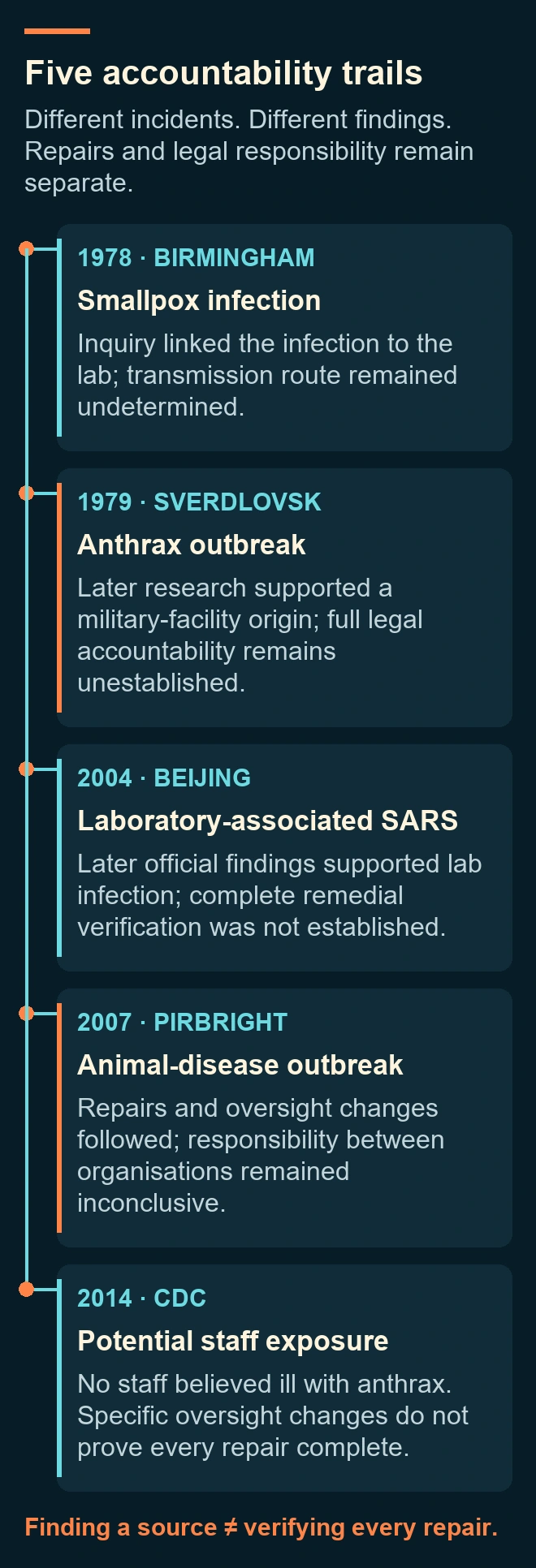
History is useful here because it allows the reassurance given during an emergency to be compared with later findings. These cases are deliberately different: human infection, a military programme, laboratory-associated SARS, animal disease and potential occupational exposure. They do not share a single cause.
1978 — Birmingham: an infection source is not a proven transmission route
Janet Parker, a medical photographer at Birmingham Medical School, died from smallpox. WHO’s 1979 record describes two cases, one death and one secondary transmission; surveillance and containment ended the outbreak. [58] The Shooter inquiry attributed the infection to the university laboratory, but its government foreword said the route remained undetermined. The university disputed the assessment. HSE prosecuted the university; magistrates dismissed the case, and reasons were not published. Neither dismissal nor the inquiry justifies inventing a proved route. [14]
The government accepted the substance of general recommendations in January 1979, including statutory notification, movement towards licensing and review of the Dangerous Pathogens Advisory Group. The 1981 regulations established prior notification of listed pathogen work. Those are traceable institutional consequences. They do not demonstrate implementation of every recommendation. Four inquiry members were drawn from the existing advisory group, with additional observers: its expertise and relationship to the oversight system should both be visible. [15] [16]
1979 — Sverdlovsk: secrecy obstructs the record
Soviet authorities blamed contaminated meat for an anthrax outbreak. Meselson and colleagues’ 1994 investigation used medical, administrative, cemetery, pathology and interview evidence to support an inhalational outbreak originating from the military facility. The paper reports 68 deaths on an administrative compensation list, not a complete final casualty census. Records had been confiscated, and the researchers did not have unrestricted access to the facility. [17]
Later sequencing of archived specimens characterized the outbreak strain and found no evidence of genetic engineering. It could not by itself establish a release mechanism, a decision-maker or compliance with the Biological Weapons Convention. State acknowledgement and compensation records matter, but the reviewed evidence does not establish a completed independent treaty investigation or full legal accountability. This is a military-programme case; it must not be used as proof that every civilian reference laboratory has the same purpose. [18] [52]
2004 — Beijing: later evidence changes the answer
WHO’s 18 May update reported two infected researchers at Beijing’s National Institute of Virology, closure on 23 April and an apparently broken human transmission chain. It said the initiating source or procedural error had not been identified; neither researcher was known to have worked directly with live SARS virus. That was the contemporaneous position. [19] CDC’s 19 May update records nine cases in total, one fatal: seven cases followed contact chains beyond the two researchers, including a family member and a nurse. This was not an incident confined to laboratory staff. [57]
The Chinese Ministry of Health’s 1 July investigation summary subsequently attributed the outbreak to laboratory infection, citing the two primary cases, virological evidence and the exclusion of an identified wildlife exposure. Its seven-expert panel was drawn from Chinese military and public-health institutions; WHO experts participated in some investigation work. It was not a wholly external inquiry. The later finding strengthens laboratory association without identifying every initiating detail. Closure and containment are established; the sources reviewed do not demonstrate complete later remedial verification or criminal accountability. [20]
2007 — Pirbright: an animal-health failure with wider costs
The UK government’s lessons review recorded eight infected premises and 2,160 animals slaughtered for disease control. Restrictions, export disruption and uncertainty affected farmers beyond the infected holdings. Government-commissioned HSE, Spratt and Callaghan reviews examined the release and regulatory arrangements. A site-associated escape was the most likely explanation, but attribution between co-located organisations could not be established conclusively. [21]
Licence conditions, repairs, testing and inspections followed. The review also records a later leak that the improved system contained, alongside continuing communication failures. That is evidence both of remediation and of residual organisational weakness. HSE took over inspection and enforcement in 2008; licensing followed in 2015. Pirbright’s 2014 guilty plea and fine concerned separate licence breaches—it was not a conviction for causing the 2007 outbreak. [21] [22] [23]
2014 — CDC: potential exposure is not infection
CDC’s after-action report examined potentially unsafe material transfer and deficiencies in approved planning and oversight. It ultimately identified 41 people as potentially at risk, while reporting no staff believed ill with anthrax; testing made viable bacteria leaving the higher-containment laboratory unlikely. The incident must not be rewritten as 41 infections or an established community release. [24]
CDC conducted an internal review, USDA APHIS inspected, and an external laboratory contributed testing. Closure, clinical precautions and a temporary transfer moratorium were followed by corrective-action recommendations. GAO’s 2015 testimony identified unfinished work; later recommendation records document broader improvements to inactivation guidance, reporting and enforcement. Those records verify specific system changes, not completion of every internal recommendation or permanent safety. [24] [25] [26]
Across these cases, finding a source, containing transmission, assigning legal responsibility and verifying repairs were different stages. A laboratory system can succeed at one and leave another unfinished. That is why an announcement that an incident is “under investigation” is the beginning of an accountability trail, not its endpoint.
Who regulates the laboratories? An eight-country comparison
The comparison uses the same questions everywhere: who operates the facility, who has legal authority, what approval and reporting controls apply, what inspections are publicly documented, and what can be enforced? The countries are a purposive sample of major human- or animal-health facilities, not a complete worldwide inventory or a ranking of national safety.
Russia — Irkutsk and VECTOR
Russia’s agency-hosted copy of Federal Law 52-FZ, consolidated through 2010, records sanitary-supervision and corrective-order powers. The official 2021 promulgation records adoption of SanPiN3.3686-21 sanitary rules. This investigation did not verify the latest consolidated law or the complete current laboratory provisions. Rospotrebnadzor’s public-health system includes the anti-plague network and VECTOR. That administrative relationship poses an independence question; it does not establish that an investigation is compromised. Current permit mechanics and a recent Irkutsk site inspection were not established from the records accessed. [27] [28]
Irkutsk’s public case trail remains incomplete. VECTOR’s WHO-catalogued smallpox inspection concerns a different site and arrangement; it cannot certify Irkutsk. [51]
United States — CDC and Galveston National Laboratory
For listed select agents, CDC and USDA jointly administer registration, inspection, incident reporting and enforcement. These agent-specific controls do not describe every US biological laboratory. UTMB owns and operates Galveston National Laboratory; it is not a CDC laboratory simply because CDC participates in the regulatory programme. [29] [30]
FSAP’s 2024 report records 230 registered entities and 196 inspections, including announced and unannounced visits. It describes corrective-action plans, suspension/revocation and investigative referrals, and reports one monitored corrective-action plan and no registration suspensions or revocations that year. These aggregate figures show regulatory activity, not the results of a particular Galveston visit. [13]
GAO’s 2017 independence critique is not the last word. Its updated recommendation records describe cross-agency lead inspections—APHIS for CDC-owned laboratories and CDC for APHIS-owned entities—and an external structural review. Recognising those changes is essential to a fair comparison. They provide evidence of safeguards against conflicts, not a claim that conflicts or risks have disappeared. [31]
United Kingdom — UKHSA Porton laboratories
HSE’s workplace framework includes the Health and Safety at Work Act, COSHH and relevant RIDDOR reporting. Risk assessment, containment, notification and worker protections apply to deliberate biological-agent work; specified animal pathogens have an additional licensing regime. HSE can inspect and enforce. A scientific advisory committee’s guidance is not itself an inspection result. [3] [4] [22]
UKHSA’s public-health laboratories and the Ministry of Defence’s Dstl are distinct operators at Porton Down. Their shared locality does not establish shared activities or a single safety record. The reviewed documents identify the organisations and legal framework, but do not supply a current facility-specific biosafety inspection outcome for either. Pirbright’s documented enforcement demonstrates that the UK system can act; it does not certify Porton. [32] [33]
Canada — National Microbiology Laboratory
PHAC’s Centre for Biosecurity administers the Human Pathogens and Toxins licensing programme, while PHAC also operates the National Microbiology Laboratory. The agency-level dual role warrants asking how inspector independence is protected. Without evidence of the detailed internal safeguards, it is not proof of failed self-inspection. [34] [35]
The programme evaluation covering 2015–16 to 2020–21 documents risk-based inspections and high-risk facilities inspected at least once per one-to-three-year licence term. It also describes limited coverage of lower-risk licences. This is dated system evidence, not a current NML audit. The 2024 LINC surveillance adds incident outcomes and follow-up, but its public aggregates are not a facility inspection register. [36] [12]
Germany — Bernhard Nocht Institute, Hamburg
The Biological Agents Ordinance requires prior authority approval for first work at protection levels 3 or 4 and notification of qualifying accidents, malfunctions and work-related infections or deaths. Länder occupational-safety authorities have inspection and corrective-order powers under the Occupational Safety and Health Act; Hamburg identifies the competent office for the local approval process. [37] [38] [39]
These are enforceable duties, not evidence that BNITM passed a particular recent inspection. No current public site-specific outcome was located. Germany’s broader annual establishment-inspection target must not be converted into a promised annual visit to this laboratory. The relevant missing record is a dated regulator report with findings and closure evidence—not another description of its facilities.
France — Inserm P4 Jean Mérieux, Lyon
The Public Health Code makes specified microorganism/toxin activities subject to ANSM authorization tied to people, agents, activities and sites. It provides for on-site verification, refusal, suspension or withdrawal, and immediate reporting of specified losses and dissemination incidents. [40]
Here there is direct facility evidence: ANSM’s predecessor Afssaps recorded an annual inspection of Inserm’s Jean Mérieux P4 with the regional environment authority in 2011. Its report also documents national re-inspections that lifted reservations or suspensions. The 2023 ANSM report records poliovirus containment audits at unidentified facilities; it does not identify those as the Lyon P4. Historical inspection and current aggregate activity are both useful, but neither proves the P4’s present compliance. [41] [42]
Australia — Australian Centre for Disease Preparedness
The national security-sensitive biological agent scheme, under the National Health Security Act, imposes registration, reporting and standards for specified agents, with inspection and enforcement powers. It is one part of the system, alongside workplace and other applicable controls; its biosecurity scope is not all Australian biosafety. [43]
The regulator publicly states that routine monitoring inspections and audits occur; statutory protected-information provisions constrain disclosure. [43] [44] CSIRO’s ACDP also falls under Commonwealth workplace-safety law, administered by Comcare: duties cover worker protection and notifiable incidents, with inspector and enforcement powers. [60] [61] [62] A documented Comcare undertaking involving a 2017 CSIRO hydrogen incident demonstrates enforcement against the organisation, but concerned another facility and hazard. No ACDP-specific inspection outcome was located. Neither that unrelated enforcement nor a missing public report establishes ACDP’s safety performance. [62]
China — Wuhan Institute of Virology
China’s current laboratory regulation assigns health, veterinary and environmental supervisory roles, laboratory-parent responsibilities, graded qualification and activity controls. It provides incident reporting, regulator entry and record-review powers, and sanctions including suspension or withdrawal of qualifications. These are legal controls, not an absence of oversight. [45]
NHC reported an on-site qualification assessment before Wuhan’s BSL-4 facility entered operation in 2018. WIV’s management review for that year reported nine improvement requirements; it was an internal review, not independent inspection. No recent public site-specific external outcome was located in this research. That leaves ongoing implementation unverified here, rather than demonstrating that subsequent inspections did not happen. [46] [47]
The recurring distinction is between law, activity and outcome. This sample establishes legal oversight and several documented implementations. It cannot fairly rank countries by the number of reports a desk researcher could access.
What powers does WHO actually have?
The International Health Regulations allow WHO to assess reports from outside official notification channels and seek verification from a state. Article 10 contains 24-hour duties for acknowledging a verification request and supplying available public-health information. That is not a promise that an unknown diagnosis must be solved within 24 hours. [48]
WHO can offer collaboration, including support for assessment and an on-site investigation. The framework depends on state cooperation; it supplies no general compulsory right to inspect every pathogen laboratory. It also provides routes for sharing justified public-health information. Whether a specific state has met its obligations requires the actual request, receipt, acknowledgement and information record—not a comparison of press-release dates. [48]
WHO’s role is therefore consequential but bounded. It can press for the evidence needed to assess international health risk; its scientific standards and expertise can improve practice. It cannot replace the domestic regulator, compel a universal public laboratory register or adjudicate every disputed accident by announcement.
Smallpox is a specific exception, not the general model
WHO maintains a public catalogue of biosafety inspections concerning the two authorized variola-virus repositories: CDC in Atlanta and VECTOR in Russia. It lists the CDC visit of 27 April–1 May 2026 and VECTOR’s 3–8 November 2025 visit. These dated entries establish a specialized inspection arrangement. They do not show WHO routinely inspects all BSL-4 sites. [49] [50] [51]
The full PDFs of those two current reports were inaccessible through the research routes used. This article therefore makes no claim about their detailed findings or whether every recommendation was closed. Catalogue existence, inspection scope and a favourable compliance verdict are different claims.
Weapons allegations follow another route
The Biological Weapons Convention prohibits biological weapons while permitting peaceful, protective and other non-prohibited purposes. It has no implementing agency equivalent to the chemical-weapons convention’s OPCW. The UN Secretary-General’s Mechanism can investigate alleged chemical or biological weapon use; it is distinct from the BWC and is not a standing laboratory inspectorate. A civilian biosafety incident does not automatically trigger that mechanism. [52] [53]
No one international institution supplies a complete chain from project approval to workplace inspection to outbreak investigation to weapons verification. That fragmentation creates coordination problems, but describing it accurately is more useful than calling WHO powerless or omnipotent.
COVID-19: the evidence-access comparison
COVID-19 belongs in this investigation for a limited reason: it shows how missing records constrain an origins inquiry. It is not evidence that the Irkutsk worker contracted a laboratory pathogen, and a 2004 SARS laboratory-associated outbreak cannot establish the origin of SARS-CoV-2.
WHO’s Scientific Advisory Group for the Origins of Novel Pathogens assessed available evidence in its 27 June 2025 report. It judged that the weight of available evidence supported zoonotic spillover, directly from bats or through an intermediate host. The precise origin remained unsettled. It also said the laboratory-related hypothesis could not be fully assessed because relevant records were not supplied. Those positions must be reported together, without suggesting all hypotheses received equal evidential support. [54]
SAGO identified missing early-case, animal and laboratory records, and recorded no physical biosafety inspection during the 2021 mission. It also sought other governments’ underlying intelligence. Its synthesis lacked original raw datasets. Public confidence statements are not substitutes for assessable evidence. [54]
The underlying market evidence deserves its own limit. Crits-Christoph and colleagues’ 2024 Cell study reanalysed environmental samples and found wildlife genetic material at virus-positive market sites. Its location and sequence analyses support a market-emergence interpretation, but the samples do not identify an infected animal or establish which species shed the virus. Uneven sampling dates, environmental persistence and incomplete early data constrain attribution. This is substantive evidence favouring a zoonotic pathway, with a narrower conclusion than “the infected animal was found.” [64]
“Unresolved” should name the missing test, not keep suspicion permanently alive. For a laboratory-related hypothesis, relevant dated activity, health and incident records would need to connect a plausible exposure to early cases and be assessed against competing explanations. For zoonotic pathways, early-case and animal-source evidence would need to establish the chain more precisely. Absence of access is not affirmative proof of either mechanism.
SAGO’s scientific judgement and a court’s finding of legal responsibility would also answer different questions. Confidence may change as evidence changes. A credible investigation must be willing both to demand missing records and to abandon an attractive explanation if better evidence contradicts it.
Can an operator investigate itself credibly?
Internal investigation is often unavoidable at the beginning of an incident. The operator has the staff, records and immediate ability to stop work and protect people. Excluding it would weaken emergency response. The problem is treating its account as the entire investigation.
The five histories show why expertise and independence should be described rather than assumed. CDC’s internal review was supplemented by a regulator and external testing. Beijing’s panel had institutional expertise and some WHO participation, but was not wholly external. Birmingham’s panel included members of the advisory system it examined. A review can be useful while its conflicts still require scrutiny.
GAO’s US work supplies a practical counterexample to fatalism. It identified structural independence problems, recommended changes and later documented cross-agency inspections and external review. That sequence shows a governance concern can be addressed through institutional design. The remaining question is whether those safeguards work on a particular case, not whether public ownership automatically invalidates every finding. [31]
An accountable inquiry needs a published mandate, disclosed institutional relationships, evidence preserved beyond the operator, the ability to reach adverse findings, and a way to verify corrective action. These are recommendations from the comparison, not a statement that every jurisdiction already requires all five.
The strongest defence of limited disclosure is also serious: detailed facility layouts, security arrangements, personal medical records and sensitive pathogen information can create risks or violate rights. The answer is proportionate publication. A regulator can disclose its inspection date, broad findings, enforcement decision and independently verified closure without exposing a laboratory’s vulnerabilities or a worker’s private medical history.
More transparency is not automatically more safety. An indiscriminate data dump can harm workers and aid misuse; a poorly designed reporting penalty can discourage early disclosure. The aim should be evidence of accountability at the right level, backed by confidential access for a competent independent investigator.
The five records that make reassurance testable
A neighbour, worker, funder or public-health authority should be able to ask five questions. These are proposed public-accountability tests, not a universal description of current legal duties.
- The authority record. Who approved this category of work, under what law, and who can suspend it? Institutional accreditation alone does not answer that.
- The inspection record. When did a regulator or genuinely external assessor inspect, what was within scope, and were significant findings made? A visit to another campus is not evidence.
- The incident record. Was there an exposure, infection, release or community transmission? What is confirmed, suspected or ruled out, and on whose evidence?
- The correction record. Who is responsible for each material finding, what is the deadline and what interim restrictions protect people?
- The closure record. Who checked completion, using what evidence, and can their non-sensitive conclusion be inspected?
This would not require publishing experimental instructions. A short regulator-issued summary could carry dates, scope, a redacted account of significant findings and closure status. Secure underlying records should remain available to authorized reviewers, with clear access and retention duties.
There are costs: inspectors need expertise and time; translating records and maintaining consistent incident definitions require money; operators must retain evidence; confidentiality decisions need review. Mandating a public summary without funding the inspection behind it would produce another paperwork exercise. The first priority should be serious incidents and the highest-consequence work, with lower-risk activity handled proportionately.
For funders, project-level benefit review should ask whether the claimed output needs the proposed hazard, whether alternatives were considered, and who bears the residual risk. For regulators, annual reporting should distinguish exposures from infections and releases, publish denominator definitions, and show unresolved corrective actions. For operators, protected reporting routes and a learning culture should accompany enforceable duties.
For readers, the useful signal is a changing record. New diagnostic results, independent review, or verified closure should change this file’s assessment. Another assertion that a laboratory is “world class” should not.
Method, scope and what remains inaccessible
This is a public-record desk investigation, researched to 8 October 2026. It compares Russia, the United States, the United Kingdom, Canada, Germany, France, Australia and China, selected for the facilities and regulatory systems specified in the commission. It does not survey all laboratories, audit a site or estimate worldwide escape probability. No interviews, private laboratory records or on-site access were obtained.
Research began with current search-intent and competing-coverage analysis, then followed original regulator material, legislation, WHO records, inquiries and scholarly studies. Legal powers were checked against jurisdiction-specific text; implementation was assessed separately through inspection reports, evaluations and incident follow-up. Repeated reporting of one official statement was treated as one evidence chain. Operator material was used to identify ownership and claimed capability, not certify safety. Sources were read in English and relevant official Chinese text, with translated legal material checked against the cited provisions; this was not an exhaustive multilingual systematic review.
The substantive findings relied on were read with relevant methods and limitations. The Ebola trial’s two correction notices were checked. WHO’s current SAGO page also records a corrected reference and BANAL-52 collection year; neither changes the limited conclusions used here. Publication-status checks were bounded and are not guarantees against later correction. Exact reading scopes, the question matrix and unsuccessful access attempts are retained in the research record.
Historical records were read in the sections relevant to attribution, legal outcomes and remediation. The 236-page scanned Birmingham inquiry was not read cover to cover: the official foreword, parliamentary implementation statement and enacted regulations support the specific findings used here. The Pirbright review was likewise read by relevant incident, site and chronology sections. This article does not claim a complete reading of either large inquiry.
The SAGO executive assessment, methods, biosafety discussion, synthesis and recommendations were assessed for the bounded COVID-19 comparison. Unavailable raw origin data remain a limitation of that source, as well as this investigation. Current WHO smallpox inspection catalogue entries were accessible; their two full reports were not. Recent public facility-level inspection outcomes were not located for several named laboratories. Those gaps are reported consistently, not converted into an accusation of no oversight.
Verified means the cited evidence establishes the specified claim. Contested identifies competing interpretations or disputed responsibility. Unresolved names a material gap and the evidence needed to close it. A general claim that all labs are safe—or that all are a danger—would go beyond this record.
Evidence Ledger
What the record supports
Country-specific law and regulator records establish approval, reporting and enforcement powers; scope differs. Sources 3–4,27–47. Russia’s cited consolidation is historical; complete current provisions were not verified.
Five cases are separated by source attribution, transmission, harm and legal outcome. Sources 14–26.
ERVEBO development, clinical results and regulatory review support a specific benefit, not every experiment. Sources 6–9.
WHO’s 7 October account sought tests, investigation information and contact outcomes; it did not establish this diagnosis or cause. Source 1.
The country comparison identifies those access limits. It does not establish that inspections were absent; dated reports and closure findings would resolve the gaps.
The IHR depend on verification and cooperation; smallpox-repository inspections are a specific arrangement. Sources 48–51.
The inquiry attributed the source to the laboratory; the university disputed it and the prosecution was dismissed. The transmission route remained unresolved. Source 14.
SAGO found available evidence favoured zoonotic spillover while material origin and laboratory records remained missing. Source 54.
Final Assessment
Dangerous pathogen laboratories are checked, but the checking is nationally fragmented and often only partly visible. The comparison identifies legal regulators, reporting duties, enforcement powers and real inspection activity. It also shows why a safety framework, an inspection visit and verified correction are not interchangeable.
The research has defensible public-health benefits, including a vaccine with measured clinical evidence. Historical incidents establish genuine harm and recurring accountability problems. Neither finding cancels the other. The justified response is activity-specific benefit review, competent regulation and a traceable closure process—not universal reassurance or indiscriminate prohibition.
For Irkutsk, the answer remains narrow: WHO was awaiting evidence necessary to assess the reported event. Plague, occupational acquisition and onward transmission were not established by the record reviewed. The deceased worker’s diagnostic evidence, a clear exposure investigation and contact outcomes would materially change that assessment. A reliable finding of an unrelated illness should close the laboratory-causation allegation; a verified work link should trigger a transparent account of correction and independent follow-up.
Who checked that the problem was fixed? Until that answer has a dated record, “under investigation” and “lessons learned” describe a process. They do not prove its completion.
First published 8 October 2026. Evidence cutoff: 8 October 2026; the current-case chronology is grounded in WHO’s 7 October statement. This assessment should change when diagnostic, investigation or independently verified closure records warrant it.
Sources
References and further reading
- 012026WHO — Director-General media briefing, 7 October 2026Original record / primary research
- 022022WHO — Plague fact sheet, 2022Original record / primary research
- 032026HSE — Safe deliberate work with biological agents (undated page; accessed 8 October 2026)Original record / primary research
- 042026HSE — Biosafety and the law (undated page; accessed 8 October 2026)Original record / primary research
- 052021Yeh et al. — High-containment laboratories during COVID-19, Frontiers, 2021, DOI:10.3389/fbioe.2021.720315Scholarly perspective
- 062019FDA — ERVEBO regulatory decision, 19 December 2019; revised January 2020Original record / primary research
- 072017Henao-Restrepo et al. — Ebola ring-vaccination trial, Lancet, 2017, DOI:10.1016/S0140-6736(16)32621-6Primary empirical research / investigation
- 082016Lancet — First trial correction, DOI:10.1016/S0140-6736(16)32633-2Original record / primary research
- 092017Lancet — Second trial correction, DOI:10.1016/S0140-6736(17)30210-6Original record / primary research
- 102014Lipsitch and Galvani — Ethical alternatives to experiments with novel potential pandemic pathogens, PLOS Medicine, 2014Scholarly ethical analysis
- 112024Blacksell et al. — Laboratory-acquired infections and pathogen escape, Lancet Microbe, 2024, DOI:10.1016/S2666-5247(23)00319-1Scholarly scoping review
- 122025PHAC — Laboratory exposures to human pathogens and toxins, Canada, 2024; published 2025Original record / primary research
- 132024Federal Select Agent Program — Annual Report 2024Regulator / oversight record
- 141980Shooter inquiry — Birmingham smallpox occurrence, HC668, 1980; Secretary of State forewordOriginal record / primary research
- 151979Hansard — Birmingham smallpox inquiry recommendations, 24 January 1979Original record / primary research
- 161981UK — Health and Safety (Dangerous Pathogens) Regulations 1981Legislation / legal framework
- 171994Meselson et al. — Sverdlovsk anthrax outbreak of 1979, Science, 1994, DOI:10.1126/science.7973702Primary empirical research / investigation
- 182016Sahl et al. — Genome sequence of the Sverdlovsk anthrax outbreak strain, mBio, 2016Primary empirical research / investigation
- 192004WHO — Beijing SARS update, 18 May 2004Original record / primary research
- 202004China Ministry of Health / NHC — Beijing laboratory-associated SARS investigation summary, 1 July 2004Original record / primary research
- 212008UK government — Foot and mouth disease 2007: review and lessons learned, HC312, 2008Original record / primary research
- 222026HSE — Regulation of specified animal pathogens: history and responsibilities (undated page; accessed 8 October 2026)Original record / primary research
- 232014Pirbright — Separate licence breaches: plea and fine, 2014Original record / primary research
- 242014CDC — Potential anthrax exposure after-action report, July 2014Original record / primary research
- 252015GAO — CDC laboratory safety testimony, GAO-15-792T, 2015Regulator / oversight record
- 262016GAO — Inactivation oversight, GAO-16-642, 2016; updated recommendation statusRegulator / oversight record
- 271999Russia — Federal Law 52-FZ, 1999; agency-hosted copy consolidated through September 2010, Articles 50–51Legislation / legal framework
- 282021Russia — SanPiN3.3686-21, official promulgation, 2021Legislation / legal framework
- 292026US — Select agent regulations, 42CFR Part 73, current textLegislation / legal framework
- 302026UTMB — Galveston National Laboratory: research FAQs (undated page; accessed 8 October 2026)Original record / primary research
- 312017GAO — Oversight independence, GAO-18-145, 2017; updated recommendation statusRegulator / oversight record
- 322023UKHSA — Science strategy, 2023Original record / primary research
- 332026Dstl — Organisation and Porton Down headquarters (undated page; accessed 8 October 2026)Original record / primary research
- 342026PHAC — Human Pathogens and Toxins licensing program (undated page; accessed 8 October 2026)Original record / primary research
- 352026PHAC — Departmental Plan 2026–27, National Microbiology LaboratoryOriginal record / primary research
- 362021PHAC — Evaluation of HPTA/HPTR framework, 2015–16 to 2020–21Regulator / oversight record
- 372026Germany — Biological Agents Ordinance, current BioStoffVLegislation / legal framework
- 382026Germany — Occupational Safety and Health Act, supervisory powers, §§21–22Legislation / legal framework
- 392026Hamburg — BioStoffV competent authority, updated September 2026Original record / primary research
- 402026France — Public Health Code, microorganism and toxin controls, R5139Legislation / legal framework
- 412011Afssaps — Annual report 2011, Jean Mérieux P4 inspection and enforcement, pp 106–108Regulator / oversight record
- 422023ANSM — Inspection report 2023, published 2024Regulator / oversight record
- 432026Australia — National Health Security Act 2007, current compilationLegislation / legal framework
- 442026Australian health department — SSBA regulator monitoring inspections and auditsOriginal record / primary research
- 452026China — Pathogenic microorganism laboratory biosafety regulation, consolidated 2026Legislation / legal framework
- 462018China NHC — Wuhan BSL-4 on-site qualification and operation, 3 January 2018Original record / primary research
- 472018Wuhan Institute of Virology — Internal management review 2018, published 2019Original record / primary research
- 482024WHO — International Health Regulations, consolidated 2005/2022/2024 texts, Articles 9–10 and 13Legislation / legal framework
- 492026WHO — Smallpox biosafety inspection report catalogue (undated page; accessed 8 October 2026)Original record / primary research
- 502026WHO — CDC smallpox inspection, 27 April–1 May 2026, report catalogue entryRegulator / oversight record
- 512025WHO — VECTOR smallpox inspection, 3–8 November 2025, report catalogue entryRegulator / oversight record
- 522026UNODA — Biological Weapons Convention (undated page; accessed 8 October 2026)Original record / primary research
- 532026UNODA — Secretary-General mechanism for alleged chemical/biological weapon use (undated page; accessed 8 October 2026)Original record / primary research
- 542025WHO SAGO — Independent assessment of SARS-CoV-2 origins, 27 June 2025; corrected hosted versionScientific advisory evidence synthesis
- 552016WHO — Post-eradication smallpox oversight history, 28 June 2016Original record / primary research
- 562020FSAP — Evolution of the select-agent programme, reviewed 2020Original record / primary research
- 572004CDC — Beijing SARS cases and onward transmission, 19 May 2004Original record / primary research
- 581979WHO — Smallpox cases and containment, Assembly record 1979Original record / primary research
- 592012Fouchier, García-Sastre and Kawaoka — Case for resuming H5N1 transmission research, mBio 2012, DOI:10.1128/mBio.00358-12Research proponents’ commentary
- 602026Comcare — Commonwealth workplace safety regulator role (undated page; accessed 8 October 2026)Original record / primary research
- 612011Australia — Commonwealth Work Health and Safety Act 2011, current textLegislation / legal framework
- 622023CSIRO — Enforceable undertaking, Commonwealth status and documented oversight, completed 2023Regulator / oversight record
- 632008Rospotrebnadzor — Anti-plague system remit, Order 152, 2008Original record / primary research
- 642024Crits-Christoph et al. — Genetic tracing of market wildlife and viruses, Cell 2024, DOI:10.1016/j.cell.2024.08.010Primary empirical research / investigation
Continue the Chain
Institutions, research and public accountability.