The JFK Assassination: The Complete Truth Files Dossier
Oswald fired the shots that hit Kennedy. Whether anyone else was involved, and what the CIA and FBI knew and concealed, is the question the records still cannot close.
Opening Brief
President Kennedy was shot in Dealey Plaza, Dallas, at about 12:30 p.m. on 22 November 1963 and was pronounced dead at 1:00 p.m. [1] The Warren Commission (1964) and the House Select Committee on Assassinations (1979) both found that Lee Harvey Oswald fired shots that hit him. [1] [10] What no official body has settled is whether anyone else was involved. The Commission found no evidence of a conspiracy but said so with a hedge. [1] The House committee found a "probable" conspiracy, premised in part on a second gunman identified from police-radio acoustics that a 1982 National Research Council panel rejected. [9] [11] [13] The Assassination Records Review Board (1998) released records and offered no conclusion of its own. [18]
The documented problem is not a missing bullet but a concealed record. Three agency actions are on the record: the CIA's plots against Castro were not given to the Warren Commission, according to the Church Committee [15] [16]; an FBI agent destroyed a note Oswald left at the Dallas office [12]; and a CIA officer who oversaw the anti-Castro student group that clashed with Oswald in 1963 later served as the CIA's liaison to the House committee without telling it of that role, according to a former committee investigator and a 2009 New York Times report. [42] [48] Whether any of that hid foreknowledge of a plot, or only embarrassment and failure, is not known.
At a glance
- Who fired (Verified): Oswald's rifle and three spent cases were found at the sixth-floor window, and both official bodies found he fired the shots that hit Kennedy. [1] [10]
- Whether he acted alone (Contested): the Commission said no evidence of conspiracy; the House committee said probably a conspiracy, but could not identify anyone else. [1] [9]
- What the agencies withheld (Verified in specific cases): the CIA Castro plots, the Hosty note and the Joannides role are each documented; their meaning is not. [12] [15] [16] [42]
- What remains withheld (Unresolved): in May 2026 a CIA officer told a Senate committee the agency took back about 40 boxes of JFK and MKUltra material from declassification review; the Director of National Intelligence's office denied a "raid". That is an allegation, not a document. [28] [29]
- What Americans believe: Gallup found 65% in October 2023 said Oswald worked with others, against 29% who said he acted alone. [25]
If you want the case in order, read from Background to The Later Investigations. To test a particular theory, go to the theory table and then the Evidence Ledger. If you only need a quick answer, the Quick Answers section gives each in two or three sentences. Each claim is labelled Verified, Contested or Unresolved; the Method section explains how.
The Question and Its Limits
The central question is this: what does the documentary and physical record establish about who killed President Kennedy and whether anyone else was involved, and what has the concealment and release of records changed? Supporting questions follow from it. Who fired the shots that hit Kennedy? Did anyone else fire? Did Oswald act alone? What did the FBI and CIA know about Oswald, and what did they hide? What do the records released between 1992 and 2026 show? What does the public believe, and why?
The investigation covers the shooting, Oswald, the four official reviews, the main alternative theories, the New Orleans prosecution and the records releases to 12 October 2026. It does not re-argue every ballistic or medical detail, and it does not cover Robert Kennedy's or Martin Luther King Jr.'s assassinations except where their records were released together. It states plainly where evidence runs out.
Two things are kept apart throughout. Concealment is not proof of a plot: an agency hiding material can be protecting a failure, a source or a method. Absence of proof is not proof of absence: a lone-gunman finding that rests on the evidence available to a 1964 commission is not the same as a finding that nothing else exists.
Background: Kennedy, Cuba, Vietnam and the CIA
John F. Kennedy took office in January 1961 inside an argument with the intelligence agencies. The Bay of Pigs invasion by CIA-trained Cuban exiles failed in April 1961. The CIA's own pre-existing plots against Fidel Castro, some involving organised-crime figures, ran alongside the later covert programme known as Operation Mongoose. The Senate's Church Committee said in its plots report that they could not be understood without the Bay of Pigs and Mongoose. [15] Book V of its report states that neither the CIA nor the FBI told the Warren Commission about the CIA's attempts to assassinate Castro, and that, with the exception of Allen Dulles, a Commissioner, it is unlikely anyone on the Commission knew of them; the plots report itself says Dulles's awareness of the early phase is disputed. [15] [16]
On 22 November 1963, the day of the shooting, a CIA officer was meeting a Cuban agent code-named AMLASH. The CIA's own Inspector General, in a report that the Church Committee quoted, wrote that it was likely that "at the very moment President Kennedy was shot, a CIA officer was meeting with a Cuban agent" and that the officer offered him a poison pen for use against Castro. The Church Committee treated the plan as an assassination operation; the senior CIA officers involved disagreed with that description. [15]
The Cuban Missile Crisis in October 1962 and the 1963 test-ban treaty form the wider backdrop. Some theories treat reported autumn 1963 back-channel contacts with Havana as a motive; this investigation did not verify the details of those contacts and does not rely on them.
Vietnam
National Security Action Memorandum 263, dated 11 October 1963 and signed by McGeorge Bundy, records that the President approved the military recommendations in Section I B (1-3) of the McNamara-Taylor report and directed that no formal announcement be made of the implementation of plans to withdraw 1,000 US military personnel by the end of 1963. [40] The text sets no date for full withdrawal. After the assassination, NSAM 273 of 26 November said the objectives on withdrawal "remain as stated" in a White House statement of 2 October 1963. [49] Historians disagree on what the October order meant; Fredrik Logevall has written that a surviving Kennedy would probably have kept Vietnam on the back burner through the 1964 election. [50] South Vietnam's President Diem was overthrown and killed on 1 and 2 November 1963, three weeks before Dallas.
Why this matters for the case. Almost every theory is a theory of motive, and motive is where this background does its work. None of these disputes is documented as the cause of the killing. The Commission found no evidence of any such connection, and the House committee cleared the Soviet and Cuban governments and found other groups not involved "as groups". [1] [12]
22 November 1963: Dallas Hour by Hour
The times below come from the Warren Commission's own narrative, the account later investigations tested against other evidence.
| Time (Central) | Event |
|---|---|
| Fri 22 Nov, about 12:30 p.m. | Shots fired as the presidential limousine passes the Texas School Book Depository on Elm Street. The Depository clock read 12:30 as the motorcade turned; the Commission says the shots came seconds later. [1] |
| About 12:33 p.m. | The Commission concluded Oswald probably left the Depository at about this time; a patrolman and the building superintendent had met him in the second-floor lunchroom. [4] |
| 1:00 p.m. | Kennedy pronounced dead at Parkland Memorial Hospital. [1] |
| About 1:15 to 1:16 p.m. | Patrolman J. D. Tippit shot dead in Oak Cliff. [1] [4] |
| 1:22 p.m. | Deputy Sheriff Eugene Boone finds a rifle on the sixth floor. [1] |
| 2:38 p.m. | Lyndon Johnson sworn in aboard Air Force One by Judge Sarah T. Hughes. [1] |
| 7:10 p.m. | Oswald charged with Tippit's murder. [1] |
| Sat 23 Nov, shortly after 1:30 a.m. | Oswald charged with Kennedy's murder. [1] |
| Sun 24 Nov, 11:21 a.m. | Jack Ruby shoots Oswald in the Dallas police basement. [5] |
| Sun 24 Nov, 1:07 p.m. | Oswald declared dead at Parkland. [5] |
The scene. The Commission found the shots came from the sixth-floor southeast window of the Depository and that "no credible evidence" pointed to a shot from anywhere else. [1] [3] Some witnesses reported shots from the grassy knoll; the Commission did not find that credible, and the House committee later found acoustic evidence of a knoll shot that it said missed the President. [3] [11]
The custody gap. Dallas police held Oswald for about two days. The Commission described a crowded building in which reporters were admitted under a police order and said the police's need to correct early errors gave rise to "doubts regarding the veracity of the police." [5] Oswald never stood trial, so none of the evidence below has been tested in court under cross-examination.
Lee Harvey Oswald: Who He Was
Oswald was 24, a former Marine and Soviet defector who had worked at the Depository for about five weeks. The Commission found he was arrested at the Texas Theatre carrying a revolver. [4] What is disputed is whether he was more than a lone drifter. The facts below follow the Warren Commission's biography unless stated otherwise.
Early life, the Marines and the USSR. Born in New Orleans on 18 October 1939, Oswald joined the Marine Corps in October 1956 and moved to the Marine Reserve in September 1959, about three months before his scheduled separation. [7] He arrived in Moscow on 16 October 1959, attempted suicide on 21 October and renounced his citizenship at the US Embassy on 31 October. [7] [8] He worked in a radio and television factory in Minsk and married Marina Prusakova on 30 April 1961. [7] [8] The family crossed the Soviet frontier on 2 June 1962, after he signed a note at the US Embassy for a repatriation loan of $435.71, and reached Fort Worth on 14 June. [8]
1963. The Commission found that on 10 April he tried to shoot the retired General Edwin Walker. [7] In New Orleans that summer he handed out pro-Castro leaflets and was arrested on 9 August after a street confrontation with Cuban exiles, including Carlos Bringuier; the House committee found no relationship between the two beyond that confrontation. [7] [12] He travelled to Mexico City, arriving on 27 September, visited the Cuban and Soviet embassies, and was back in Dallas on 8 October. [6] [7] A neighbour of Ruth Paine, who was housing Marina, told her the Depository might need help; Oswald was hired as an order filler on 15 October. [6]
The rifle. The Commission found that a coupon signed "A. Hidell, P.O. Box 2915, Dallas" ordered a Mannlicher-Carcano rifle, that the order was received on 13 March 1963 and shipped on 20 March, and that examiners said the coupon printing was in Oswald's handprinting. [4] A palm print on the underside of the barrel was lifted by a Dallas police lieutenant and identified by the FBI's fingerprint examiner as Oswald's right palm. [4] The Commission found a paper bag near the sixth-floor window bearing Oswald's left index finger and right palm print; the two witnesses who saw him carry a package that morning put its length at about two feet and about 28 inches, and the Commission concluded they were "mistaken as to the length of the bag." [4] The length dispute is one of the points critics press hardest, and the Commission's answer rests on its judgement of two witnesses.
Tippit and arrest. Four cartridge cases at the Tippit scene were found to have been fired from the revolver in Oswald's possession "to the exclusion of all other weapons." [4] Helen Markham identified Oswald as the gunman; Domingo Benavides, who was nearby, did not identify him. [4] At the Texas Theatre a police officer heard him say "Well, it's all over now." [4]
His denials. Asked whether he killed the President, Oswald answered "No. I have not been charged with that." [5] The Commission listed lies he told police, including about owning a rifle, buying the revolver, the Hidell alias and the "curtain rods" explanation for his package. [4] Oswald and his defenders have argued that he was a scapegoat, a "patsy". That is an argument, not evidence; the evidence tests below ask what supports it.
Ruby. Jack Ruby, a Dallas nightclub owner aged 52, shot Oswald at 11:21 a.m. on 24 November. [5] [37] He was convicted of murder with malice on 14 March 1964 and sentenced to death; the Texas Court of Criminal Appeals reversed the conviction in October 1966, and he died at Parkland Hospital on 3 January 1967 of a blood clot in the lungs, with terminal lung cancer already diagnosed, before a retrial. [37] The Warren Commission found no evidence that Ruby acted with anyone. [1] The House committee disagreed on a narrower point: it found the Commission "incorrect" in saying Oswald and Ruby had no significant associations, and said it found associations of both men that the Commission did not know of. [12] It also found Ruby was not a member of organised crime but had a significant number of associations with underworld figures. [12]
The Official Case: The Warren Commission
President Johnson created the seven-member Commission on 29 November 1963. It presented its report to him on 24 September 1964. [2] Chief Justice Earl Warren chaired it; the members were Senators Richard Russell and John Sherman Cooper, Representatives Hale Boggs and Gerald Ford, former CIA Director Allen Dulles and former World Bank president John McCloy. [2]
The Commission's central findings were:
- The shots that killed Kennedy and wounded Governor John Connally came from the sixth-floor southeast window; three shots were probably fired. [1]
- The nearly whole bullet and two fragments were fired from Oswald's 6.5 mm Mannlicher-Carcano rifle "to the exclusion of all other weapons." [1]
- Oswald killed Patrolman Tippit; Ruby acted with no one; there was "nothing to support the speculation" that Oswald was an agent, employee or informant of the FBI, the CIA or any other government agency. [1]
- On the single bullet, the Commission wrote that, although it was "not necessary to any essential findings" to decide which shot hit Connally, "there is very persuasive evidence from the experts" that the same bullet that pierced the President's throat also caused his wounds. [1] It cautioned elsewhere that the alignment of the wounds was "only indicative and not conclusive". [3]
The Commission's own wording on conspiracy is more careful than its reputation. It wrote that "because of the difficulty of proving negatives to a certainty the possibility of others being involved with either Oswald or Ruby cannot be established categorically," but that any such evidence "has been beyond the reach of all the investigative agencies and resources of the United States" and "has not come to the attention of this Commission." [1] Critics tend to quote the conclusion and drop the qualification. Defenders tend to quote the qualification only as an apology.
The problems critics identified
- Dependence on the agencies it was examining. The FBI and CIA supplied much of the evidence, and the Church Committee wrote that its evidence "impeaches the process" by which the agencies reached their conclusions, that the agencies' investigation "was deficient", and that the CIA's Castro plots were not disclosed to the Commission. It found no evidence sufficient to justify a conclusion that there was a conspiracy, and recommended that its successor committee continue the investigation. [16] The House committee found the Commission "failed to investigate adequately the possibility of a conspiracy." [9]
- Dissent inside the Commission. Edward Jay Epstein's 1966 book Inquest, relayed in a Commentary review, reported from interviews that Commissioners Ford, Dulles and McCloy believed one bullet had passed through both men, while Russell, Cooper and Boggs were unpersuaded. [36] This is a contemporary secondary account, not a Commission record. Connally himself testified that the first shot could not have hit him, because he heard it before he felt anything, and that his chest wound came from the second; critics read this as hard to reconcile with one bullet striking both men. [43]
- Good faith, but too definitive. The House committee said the Commission's conclusions were reached "in good faith, but presented in a fashion that was too definitive." [9] Its investigation of Oswald's own role, the committee said, was thorough. [9]
The Physical Evidence
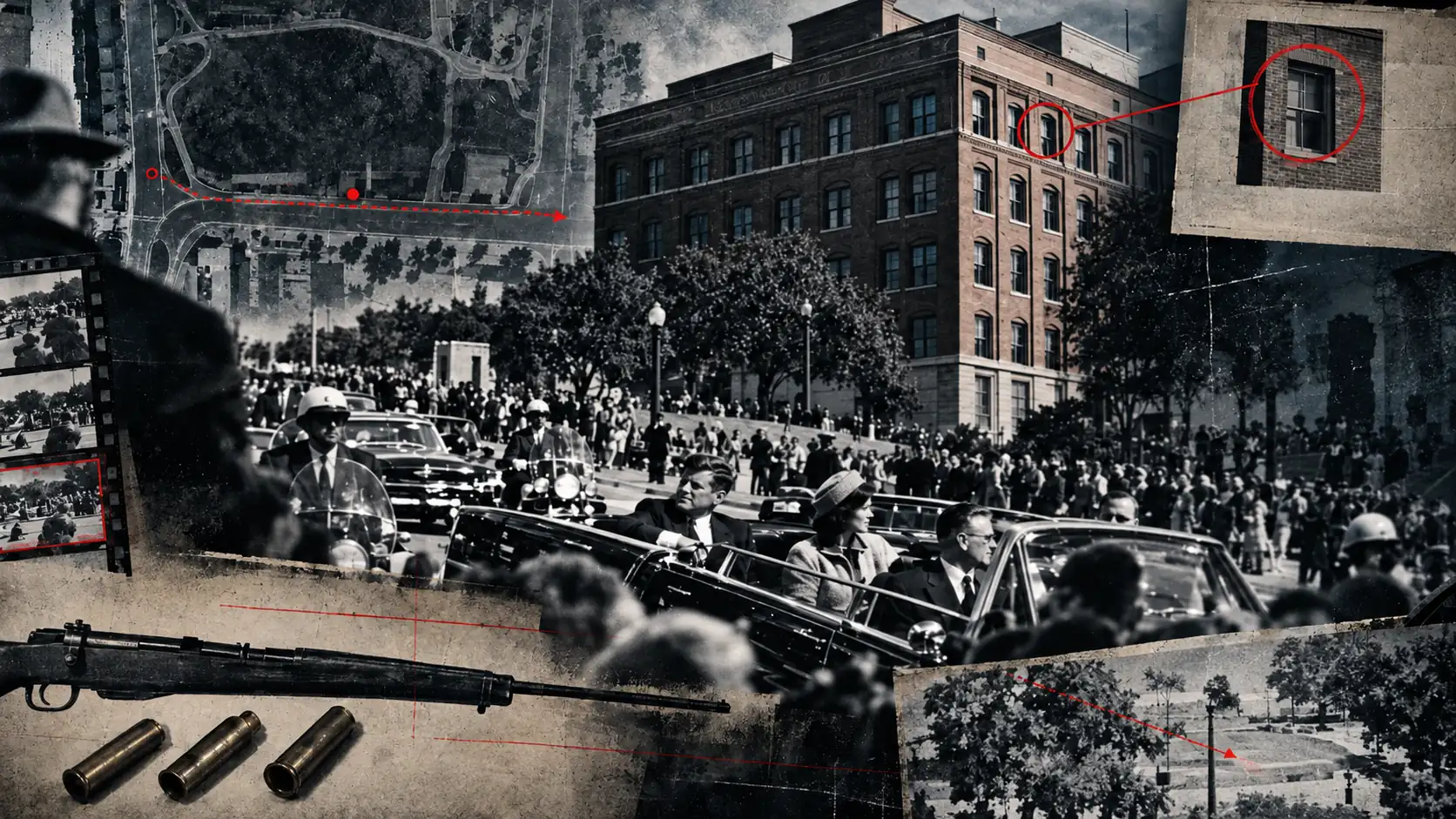
The physical evidence strongly supports shots from the Depository fired from Oswald's rifle, and the House committee agreed that Oswald fired three shots, the second and third hitting Kennedy. [10] What remains disputed is whether anyone else also fired, and several of the Commission's supporting exhibits have been weakened by later science.
| Evidence | Official finding | Challenge or later findings | Status |
|---|---|---|---|
| Rifle, bag and prints | A 6.5 mm Carcano ordered under the Hidell alias in March 1963; Oswald's palm print on the barrel and on the bag; three cartridge cases at the window, which the FBI examiners matched to the rifle. [3] [4] | Two witnesses put the package Oswald carried at about two feet and 28 inches; the Commission found them mistaken. Critics question the handling of exhibits; we found no primary-source resolution beyond the Commission's account. [4] | Verified that the rifle was Oswald's; its sole use is not proved |
| Single-bullet theory | One bullet passed through Kennedy's neck and caused Connally's wounds, "very persuasive" but "not necessary to any essential findings". [1] | The House forensic pathology panel found the medical evidence consistent with it (one member dissenting); its photographic panel put Connally's reaction at frames 222 to 226 and found the alignment consistent. [11] Cyril Wecht, the dissenting panel member, wrote that the angles at which the two men were hit do not permit a straight-line path for the bullet. [44] A computer reconstruction by Dale Myers concluded one bullet struck both men. [35] | Contested |
| Bullet-lead analysis | Neutron activation analysis was cited in 1979 as showing the recovered fragments came from only two bullets, as the later critiques describe it. [33] [34] | A 2006 peer-reviewed paper found no forensic basis for saying only two bullets were fired; a 2007 statistical paper argued the basis for excluding a second assassin was flawed. [33] [34] | Weakened |
| Autopsy | Both shots hit from behind. [3] [10] | The House report notes that neither the 1968 Clark Panel nor the Rockefeller Commission tried to authenticate the X-rays and photographs; the House panel placed the skull entry near the cowlick and found no medical evidence of a shot from the front. [10] Kennedy's brain, microscopic tissue slides, tissue sections and bone fragments are unaccounted for; the House committee could not determine precisely what happened to them and wrote that circumstantial evidence indicates it is possible that Robert F. Kennedy either destroyed them or otherwise rendered them inaccessible. [17] | Contested; evidence lost |
| Zapruder film | Frames 210 to 225 for the neck wound; an 18.3 frames-per-second camera. [3] | The House committee tested frame 312 for the head shot and, after its synchronisation work, concluded frame 319 fit best. [11] Critics read the head's backward motion as a frontal shot; defenders attribute it to a nerve reaction and the physics of the wound. We did not resolve that dispute. | Contested |
| Acoustic recording | Not known to the Commission. | House committee: "high probability" of a knoll shot that missed. 1982 National Research Council panel: reliable acoustic data do not support a second gunman. [11] [13] | Weakened; disputed |
| Eyewitnesses | Witnesses saw a rifle in the sixth-floor window and heard three shots. [1] [3] | Some witnesses reported shots from the grassy knoll; accounts of the number and direction of shots differ. [3] | Contested |
The acoustic evidence in detail
In 1978 the House committee relied on a Dallas police radio recording to find a "high probability" that a second gunman fired from the grassy knoll and missed. [11] The original analyst's own estimate was only 50% for a knoll shot; a later analysis claimed a certainty of 95% or better. [11] In 1982 a National Research Council panel chaired by physicist Norman Ramsey concluded that "reliable acoustic data do not support a conclusion that there was a second gunman," and that the sounds attributed to gunfire were recorded about a minute after the shooting. [13] The panel's findings were published in Science in 1982. [14] A researcher, Donald Thomas, later argued in a 2001 paper that its statistics were wrong, and members of the panel replied in 2005; we know that exchange only from secondary summaries. The panel's conclusions, quoted above from its report, were unanimous. The recording was rejected by the 1982 panel, but the House committee's conspiracy finding was premised in part on it, so the dispute still matters.
What the evidence does not do. It does not prove Oswald acted alone, and it does not prove he did not. It places the rifle, the cases and the bag at the window. The case for anyone else is mostly circumstantial or disputed, which is why the argument moved from forensics to the intelligence record.
Oswald and the Intelligence Trail
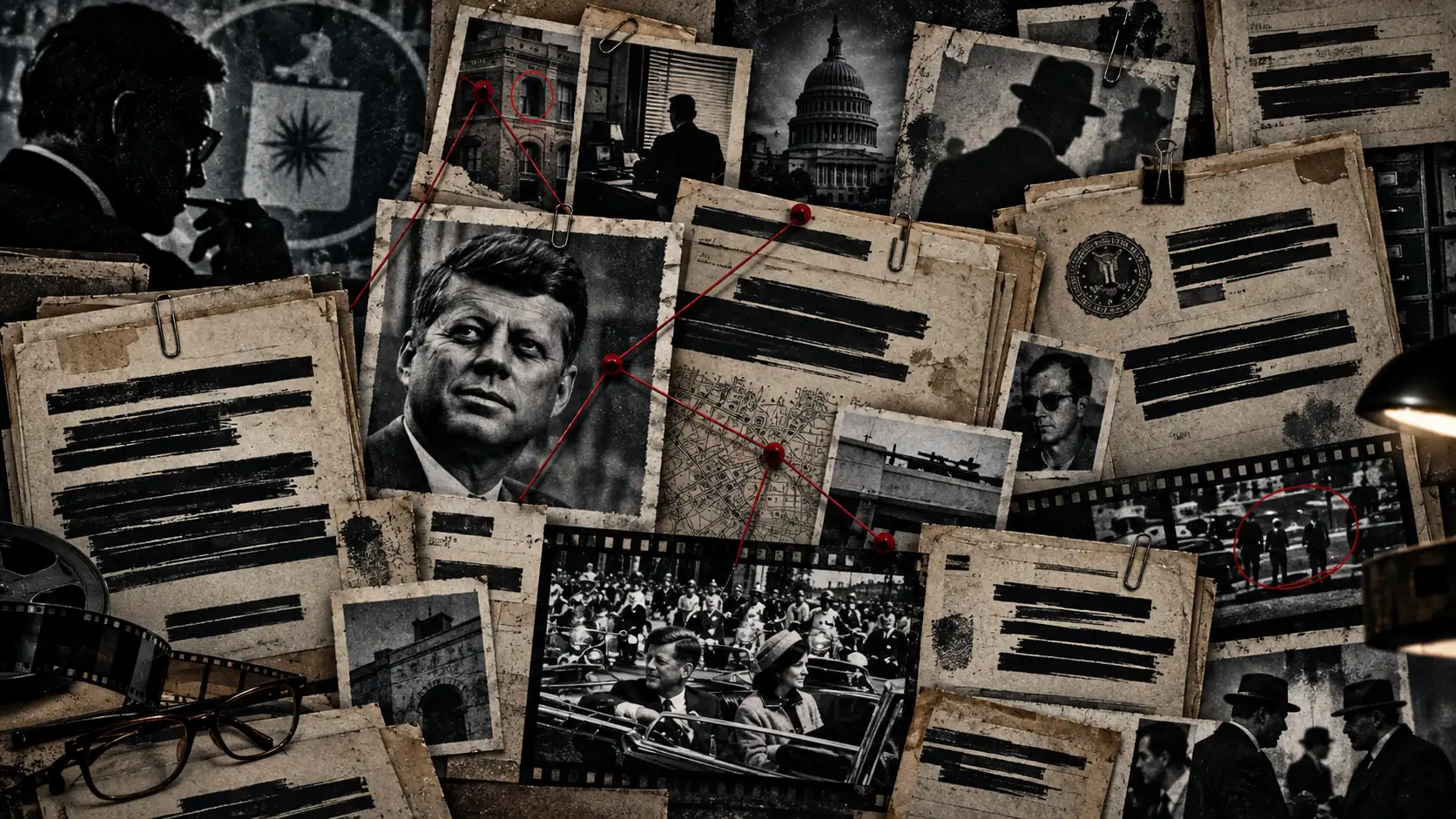
The strongest documented case that the official story was incomplete is not about bullets but about what the FBI and CIA knew about Oswald and when they said so.
| Thread | What is documented | What is disputed | Status |
|---|---|---|---|
| Defection and return | A Marine radar operator defected in 1959, returned in 1962 and was interviewed by the FBI. [7] [8] The House committee judged it "highly probable" that the Soviet government held information on Oswald it had not provided. [12] | Whether he was debriefed by the KGB or sent as an agent. The committee also found no evidence of any relationship between Oswald and the CIA. [12] | Verified facts; motive unresolved |
| The Hosty note | FBI agent James Hosty said he destroyed a note from Oswald on 24 November on the orders of the Dallas FBI chief, James Shanklin; Shanklin denied it, and the destruction became public in 1975. [12] | The note's content. The House committee called it "a serious impeachment" of both men's credibility. [12] | Verified destruction; content contested |
| Mexico City | Oswald visited the Cuban and Soviet embassies in late September 1963; the CIA photographed and tapped the missions. [6] [7] A staff history of the CIA's Mexico City station remains heavily redacted as of October 2026. [32] | Whether a visitor to the Cuban consulate was Oswald: the consul insisted not, a consular employee said yes; both described a "gaunt and blond-haired" man. [12] | Verified visit; impostor claim unproven |
| Joannides and the DRE | In August 1963 Oswald was in a street confrontation with members of the anti-Castro DRE group. [7] [12] In its 2016 opinion in Morley v. CIA the D.C. Circuit recorded that Morley had proffered, and the CIA had not disputed, that Joannides served as the CIA case officer for the DRE, with whose officers Oswald was in contact before the assassination. [47] Dan Hardway, a former House committee investigator, told a House task force in 2025 that the CIA assigned Joannides to handle liaison with him and a colleague from May 1978, had told the committee it had no officer working with the DRE in 1963, and did not tell him of Joannides's DRE role. [48] A 2009 New York Times report said the same, and Blakey wrote in 2014 that the CIA had told the committee it had no employee in contact with the DRE in 1963. [42] [52] In July 2025 the CIA declassified 62 pages of his personnel file. [26] [27] | Whether Joannides or the DRE had any operational contact with Oswald, and why the role was concealed. Rep. Luna's office claims the DRE had direct contact with Oswald but cites no document; Morley, who sought the file, says it does not answer these questions; and the court found the documents released to him "appear to reveal little, if anything, about President Kennedy's assassination". [26] [27] [47] | Verified file; significance unresolved. The court's account and the 2009 report both come out of Morley's litigation; Hardway and Blakey are the independent first-hand witnesses |
| Nosenko | KGB defector Yuri Nosenko said the KGB never recruited Oswald; the House committee examined his account. [12] | The House committee called him an unreliable source and could not resolve whether he was a plant. [12] | Unresolved |
Why it matters
The Commission worked from what the agencies gave it. The Church Committee later reported that the CIA did not tell the Commission about its plots against Castro, and the House committee found the Commission's conspiracy investigation inadequate. [9] [15] [16] Withholding relevant information is established in these specific cases. Whether anything withheld shows foreknowledge of a plot is not.
A caution about headlines. Rep. Luna's office called the 2025 Joannides file a 62-year cover-up and said the DRE had direct contact with Oswald, without citing a document. [27] Jefferson Morley, a researcher who has pursued the file in court since 2003, describes a memo about a false licence in January 1963 and reads another as saying Joannides was honoured for stonewalling investigators about his agents' contacts with Oswald; that is Morley's reading, and he says the file does not answer what Joannides did with Oswald. [26] We treat the 2025 file as showing a senior officer with a concealed role, not an operational link to Oswald.
The Later Investigations
Four official reviews followed the Warren Commission. Each moved the debate: the Church Committee exposed what the agencies withheld, the House committee found a probable conspiracy, a scientific panel rebutted its key evidence, and the Review Board forced out millions of pages.
| Year | Body | What it did | Key finding |
|---|---|---|---|
| 1975-76 | Church Committee | Investigated how the CIA and FBI handled the case for the Warren Commission | The CIA's Castro plots were not given to the Commission except through Dulles; the intelligence agencies' investigation was deficient. [15] [16] |
| 1976-79 | House Select Committee on Assassinations | Re-investigated the Kennedy and King killings | Oswald fired three shots, two hit Kennedy; a high probability of a second gunman, from acoustics; Kennedy probably killed as a result of a conspiracy; other gunman and extent unidentified. [9] [10] [11] [12] |
| 1982 | National Research Council | Reviewed the recording the House committee used | Reliable acoustic data do not support a conclusion that there was a second gunman. [13] |
| 1994-98 | Assassination Records Review Board | Collected and released withheld records under the 1992 Act | Released records; its report "does not offer conclusions" about what the records prove. [18] |
What the House committee did and did not say
The 1979 report is often misquoted both ways. It found that Oswald fired the shots that hit Kennedy. It found that the Soviet and Cuban governments, the Secret Service, the FBI and the CIA were not involved in the assassination. It said anti-Castro Cuban groups and the national organised-crime syndicate were not involved "as groups" but could not preclude that individual members were. [9] [12] It said the Warren Commission's conclusions were reached in good faith but presented too definitively, and that its conspiracy investigation was inadequate. [9] And it said it could not identify the other gunman or the extent of the conspiracy. [9] [12]
What fell away. Once the acoustic finding was rebutted, the strongest scientific basis for a second shooter was gone, and the committee's conspiracy conclusion lost its main physical support; the House report itself said only the acoustic analysis supported a second shooter. [11] [13] Defenders argue other circumstantial evidence still pointed beyond Oswald, and that the 1982 rebuttal has itself been challenged by Donald Thomas (2001), a challenge we know only from secondary summaries.
The Theories, and What the Evidence Says About Each
No theory beyond Oswald's own guilt has direct evidence behind it, but several rest on documented motives and documented concealment. "Not involved as a group" is the House committee's wording, not ours.
| Theory | Core claim | What supports it | What counts against it | Status |
|---|---|---|---|---|
| Lone gunman | Oswald fired all shots and acted alone | Rifle, cases, bag, palm print, window, flight, the Tippit killing, his lies. [1] [4] | The House committee found the conspiracy investigation inadequate; agency material was withheld; Oswald never faced trial. [9] | Best supported on who fired; "alone" unproven |
| Organised crime | Mafia leaders angered by Robert Kennedy's prosecutions had Kennedy killed | Ruby's underworld associations; the CIA-Mafia Castro plots. [12] [15] | The House committee found the syndicate not involved as a group but could not preclude individual members. [12] | Plausible, unproven |
| Anti-Castro exiles or CIA individuals | Exiles, with or without CIA officers, killed Kennedy over Cuba | Bay of Pigs bitterness; the DRE's clash with Oswald; CIA concealment of its Cuba operations and of Joannides's role. [12] [15] [42] | The committee found exile groups "as groups" and the CIA as an agency not involved, and could not preclude individual members of the exile groups; we found no document linking a CIA officer to a plot. [12] | Unresolved |
| Castro retaliation | Cuba ordered the killing after the CIA plots | Plots against Castro; Oswald's embassy visit; the AMLASH meeting on the day of the shooting. [15] | The House committee found no Cuban government involvement. [12] | Largely rejected |
| Soviet / KGB | Moscow used Oswald | Defection and return; Mexico City contact with a Soviet consular staff. [7] [12] | The committee found no Soviet government involvement, while judging it highly probable the Soviets held more on Oswald than they gave. [12] | Largely rejected |
| Johnson, Vietnam or the military | Kennedy was removed over policy | NSAM 263; the Diem coup three weeks earlier. [40] | We found no evidence implicating Johnson or the military; the withdrawal plan was conditional and historians disagree. [40] [50] | Motive only |
| Oswald impostor | Someone else used Oswald's name in Mexico City | The consul's insistence; the gaunt blond description; a disputed intercept. [12] | Another consular employee identified Oswald. [12] | Unproven |
How to weigh them. Three questions separate strong from weak theories. Is there a motive that fits what the person or group wanted in 1963? Is there any document or witness placing a named participant with Oswald in a plan? Was information about them withheld from the 1964 investigation? The Mafia, exile and CIA-individual theories score on the first and third, but none has the second (Ruby's underworld associations are associations, not a documented plan), which is why the House committee could call a conspiracy "probable" yet could not name a single other participant. [9] [12]
Claims we found no support for. We found no primary record supporting several popular claims: that the limousine driver shot Kennedy, that the Secret Service stood down, or that Oswald was an FBI informant (the Commission found no evidence of the last, and the House committee found no relationship between Oswald and the CIA [1] [12]). A long list of "mysterious deaths" of witnesses mixes deaths with no connection to the case. Judge each claim by its source, not by how often it is repeated.
Garrison, Clay Shaw and the New Orleans Case
New Orleans District Attorney Jim Garrison charged businessman Clay Shaw with conspiring to kill Kennedy and lost: the case went to the jury on the evening of 28 February 1969 and Shaw was acquitted in the early hours of 1 March. [39] It is the best-known failure of the conspiracy case.
What Garrison alleged. In early 1967 he charged Shaw, on 1 March 1967, with masterminding a plot that ended in Kennedy's death, and said Shaw used the alias "Clay Bertrand". [45] [46] Ferrie died on 22 February 1967; the coroner's autopsy protocol records a ruptured berry aneurysm and classifies the death as natural. [38]
What the trial showed. Dean Andrews, the lawyer who told the Warren Commission that a man named "Clay Bertrand" asked him to represent Oswald, testified on 25 February 1969 that "Clay Bertrand is a figment of my imagination"; his account shifted within the same testimony, and his statements show only what he said at trial. [46] The transcripts of the trial are held by the Assassination Archives and Research Center. [39]
What was real in the New Orleans story.
- Oswald spent summer 1963 in New Orleans handing out pro-Castro leaflets. [7]
- Guy Banister's detective agency was in the building at 544 Camp Street, an address on some of Oswald's leaflets; the House committee said there was at least a possibility they were acquainted, and that Banister's files were destroyed. [12]
- The House committee said Ferrie "might have once been Oswald's superior officer" in a Civil Air Patrol unit but called the association "largely a mystery". [12]
- A CIA historical study records that Shaw volunteered a first report to the agency's Domestic Contact Service in 1948 and relayed information on 33 occasions over the next eight years, unpaid; the relationship lapsed after 1956 and was never developed into a covert role. That shows a CIA relationship, not a role in any plot. [45]
- The House committee found certain Louisiana witnesses credible and significant, but made no ruling on Garrison's case. [12]
Oliver Stone's 1991 film JFK dramatised Garrison's version of the case. Shaw's acquittal and the later House committee findings on New Orleans are set out above.
The Records: 1992 to 2026
The National Archives holds the JFK Assassination Records Collection, which it describes as "over six million pages" of records, photographs, motion pictures, sound recordings and artefacts, "the vast majority" of it declassified. [19] The fight since 1992 has been over the remainder and over what agencies kept back before 1992. Counts below are as the Archives states them; documents (2017-18) and pages (2025-26) are different units and cannot be added together.
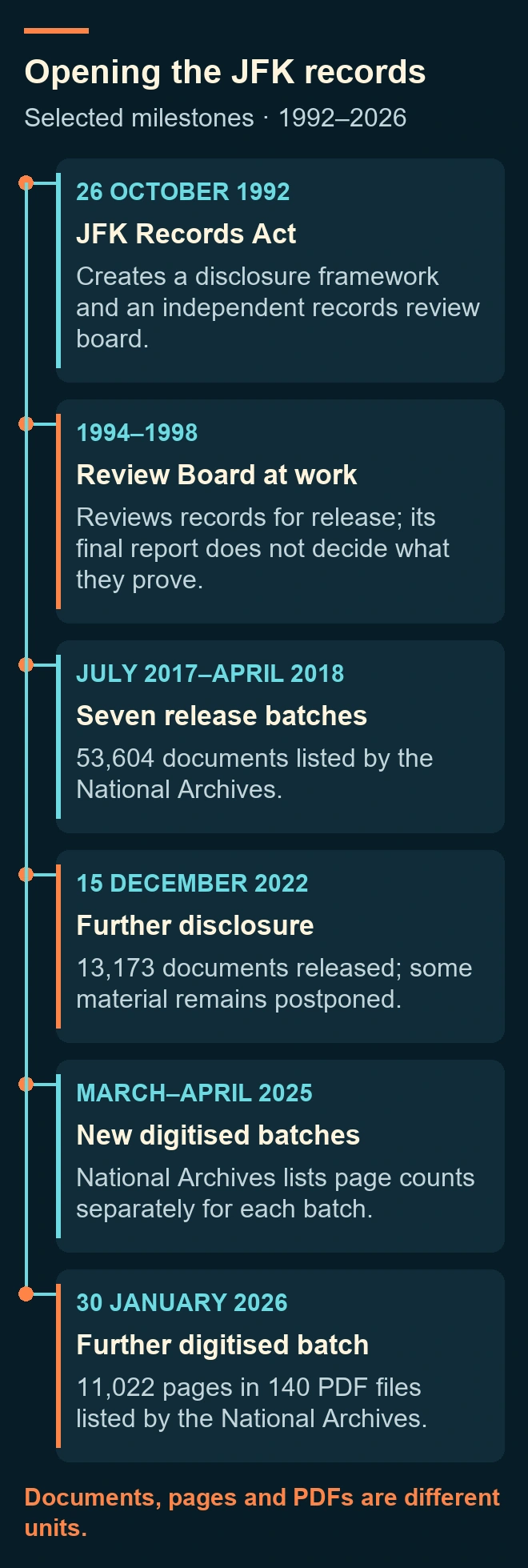
1992: the JFK Records Act. President George H. W. Bush signed it on 26 October 1992. It created the Review Board, which worked from 1994 to 1998, and required release of all records by 2017 unless the President certified harm to national security. [18] [20] The Board said its report "does not offer conclusions about what the assassination records released did or did not prove." [18]
2017 and 2018. The Archives lists seven releases between 24 July 2017 and 26 April 2018, totalling 53,604 documents; it notes some counts share a PDF. [21] The Archives states that the vast majority of the collection, about 88%, had been open in full since the late 1990s. [21]
December 2022. The Archives released 13,173 documents and reported 515 withheld in full, 2,545 withheld in part and fewer than 4,400 postponements, with "over 97%" of the collection available. A presidential memorandum let agencies continue reviewing postponed records under a temporary certification, and agency "transparency plans" were posted online. [22]
2025: the executive order. On 23 January 2025 President Trump signed Executive Order 14176 directing release of the remaining records on the Kennedy, Robert Kennedy and Martin Luther King Jr. assassinations. [24] Under a 17 March 2025 directive, the Archives posted files in batches: 31,419 pages and 37,127 pages on 18 March, 14,318 on 20 March, 53 on 26 March and 704 on 3 April 2025, and a further 11,022 pages (140 PDF files) on 30 January 2026. [23] Reporting on the first batches quoted historians who did not expect the files to overturn the established picture. [41]
2025: the Joannides file. In July 2025, at the request of a House declassification task force, the CIA released 62 previously redacted pages from Joannides's personnel file. [26] [27] See the Intelligence Trail section for what the file does and does not show.
2026: the "40 boxes" dispute. On 13 May 2026 a CIA officer, James Erdman III, testified before the Senate Homeland Security and Governmental Affairs Committee, under subpoena, that when the Director of National Intelligence's initiatives group ceased operations, "the CIA took back 40 boxes of JFK and MK-Ultra files" being processed for declassification. [28] [30] The Director of National Intelligence's press secretary said the claim that the CIA raided the office was "false". [29] No document or later report has confirmed or refuted that boxes were recalled; it is an allegation resting on one witness. [28] [29] On 30 June 2026 a House task force held a hearing on the CIA's MKUltra experiments, and its chair said the CIA was declassifying newly found MKUltra documents. [31]
October 2026. The National Security Archive reported on 1 October that a three-volume CIA history of its Mexico City station, released in redacted form in January 2026, still has major redactions and is subject of a pending request. [32] It is an advocacy group's account; we have not seen the document.
What the pattern shows. Reporting on the first 2025 batches quoted historians who did not expect them to overturn the established picture. [41] A few, like the Joannides file, add detail about a role that had been concealed. A decades-long fight over a small remainder, plus the 2026 allegation that more material exists, keeps suspicion alive regardless of what any single file says.
The Strongest Case on Each Side
Each case below is the strongest we could assemble from the sources we read, not from the whole literature; the Method section lists what was not read.
The strongest case that Oswald acted alone
The lone-gunman case rests on convergence: his rifle, bought under his alias; his palm prints on the barrel and the bag; three cases at the window; his departure from the building minutes after the shooting; the killing of a patrolman about forty-five minutes later with a revolver whose shells matched; and a record of lies. Two official bodies, with very different views on conspiracy, agree he fired. [1] [4] [10] Vincent Bugliosi's 2007 book, a long and prominent published defence of that conclusion, argues that the physical evidence ties Oswald, and no one else, to the crime and that no evidence links the CIA, the Mafia or other groups to it; we read its introduction, closing pages and notes on acoustics, the single bullet and the CIA. [51] The acoustic challenge to the official account was rejected by the 1982 panel [13] [14], and the bullet-lead challenge shows that an inference of only two bullets is unsupported, not that a second weapon was used [33] [34]. A computer reconstruction by Dale Myers, aired by ABC News in 2003, concluded that a single bullet struck both men. [35]
The strongest case that others were involved
The conspiracy case does not depend on a second shooter. It rests on documented concealment, a Commission that was not told of the CIA's Castro plots, a House committee that found a probable conspiracy, an accused killed before trial, and Oswald's real but unexplained intelligence-adjacent history. [9] [12] [15] Its most weighty recent move is from inside the House committee: its former chief counsel, G. Robert Blakey, wrote in 2014 that the CIA hid its work with the DRE from every investigation, that Joannides "lied directly to me", and that he could "no longer say with confidence, as the HSCA Final Report did, that Oswald had no significant relationship with DRE." [52] Cyril Wecht, the House pathology panel's dissenter, wrote that the single-bullet theory "is unequivocally repudiated" by the medical and physical data. [44] John Newman has argued that an impostor posed as Oswald in Mexico City and that the impersonation is best explained by a plot, citing post-assassination playbacks of tapes and two differing accounts from the CIA officer David Phillips. [53] That is Newman's own inference. The strongest weakness of the case is that none of this is a document or witness placing a named person with Oswald in a plan, which is why even the House committee could not name anyone.
Where the strongest challenges to each side land
- To the lone-gunman case: the length of the package, the single-bullet path and the lost autopsy material are real weaknesses, but none of them identifies another shooter.
- To the conspiracy case: the acoustic evidence the House committee relied on was rebutted, bullet-lead testing no longer supports "only two bullets" but does not show a second weapon, and the intelligence documents show concealment without showing foreknowledge. [13] [33] [34]
The honest summary is a wide gap between what has been shown and what has been suspected, with the records still being released.
Quick Answers
Who killed President Kennedy?
Both major official investigations found that Lee Harvey Oswald fired the shots that hit him. They disagree on whether he acted alone: the Warren Commission found no evidence of conspiracy; the House committee found a probable one but could not name anyone else. [1] [9]
How many shots were fired?
The Commission concluded three. The House committee also found three from Oswald's position, plus a fourth that missed from the grassy knoll on the strength of acoustics later rebutted. [1] [10] [11] [13]
What is the single-bullet theory?
The theory holds that one bullet passed through Kennedy's neck and wounded Governor Connally. The Commission called the evidence "very persuasive" but "not necessary to any essential findings"; the House forensic panel found it consistent with the wounds. [1] [11] Critics, including the House panel's dissenting member, dispute the geometry. [44]
What did the House Select Committee conclude?
In 1979 it found Oswald fired three shots and that Kennedy was probably killed as a result of a conspiracy. It cleared the Soviet and Cuban governments and the CIA, FBI and Secret Service, and found exile groups and the organised-crime syndicate not involved "as groups". [9] [12]
Was Oswald working for the CIA or FBI?
No document establishes it, and the Commission and the House committee found no evidence of it. Both agencies had files on him. How much each knew and what they concealed afterwards is the live question. [1] [12]
Who was George Joannides?
A senior CIA officer in Miami who oversaw the DRE group in 1963. In 1978 he was the CIA's liaison to the House committee, which was not told of that role. In July 2025 the CIA released 62 pages of his personnel file. [26] [27] [42] [47]
Did the CIA kill Kennedy?
No evidence shows that. The House committee found the CIA was not involved as an agency. What is documented is that the CIA withheld information from investigators in specific cases. [12] [15]
Are all the JFK files released?
The Archives describes the vast majority as declassified, with more than six million pages in the collection. A small remainder and the 2026 "40 boxes" allegation remain in dispute. [19] [28] [29]
Why do most Americans think there was a conspiracy?
Gallup's October 2023 poll found 65% said others were involved, against 29% who said Oswald acted alone; belief was 52% days after the shooting and between 74% and 81% across six readings from the mid-1970s to the early 2000s. Among those who suspect a conspiracy, 20% named the federal government and 16% the CIA, while 39% named no one. [25] Belief in a conspiracy is a statement about trust in institutions at least as much as about evidence.
Method and Limits
This file is dated 12 October 2026, the cutoff for evidence. Consequential claims are tied to the primary document where we could read it: the Warren Report chapters, the House committee's report, the National Archives pages and the Gallup report were opened for the passages relied on. Long pages were read in sections, so check any quotation against the linked page before relying on it.
Reading limits. Church Committee Book V was read in a text transcription that contains scanning errors, and only its summary and findings (pages 6 to 8) and its section on the Warren Commission's knowledge of the Castro plots were read closely; check quotations against the printed report. The autopsy discussion rests on the House committee's 1979 medical panel and chain-of-custody volume; the Review Board's medical depositions and its work on authenticating the photographs were not read. The CIA's Mexico City surveillance is covered through the Warren Report, the House committee's report and the National Security Archive's 2026 briefing; the House staff's Lopez Report and the Tippit-scene literature beyond the Warren Report were not read. Several 2025 and 2026 items depend on a single outlet or on one witness's testimony and are labelled in the text; the Erdman hearing page and prepared testimony could not be opened. Dan Hardway's account is a participant's testimony, not a neutral record. Two secondary sources support narrow points only: Dale Myers's own site, an advocate for the single-bullet finding, which is the only source here for the 2003 ABC broadcast and his reconstruction, and a Belfer Center summary page.
Literature. Bugliosi's Reclaiming History was read in part, as noted above; Wecht's dissent, Blakey's 2014 essay and Newman's 1999 article were read in full. The books by Gerald Posner, Mark Lane, Edward Jay Epstein, John Newman (1995), Blakey and Billings (1981) and Jefferson Morley (2008) could not be read because the available copies are borrow-only. Lane's and Epstein's arguments are cited only through a 1966 review that is hostile to both, and Epstein's account of the Commissioners' private views is a contemporary secondary report. The findings in this file rest on the official record, not on any of these books. [36]
How labels were set. Verified means a primary record or the reporting body's own report establishes it. Contested means credible sources conflict or later review has challenged the evidence. Unresolved means the record does not decide it. Well-known background events, such as the Missile Crisis and the Diem coup, are stated without individual citation and carry no weight in any finding.
What would change the conclusion. A document or witness placing a named person with Oswald in a plan would move the conspiracy question. An authoritative reading of the recorded acoustics, or the contents of the Mexico City station history or the boxes alleged to have been recalled, would move the second-gunman and concealment questions.
Evidence Ledger
What the record supports
Warren Commission narrative (Sources 1-2).
The Commission's firearms findings (Sources 1, 4); the House committee found Oswald fired three shots (Source 10).
House Select Committee finding (Source 10); the Commission also found three shots (Source 1).
Book V of the committee's report, which adds that, except for Dulles, it is unlikely anyone on the Commission knew; the plots report documents the plots and says Dulles's awareness of the early phase is disputed (Sources 15-16).
House committee account; the Dallas FBI chief denied ordering it (Source 12). The note's content is not established.
D.C. Circuit opinion (Source 47), Hardway's 2025 statement (Source 48) and a 2009 New York Times report (Source 42). None says why the role was not disclosed; Hardway is a participant, and the court recorded Morley's proffer as undisputed rather than finding the fact itself.
House committee chain-of-custody volume: the committee could not determine precisely what happened; circumstantial evidence indicates it is possible Robert F. Kennedy either destroyed them or rendered them inaccessible (Source 17).
Commission: very persuasive, not essential; House pathology panel: consistent; critics dispute the path and the bullet's condition (Sources 1, 11, 35).
House committee: high probability, from acoustics; National Research Council 1982: reliable acoustic data do not support it; later disputes on both sides (Sources 11, 13, 14).
Commission: no evidence of conspiracy, hedged; House committee: probably a conspiracy, no one identified (Sources 1, 9, 12).
Consul Azcue insisted he was not; a consular employee said he was; the consular evidence conflicts (Source 12).
House committee could not preclude individual members; found no group involvement (Source 12).
The 2025 file shows a concealed role and an alias; it does not show contact with Oswald (Sources 26-27).
One witness's testimony and a denial of a 'raid'; no document confirms or refutes the recall (Sources 28-29).
A three-volume station history remains heavily redacted (Source 32).
No document or witness places another named person in a plan; official findings conflict (Sources 1, 9, 12, 18).
Final Assessment
The strongest defensible answer is in three parts. First, Oswald fired the shots that hit Kennedy: two official bodies with opposite views on conspiracy agree, and the physical chain, while imperfect, is consistent. Second, whether anyone else was involved is not established either way. The Commission's finding of no evidence was hedged and made with an incomplete record; the House committee's finding of a probable conspiracy was premised in part on acoustic evidence that has since been rebutted. Third, the documented concealment is real but its meaning is not: the CIA withheld its Castro plots and its officer's role, an FBI agent destroyed Oswald's note, and parts of the CIA's record on Oswald's Mexico City visit are still redacted.
Our confidence is high that Oswald fired, moderate, on the official record, that no second shooter fired, and low on any claim that others planned or helped. The question that would be most useful to answer next is not who fired, but what the withheld Mexico City and Joannides material contains.
The evidence would change if a document or witness linked a named person to a plan, if the original acoustic recording were convincingly reanalysed, or if the 40 boxes' contents became public. Until then the honest position is the one the evidence supports: a verified shooter, an unproven conspiracy, a proven concealment and a record that is still, in part, closed.
Sources
References and further reading
- 011964Warren Commission Report, Chapter 1: Summary and Conclusions (National Archives)Original record / primary research
- 021964Warren Commission Report, Foreword and Introduction: creation and presentation of the Report (National Archives)Original record / primary research
- 031964Warren Commission Report, Chapter 3: The Shots from the Texas School Book Depository (National Archives)Original record / primary research
- 041964Warren Commission Report, Chapter 4: The Assassin (National Archives)Original record / primary research
- 051964Warren Commission Report, Chapter 5: Detention and Death of Oswald (National Archives)Original record / primary research
- 061964Warren Commission Report, Chapter 6: Investigation of Possible Conspiracy (National Archives)Original record / primary research
- 071964Warren Commission Report, Chapter 7: Lee Harvey Oswald, Background and Possible Motives (National Archives)Original record / primary research
- 081964Warren Commission Report, Appendix XIII: Biography of Lee Harvey Oswald (National Archives)Original record / primary research
- 091979House Select Committee on Assassinations, Summary of Findings and Recommendations (National Archives)Original record / primary research
- 101979House Select Committee on Assassinations, Final Report Part I.A: Findings on the President's assassination (National Archives)Original record / primary research
- 111979House Select Committee on Assassinations, Final Report Part I.B: Scientific acoustical evidence and Zapruder synchronisation (National Archives)Original record / primary research
- 121979House Select Committee on Assassinations, Final Report Part I.C: Conspiracy findings, Ruby, Mexico City, New Orleans (National Archives)Original record / primary research
- 131982National Research Council, Report of the Committee on Ballistic Acoustics (1982), full text PDF, Section VII Conclusions (read in full)Original record / primary research
- 141982Ramsey, Alvarez, Chernoff, Dicke, Elkind and others, Reexamination of acoustic evidence in the Kennedy assassination, Science (1982) (IBM Research listing; the Committee on Ballistic Acoustics' published paper)Peer-reviewed research / abstract page
- 151975Senate Select Committee (Church Committee), Alleged Assassination Plots Involving Foreign Leaders, S. Rept. 94-465 (1975)Original record / primary research
- 161976Senate Select Committee (Church Committee), Final Report Book V: The Investigation of the Assassination of President Kennedy (1976), S. Rept. 94-755 (text transcription on archive.org)Original record (transcription with scanning errors)
- 171979House Select Committee on Assassinations, Volume VII, Section III: Chain of custody of the materials acquired during the autopsy (read in full)Original record / primary research
- 181998Assassination Records Review Board, Final Report (1998) (read in part)Original record / primary research
- 192025National Archives, President John F. Kennedy Assassination Records Collection (page reviewed 19 March 2025)Original record / primary research
- 202025National Archives, JFK Assassination Records: background to the JFK Records ActOriginal record / primary research
- 212018National Archives, JFK Assassination Records: 2017-2018 releasesOriginal record / primary research
- 222022National Archives press release, 15 December 2022: NARA releases more JFK recordsOriginal record / primary research
- 232026National Archives, JFK Assassination Records: 2025 documents release (with 30 January 2026 batch)Original record / primary research
- 242025National Archives news article, 27 March 2025: JFK records release under Executive Order 14176Original record / primary research
- 252023Gallup, Decades later, Americans doubt a lone gunman killed JFK (13 November 2023)Polling / original survey report
- 262025JFK Facts (Jefferson Morley), New JFK file: a spy called Howard (14 July 2025)Specialist reporting (advocate source)
- 272025Rep. Anna Paulina Luna, Declassification task force secures George Joannides CIA file (July 2025)Official press statement (partisan characterisation)
- 282026Washington Examiner, Luna whistleblower: CIA JFK and MKUltra files (13-14 May 2026)News reporting
- 292026Washington Examiner, ODNI denies claims the CIA raided the DNI's office (14 May 2026)News reporting
- 302026JFK Facts, CIA officer says agency defies Trump's JFK order (14 May 2026)Specialist reporting (advocate source)
- 312026Washington Examiner, CIA declassifying newly found MKUltra documents, Luna says (30 June 2026)News reporting
- 322026National Security Archive, The CIA Station in Mexico: The Last JFK Assassination Records Secrets (1 October 2026)Research institute briefing (advocate source)
- 332006Randich and Grant, Proper assessment of the JFK assassination bullet lead evidence, Journal of Forensic Sciences 51(4) (2006) (OJP abstract)Peer-reviewed research / abstract page
- 342007Spiegelman, Tobin, James, Sheather, Wexler and Roundhill, Chemical and forensic analysis of JFK assassination bullet lots: Is a second shooter possible? Annals of Applied Statistics 1(2) (2007) (arXiv 0712.2150)Peer-reviewed research / preprint listing
- 352003Dale Myers, Secrets of a Homicide: JFK Assassination, FAQ on the computer reconstruction (aired by ABC News, 20 November 2003)Researcher's own site (advocate for the single-bullet finding)
- 361966Alexander Bickel, The Failure of the Warren Report, Commentary, October 1966 (relays Edward Jay Epstein's Inquest interviews with Commissioners)Secondary / contemporary commentary
- 372026Handbook of Texas Online, Jack RubyReference work
- 381967Orleans Parish Coroner's autopsy protocol for David Ferrie, No. W67-2-255 (transcribed on jfk-assassination.net)Original record, transcribed by a researcher site
- 391969Assassination Archives and Research Center, Clay Shaw trial transcripts, February-March 1969 (index and summary)Trial record index with summary
- 401963Foreign Relations of the United States 1961-1963, vol. IV, document 194: National Security Action Memorandum 263 (11 October 1963) (State Department Office of the Historian)Original record / primary research
- 412025Al Jazeera, New JFK files: what was revealed about Oswald and CIA operations (20 March 2025)News reporting
- 422009The New York Times, C.I.A. Is Still Cagey About Oswald Mystery (16-17 October 2009; reprinted by History News Network)News reporting
- 431964John B. Connally's Warren Commission testimony (excerpt on jfk-assassination.net)Testimony transcript, transcribed by a researcher site
- 441979Cyril H. Wecht, dissenting view, addendum to the forensic pathology panel report, HSCA Volume VIIOriginal record / primary research
- 452001Max Holland, The Lie That Linked CIA to the Kennedy Assassination, Studies in Intelligence 45(5) (2001) (CIA Center for the Study of Intelligence)Agency-published historical study (read in full)
- 461969Clay Shaw trial, testimony of Dean Andrews, 25 February 1969, transcript excerpt (transcript certified 3 March 1969)Transcript excerpt, transcribed by a researcher site
- 472016Morley v. CIA, 810 F.3d 841 (D.C. Cir. 2016), No. 14-5230, opinion of 21 January 2016Court opinion
- 482025Dan Hardway, submitted statement to the House Task Force on the Declassification of Federal Secrets, 20 May 2025 (former House Select Committee staff investigator)Congressional testimony (participant's account)
- 491963Foreign Relations of the United States 1961-1963, vol. IV, document 331: National Security Action Memorandum 273 (26 November 1963)Original record / primary research
- 502023Belfer Center, Fredrik Logevall and Martin Di Caro, History, It Happens: What if Kennedy and Vietnam (15 September 2023; summary page)Historian's essay (summary page only)
- 512007Vincent Bugliosi, Reclaiming History: The Assassination of President John F. Kennedy (2007) (read in part: introduction, closing pages and notes on acoustics, the single bullet and the CIA)Book (read in part)
- 522014G. Robert Blakey, essay on the HSCA and the CIA (2014), Assassination Archives and Research CenterEssay by the House committee's former chief counsel
- 531999John M. Newman, Oswald, the CIA and Mexico City, Probe 6(6) (September-October 1999)Researcher's article (advocate for the impostor thesis)
Continue the Chain
The agencies, the records and the open questions.