UK UFO Files: What Britain’s Own Records Really Show
For almost sixty years the Ministry of Defence logged, studied and then shut down its UFO work. The files are largely open, the three official assessments we read agree, and no record we could read supports alien contact. What stays open is smaller than the legend and harder to dismiss than the debunkers claim.
Opening Brief
On 11 November 2009 an official in the Ministry of Defence (MoD) told the defence minister that in "more than 50 years" no UFO sighting reported to the department had "ever revealed anything to suggest an extra-terrestrial presence or military threat to the UK". [1] [2] The MoD closed its UFO hotline and email address the following month, ending a programme that began with a secret working party in 1950. [1] [3] Between 2008 and 2013 the files were opened: about 209 files and 52,000 pages, according to the researcher who advised on the release. [4]
That is the official ending. The popular version runs the other way: that Britain holds "alien files" it cannot explain, that Churchill ordered a cover-up, that the real papers are sealed until the 2080s. This dossier tests both versions against the records themselves: the National Archives catalogue, the text of the MoD's secret Project Condign study, a peer-reviewed paper on the Berwyn Mountains night of 1974, the US Condon report on a 1956 radar case, Hansard, and the researchers who worked through the files.
Three things are new since the files were opened. In September 2025 ministers told the Commons, in written answers, that the department "has not conducted or commissioned any studies into Unidentified Anomalous Phenomena" and, as we read them, had not joined any international UAP grouping since May 2023 (the answers were read through a mirror; see Method). [5] [6] The National Archives catalogue now records that the MoD found complete originals of three "UFO policy" files of 1992 to 2003 that it had believed lost, transferred them in 2026, and, for at least two of them, destroyed the redacted copies they replaced. [7] [8] [9] And one researcher reports that the MoD released previously redacted passages of Condign in June 2026, which we could not confirm independently. [10]
At a glance
- What the official studies concluded (Verified as to what they say): Condign (2000) found "no evidence either of intelligent control of the objects" or "any hostility or threat", and the 2009 closure briefing said nothing in 50 years suggested extraterrestrial presence. A third, the 1951 working party, reached the same view; we read its conclusion as quoted by the National Archives, not the full report. [11] [1] [12]
- Are the files "sealed until the 2080s"? (The catalogue facts are Verified; the legend is misleading): the 2070s to 2090s dates attach to paper originals. Redacted digital copies of about 200 of them are public. For 201 of the 205 closed records the recorded ground is personal information about third parties. [13]
- Does any British case support non-human intelligence? (No record we could read says so): where the records are good, the cases are best explained by an earthquake and meteor display (Berwyn 1974), a rocket stage and probably a helicopter (Cosford 1993), in part a hoaxer (Broad Haven 1977) and Chinese lanterns (2008-09). [14] [15] [16] [1]
- What is still open (Contested or Unresolved): the 1956 Lakenheath-Bentwaters radar case, the 1957 West Freugh radar case, the Calvine photograph and Rendlesham, because the data are thin or the witnesses and the explanations disagree, not because any file says "alien". [17] [18]
- Concealment (documented in narrow forms): the 1951 report was kept to one circulated copy and was not in the department's hands by 2000; Condign was classified until 2006; the Calvine negatives are reported missing; original files remain closed. None of that shows what was hidden. [11] [18] [13]
What we read. The catalogue records, the National Archives' press release, highlights guide and research guide, Condign Volume 1 (Chapters 1, 4 and 5) and the Volume 3 summary, the Condon Case 2 text, the Musson paper and a transcription of the Halt memo. We did not read the full 1951 report, the contents of the DEFE 24 files themselves, the closed DI55 files or the official Hansard pages. Method and Limits sets this out.
The Question and Its Limits
Central question. What do Britain's own UFO records show, and does any British case, tested on its own evidence, support the claim that non-human intelligence is involved?
That is two questions, and the answers are graded separately. The first is documentary: what exists, what officials concluded, what is withheld. The second is evidential: whether the cases themselves, as distinct from the official verdicts on them, hold up. An official saying "no evidence" is not the same as the evidence being absent, and a case being unexplained is not the same as its being alien.
What this covers
- "UK" means all four nations. The cases include England (Rendlesham, Cosford, Todmorden), Wales (Berwyn, Broad Haven) and Scotland (Calvine). Northern Ireland has no case here because none of the records we read concerns it.
- "Alien files" is the popular label. The MoD's own terms were UFO and, from the 1990s, UAP (Unidentified Aerial Phenomena). The files are mostly sighting reports, letters, policy minutes and parliamentary briefing. [1]
- The cases were chosen by a rule, not a taste. We took cases the files themselves flag or treat at length, plus the most-cited public cases, and we included several that the records explain, so the sample is not only the residue.
- Jurisdiction matters. Lakenheath, Bentwaters and Woodbridge were RAF stations that hosted US Air Force units. Their records are partly American, and the MoD's own file shows it learned of Rendlesham from a US officer's memo in January 1981, after the events. [17] [19]
What this does not cover
This is not a history of UFOs worldwide, nor of the US programmes except where a British case depends on them; the site's Project Sign to AARO file covers those. It does not re-open Rendlesham, which has its own dossier; we summarise it here against the same template as the other cases. It does not treat crop circles, the Warminster "Thing" of the 1960s or the full literature of British abduction accounts, which would need their own files; Todmorden stands in as the test of an abduction claim. The evidence cutoff is 13 October 2026.
The supporting questions
- How did Britain come to run a UFO programme, and who ran it?
- What exists in the archive today, and what is closed or missing?
- What did the secret studies conclude, and how far can they be trusted?
- What do the best-documented British cases show when read against their own records?
- Which famous claims about cover-ups and elites have a document behind them?
- What is the government's position now?
Background: How Britain Came to Keep UFO Files
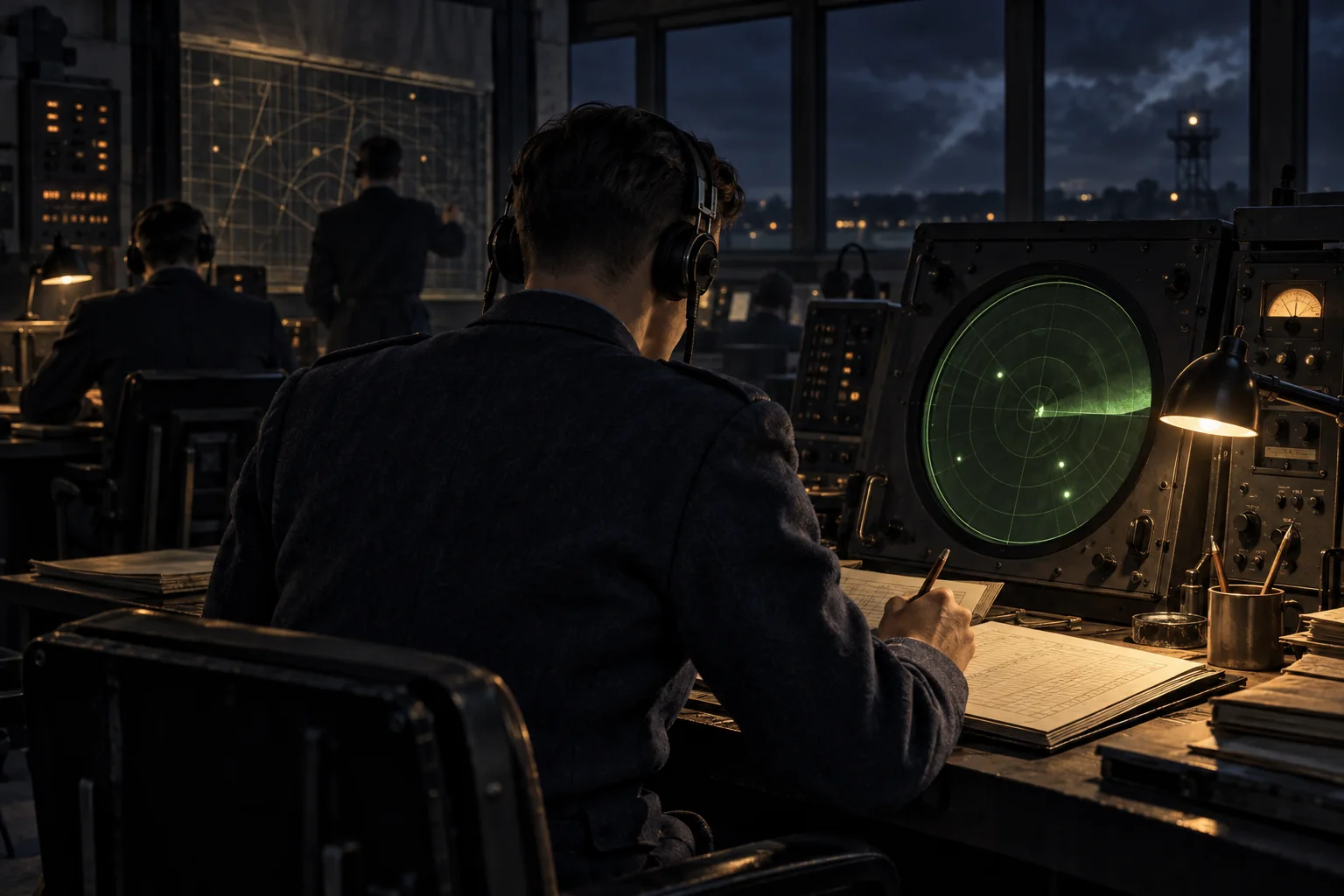
Britain's UFO programme began as intelligence work, not curiosity. The MoD's own later study said the department's interest had been, "from the outset", only an assurance that no such object was "a threat to UK airspace or assets". [11] The timeline below runs from the first working party to the 2026 file changes. Dates are those given in the records, and where records disagree the table says so.
| When | What happened |
|---|---|
| August to October 1950 | A working party on flying saucers is set up at the suggestion of Sir Henry Tizard, the MoD's chief scientific adviser. Condign dates its creation to August 1950; the researcher David Clarke gives August for the team and October for its first meeting. [11] [20] |
| June 1951 | The working party reports (DSI/JTIC Report No. 7, catalogued as DEFE 44/119). The committee that received it decided the report should have "as little publicity as possible", with outside circulation limited to one copy for Tizard, and dissolved the party. [21] [11] |
| 28 July 1952 | After the "Washington flap", Prime Minister Winston Churchill minutes the Air Ministry asking what flying saucers "amount to" and for a report. The answer, within about two weeks, cited the 1951 study. [22] [23] |
| September 1952 to December 1953 | RAF aircrew report a silver object at RAF Topcliffe during the NATO exercise Mainbrace; the Air Ministry then decides to monitor reports permanently, and a December 1953 order tells RAF stations to report to the Air Ministry and not to discuss sightings. The Churchill Centre separately mentions a September 1952 RAF order on press contact and says nothing shows Churchill knew of it. [12] [23] |
| December 1953 to May 1955 | Air Ministry orders send all RAF reports to its intelligence branch, marked "Restricted". In May 1955 the Air Minister tells MPs about 90 per cent are meteors, balloons and flares and the rest reflect "lack of data"; an internal 1955 summary says there is "no tangible evidence" of controlled manifestations from outer space. [12] |
| April 1957 | Radar plots at RAF West Freugh in Scotland reach the press and the Joint Intelligence Committee; the Air Ministry's own report cannot identify the objects (see Cases That Stay Open). [12] |
| 1958 | An Air Ministry minute, quoted in Condign, notes a campaign "to criticise government policy about the release of information on unidentified flying objects" and says "it is not possible to release official data which does not exist". [11] |
| 1967 to 2000 | Defence Intelligence's branch DI55 collects copies of UFO reports from the public-facing desk. [24] |
| November 1967 | The head of the Air Staff desk briefs the minister that statistics since 1959 show "no evidence to suggest [UFOs] have other than mundane explanations" and that a separate study would not justify the cost. [12] |
| 1978 | Peak year for reports before 2009: 750 logged. [1] |
| 18 January 1979 | The last full public statement of policy: in the Lords debate the government's spokesman says "there is nothing to suggest to Her Majesty's Government that such phenomena are alien spacecraft". [12] [25] |
| December 1980 | Rendlesham: the MoD receives the US deputy base commander's memo in January 1981, and takes no further action. [19] [26] |
| Early 1990s | Nick Pope, who died in April 2026, runs the UFO desk in the Air Staff Secretariat; in March 1993 he briefs on the Cosford night. [15] [27] |
| 1995 to 1996 | Reports jump from 117 to 609 in a year, which Clarke links to The X-Files and Independence Day. A policy review in 1996 leads to the Condign study. [28] [29] |
| 2000 | Condign is completed (December); the desk stops copying reports to DI55. [11] [3] |
| 15 May 2006 | The MoD publishes Condign, with passages withheld, after a Freedom of Information request. [29] |
| 2008 to 2013 | The National Archives opens the MoD's UFO files in ten tranches; the last, on 21 June 2013, is 25 files and 4,400 pages. [3] |
| Nov to Dec 2009 | Minister Bob Ainsworth approves ending the work; the hotline and email address close. [1] |
| 2017 to 2018 | Redacted copies of the last three DI55 "UFO policy" files reach the National Archives and the researcher. [7] [24] |
| 2026 | The MoD transfers complete originals of those policy files and destroys the redacted copies; the originals are closed. [7] [8] |
Who ran it. The public face was the UFO desk, staffed by civil servants of the Air Staff Secretariat, who took calls and letters. Technical advice came from DI55, the Defence Intelligence branch that assessed reports "for information of intelligence interest". In 2000 the Secretariat's role passed to the Directorate of Air Space, and from then reports were no longer copied to DI55. [3] By 2009 the work had fallen to one official, who faced 643 reports to the end of November and 97 Freedom of Information requests in the year. [1]
Why it matters. The programme's stated purpose never changed: to decide whether anything in British airspace was a threat. Whether it also looked at the question the public cared about is the thread through the rest of this file.
The Files: What Exists, What Is Closed
The phrase "the UFO files" covers three different things, and most confusion comes from mixing them: the open public copies, the closed original paper files, and material never transferred.
What was released
The National Archives' ten tranches (2008 to 2013) put the MoD's UFO papers online for the first time. The last tranche alone ran to 25 files and 4,400 pages covering late 2007 to November 2009. [3] Clarke's total, from June 2013, is 209 files and "approximately 52,000 pages", and he calls it "virtually all the surviving UFO files". [4] The files are mostly in the DEFE 24 series: sighting reports on the department's one-page form, letters from the public and MPs, press lines and internal policy minutes. [1]
What the catalogue shows today
We read the National Archives catalogue for series DEFE 24 with the keyword "UFO" on 13 October 2026. It returned 457 records. Of these, 200 are digital copies marked "with redactions", all open to the public. The other 205 are closed: paper originals, or extracts from them, with the description open and the document closed. [13]
- Recorded ground for closure. For 201 of the 205 records the catalogue gives one ground: "Personal information where the applicant is a 3rd party". One record, DEFE 24/1958 ("UFO policy", 1985 to 1995), adds an exemption for information supplied by security bodies or national security "in the alternative". Two small extracts cite "International Relations - prejudice". One record gives no ground in the public data. [13] [30]
- The dates. Opening dates for the closed originals run mostly from the 2070s to the 2090s. The file with the Rendlesham papers (DEFE 24/1948) opens in 2085; the one covering the Calvine period (DEFE 24/1940) in 2076; the closure briefing file (DEFE 24/2458) in 2095. In each case the redacted public copy is open now. [13] [26] [31] [2]
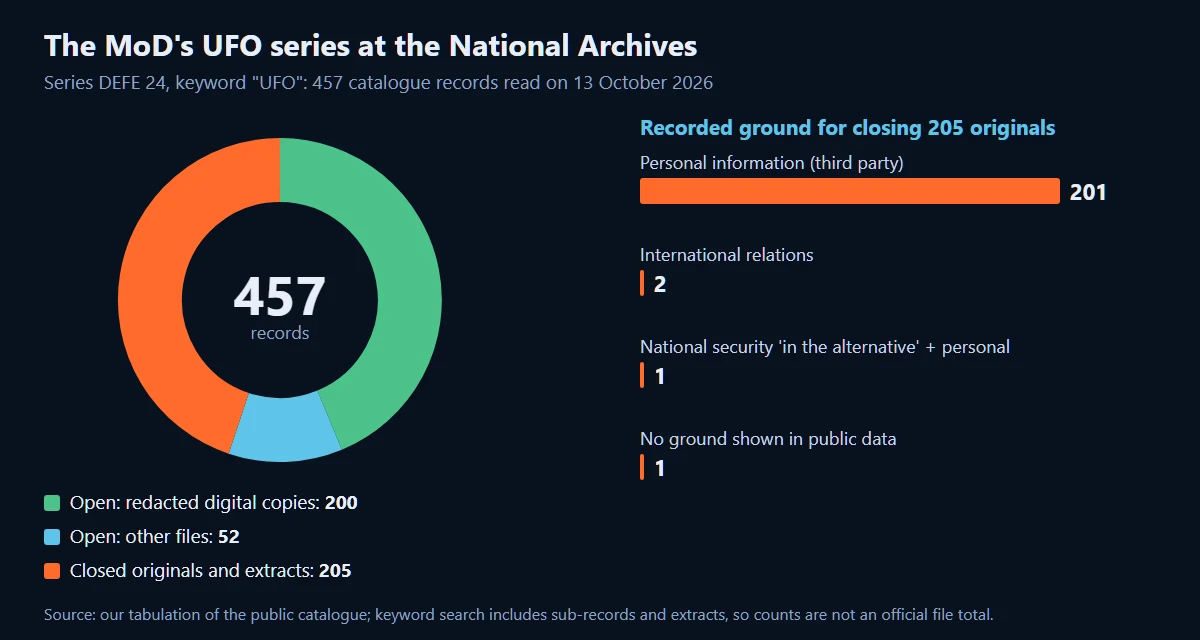
So "sealed until 2084" is accurate for a paper original and misleading as a description of what the public can read. What the closure means for the content is a different question: redaction can hide names, and it can hide other things, and the public copy does not show which. The catalogue's recorded reason is overwhelmingly privacy, which is a duty of the archive, not evidence of an alien secret.
2026: three policy files swapped
The most recent change is in the catalogue itself. For DEFE 24/3153 ("UFO policy", 1996 to 1999) the custodial history says a copy was transferred in 2017 when "the original file was believed not to survive"; the MoD "subsequently located the complete original file", transferred in 2026 "replacing the previous copy". The former redacted copy, DEFE 24/3153/1, "was destroyed by the Ministry of Defence". [7] [8] DEFE 24/3155 (1992 to 2003) has the same history, and DEFE 24/3154 (June to December 2000) a similar one. [9] [32]
What the record establishes is narrow. The originals are now at Kew and are closed, two of them until 2084 and 2088 on the personal-information ground. For those two files the redacted copies the public could read since 2019 are gone from the catalogue, and no replacement is listed. The catalogue does not say why the MoD replaced the copies, or whether a new redacted version will be published. The papers matter because, by Clarke's account, the three DI55 policy files he received in redacted form in 2018 hold the Condign minutes and a 1997 policy paper that discusses "Extraterrestrial Objects". He gives no file numbers, but the dates and DI55 file references fit these three; we have not read the papers, and a paper discussing a category is not evidence that the category is occupied. [24] [7] On the record we read, the public has less to read than before. The catalogue does say that the complete original replaced the copy; it does not say why no new redacted copy is listed. We did not ask the National Archives or the MoD, and did not check whether a replacement is planned.
What "released" leaves out
- Papers on one case are scattered. A 2008 Freedom of Information answer showed that documents on the Rendlesham sightings of 1980 were held in 109 separate files. [1]
- Parts of Condign remain redacted. The 2006 release withheld passages under FOIA sections 26 (defence), 27 (international relations) and 40 (personal information); in the text, the blacked-out runs are visible around radar performance and "related military applications". [29] [11]
- Some originals were lost, then found. Condign's original was reported missing in 2021 and said to have been "accidentally destroyed", then located in 2023, according to Clarke, the only source for that sequence. [33]
The Working Party and Churchill, 1950 to 1952
The 1951 working party report is the founding document of the British programme, and the clearest example of how secrecy and conclusion can be separated. We could not open a full transcription of the six-page report; what follows relies on the National Archives' own research guide, which quotes its conclusion from DEFE 44/119, on the department's later description in Condign, and on Clarke's account. [12] [11] [20]
Who and why. The National Archives guide says the party was set up in August 1950 under terms of reference "to review the available evidence in reports of 'Flying Saucers'" and to keep in touch with American evaluation. It was chaired by G. L. Turney, head of scientific intelligence at the Admiralty, with intelligence officers from the three services, and it questioned a group of test pilots from Farnborough who had reported sightings. [12]
What it concluded. The report, classified Secret/Discreet and delivered in June 1951, concluded that all the sightings could be explained as misidentified ordinary objects, optical illusions, psychological delusions or hoaxes. Its last sentence reads: "We accordingly recommend very strongly that no further investigation of reported mysterious aerial phenomena be undertaken, unless and until some material evidence becomes available." [12] The members relied heavily on USAF and CIA information, and a senior CIA scientist attended the meeting at which it was delivered. [12] Churchill's later reply, drawn from that study, listed the same four causes. [23]
What was done with it. Condign records the committee's minute: the report was "final", the working party should be dissolved, and, "following the lead given by the Americans", the report should have "as little publicity as possible" and one outside copy. By 2000 the department did "not possess a copy", and Condign's authors thought it "may exist within Sir H. Tizard's papers". [11] A surviving copy was found in MoD archives in 2001 and released the next year in DEFE 44/119; a copy with its covering letter to Tizard is in DEFE 19/9. [12] A report meant to be low-profile and later lost is not evidence of a hidden discovery. It does show how thin the department's own memory was, and the department had a policy that explains part of it: until 1967 UFO files were destroyed at five-year intervals as of "transitory interest", so many records from before 1962 are gone. The policy was rescinded under parliamentary pressure from 1970, and a note on a 1988 file orders that all UFO files be permanently preserved. [12]
Churchill's minute
On 28 July 1952, after sightings over Washington, Churchill wrote to the Air Minister and his scientific adviser Lord Cherwell: "What does all this stuff about flying saucers amount to? What can it mean? What is the truth? Let me have a report at your convenience." Condign prints the minute on its own preface page. [11] [22] The Air Minister replied on 9 August with the four causes and the 1951 study, and Cherwell on 14 August said he agreed. [23] Churchill is not known to have pursued it; the Churchill Centre says no further UFO documents have been found in the national or Churchill archives. [23]
The wartime legend
The cover-up story has a different origin. In 1999 a letter to the MoD claimed a grandfather, a Churchill bodyguard, overheard Churchill and Eisenhower agree in wartime to classify an RAF encounter with a "silver disc", to avoid panic. The letter sits in file DEFE 24/2008/1 and surfaced when the file was opened in 2010. [23] [34] [35] The MoD investigated and found no written record. The account is third-hand, gives no date in the sources we read beyond "wartime", and is uncorroborated; the Churchill Centre notes that neither the MoD nor the Cabinet Office found any record of such a meeting. [23] [35] The documented episode is the 1952 request for a report and the unremarkable reply. The legend has no document behind it.
Project Condign: The Secret Study
Project Condign is the one document in the British record that tried to answer the public's question with data. It was a study by DI55 of about ten years of reports, completed in December 2000 and released, with redactions, on 15 May 2006. [11] [29]
What it set out to do
The MoD's own description: during a 1996 policy review a study was begun "to determine the potential value, if any, of such reports to Defence Intelligence", looking first for "any evidence of a threat to the UK" and second for "any potential military technologies of interest". [29] Its Preface says the aim was "a rational scientific examination of the phenomena" with "neither the intention of de-bunking the extraterrestrial lobby or of taking the opposite view - except based on hard scientific evidence". [11]
What it found
- No hostility, no control, no foreign owner. "No evidence either of intelligent control of the objects, alleged 'inspections of UK strategic assets' or any hostility or threat has been found." The objects "do not belong to another nation", and there is "no evidence of extra-terrestrial activity apart from the very high probability, in some cases, of their connection with meteors". [11]
- At least 20 natural phenomena. Apart from misreported aircraft, satellites, balloons and birds, it lists "at least 20 naturally occurring visible phenomena" which even trained observers largely do not know. [11]
- A plasma hypothesis for the residue. The remaining events are "most likely due to highly charged plasma entities", linked to ball lightning and to meteors that do not burn up. The conditions for forming them "cannot be determined from the evidence available". [11]
- Abduction and contact stories set aside. They "do not impact on the findings", and its only comment is the possible effect of magnetic fields on the brain. [11]
- Key recommendation: DI55 should "no longer" monitor UAP reports because they "do not demonstrably provide information useful to Defence Intelligence". [11]
How far to trust it
Condign is evidence of what MoD analysts concluded, not an independent test of nature. Three limits are on the record. First, its data were witness forms: "this information source has many inadequacies", and the department did not pursue witnesses. [11] Second, the report itself says it "cannot offer certainty of explanation of all UAP phenomena". [11] Third, the plasma hypothesis is the authors' own; as a secret study it was not peer-reviewed, and Clarke, who obtained it and thinks UAP are natural, still calls the plasma claim unsupported. [24]
Whether the conclusion was reached before the study was finished is disputed. Clarke reads a minute of 16 April 1998 by the author as showing the recommendation to stop monitoring was set in advance, and calls it a "smoking gun". Nick Pope, who ran the desk in the early 1990s, told a reporter that "in places it looked like a conclusion-led study", and said the secrecy meant no outside experts were consulted. [24] [36] The minute and the report are both real; the inference about intent is Clarke's.
The 2023 and 2026 episodes
Clarke reports that in 2021 the MoD said the original report had been "accidentally destroyed", that in 2023 it located a complete unredacted copy, and that in June 2026 it released, to an anonymous requester, previously redacted text and images from Volume 2 after rejecting a request in February. By his account the newly open material was two speculative paragraphs on US black-project aircraft such as "Aurora", with "zero hard evidence" that those aircraft existed. [33] [10] This rests on one source and on correspondence he has not published in full. We graded it Unresolved and build nothing on it.
The Cases: How They Were Chosen and Read
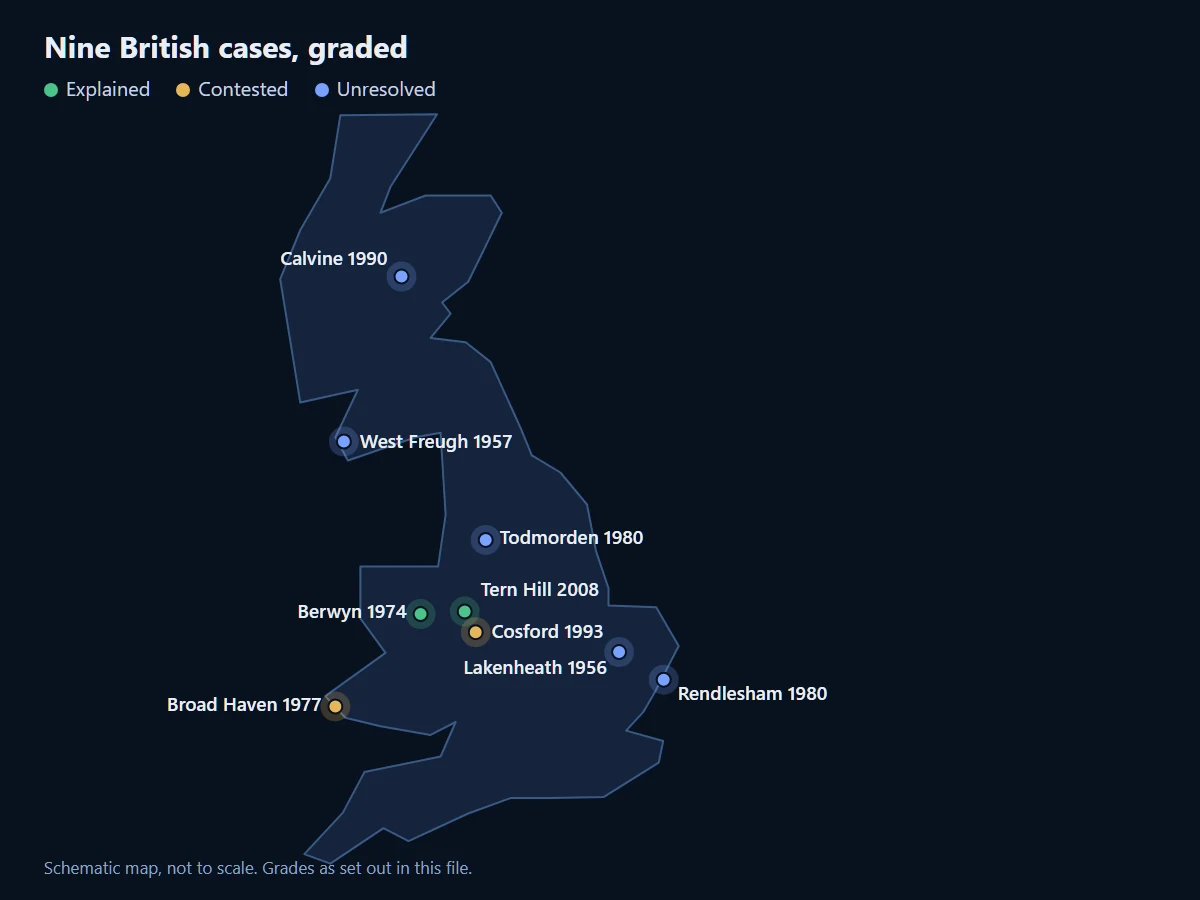
Nine cases follow. The rule for choosing them was the files' own: cases the MoD papers flag or treat at length, plus the most-cited public cases, with several that the records explain so the sample is not only the residue. Every case is read with the same four questions: what documents exist, what the witnesses said, the best conventional explanation, and the strongest objection to that explanation. Where the case rests on one witness, we say so.
| Case | Record we could read | Best conventional explanation | Status |
|---|---|---|---|
| Berwyn Mountains, Wales, Jan 1974 | Peer-reviewed paper using police logs | Earthquake, meteor display, poachers' lamps | Explained (peer-reviewed paper) |
| Cosford and Shawbury, Mar 1993 | Catalogue entry; researcher's account of the file | Rocket-stage re-entry; probable police helicopter | Contested |
| Tern Hill, Shropshire, Jun 2008 | National Archives guide to the file | Chinese lanterns from a wedding | Explained by the desk (untested) |
| Broad Haven, Wales, 1977 | Researcher's account of MoD papers | Partly a hoax; the school sighting is not explained | Contested |
| Lakenheath-Bentwaters, Aug 1956 | US Condon report text | Radar anomaly and misread lights, not excluded | Unresolved |
| West Freugh, Scotland, Apr 1957 | Air Ministry conclusion as quoted in the National Archives guide | Not identified by the Air Ministry | Unresolved |
| Rendlesham Forest, Dec 1980 | Catalogue entry; MoD handling per its officer | Fireball, lighthouse, stars, rabbit scrapes | Unresolved |
| Calvine, Scotland, Aug 1990 | Catalogue entries; 2022 print analysis | Unknown; model or black project proposed | Unresolved |
| Todmorden, Yorkshire, Nov 1980 | One witness's account | Not testable | Unresolved |
Cases the Records Explain
Berwyn Mountains, 23 January 1974
Record. Gwynedd Police opened a major-incident log at 21:00, checked with RAF Valley and Preston air traffic control in case an aircraft had crashed, and had search parties off the mountain by 23:30 with nothing found. The last search ended at 14:13 the next day; no aircraft was missing. The Institute of Geological Sciences recorded a magnitude 3.5 earthquake at 20:38, felt from the Llyn Peninsula to Shropshire. [14]
Testimony. Callers reported a bang, a rumble and lights. Coastguards on both sides of the Irish Sea reported a green meteor. A "flying sphere" was seen at Betws-y-Coed at 21:58 and a disc at Gobowen the next morning. [14]
Best conventional explanation. An earthquake, a bright meteor display the same night, and poachers' lamps on the hillside. A meteorite big enough to cause that shock would have left a crater; extensive searches found none. [14]
Strongest objection. The coincidence is odd, and the paper that explains it is titled "The enigmatic Bala earthquake". The causative fault is not identified, and lights with so small a quake are only "suggestive". The author answers that earthquakes and meteors have coincided before, in 1892 and 1896, and that such coincidences are inevitable over a long period. [14]
The legend. Folklore says the military sealed the mountain and removed a craft. The police logs contradict it: this is a confusion with an RAF Harrier crash on the Berwyn on 12 February 1982. The "strangers asking questions" were the survey team gathering earthquake reports. [14] The MoD's own papers hold only brief details of the night (AIR 2/19083, with more released to a member of the public in 2003 in DEFE 24/2045/1). [12] Verdict: the night is explained; the crash story is contradicted by the police logs.
Cosford and Shawbury, 30 to 31 March 1993
Record. The reports are in DEFE 24/2086/1. By Clarke's account of that file, the desk head, Nick Pope, briefed that "an unidentified object of unknown origin" had operated undetected by radar; his line manager suspected a secret US aircraft ("Aurora"); the Air Attaché in Washington found nothing at the Pentagon; and Pope was told to drop the subject. [37] [15]
Testimony. A MoD police patrol at RAF Cosford saw two bright lights with trails and phoned the Met Office observer at RAF Shawbury, Wayne Elliott, who later described a large object with a sweeping beam and a low hum. Dozens of people across western Britain and Ireland saw lights around 01:10 to 01:15. [15]
Best conventional explanation. The booster of the Russian satellite Cosmos 2238, launched the evening of 30 March, re-entered about 01:15 BST on a track matching the sightings. Elliott's own sighting is logged about 02:40 BST, more than an hour later, and Clarke argues it was probably a police helicopter with a searchlight. Elliott said in 2005 he was "convinced that what I saw has been explained". [15]
Strongest objection. Pope argued the rocket debris could not account for low-level lights, the hum or the beam, and the helicopter identification cannot be proved because the flight logs no longer exist. Clarke adds that a Spanish researcher reported in 1994 that NASA and NORAD agreed the path matched the rocket; we did not read that. [15] The case rests on one researcher's reading of the trajectory data; we did not read that data. Verdict: Contested, with the explanation strong for the main flap and weaker for the Shawbury sighting.
Tern Hill, Shropshire, 6 June 2008
Record. Soldiers of the Royal Irish Regiment on fire-picket duty saw lights over the barracks. One filmed 13 objects on a phone and sent the footage to a national newspaper, which ran it on its front page as "ALIEN ARMY". The files then show a hotel landlord telling a broadcaster the lights were Chinese lanterns from a wedding party, and the UFO desk officer writing that he did "not intend to investigate any further as I think we have our answer". [1]
Why it matters. The same files record that reports rose from about 150 a year in 2000 to 2007, to 208 in 2008 and 643 in 2009 (to 30 November). Many described slow formations of orange lights that the files attribute to lanterns, though some witnesses were convinced the lights were "moving under control, against the wind". Clarke adds that publicity from the file releases may have encouraged people to report. [1] [3] Note the limit: the lantern explanation for Tern Hill rests on a landlord's claim that the desk accepted without testing. Verdict: explained to the desk's satisfaction, though not independently tested.
Broad Haven, Pembrokeshire, 1977
Record. Fourteen pupils at Broad Haven Primary School reported a silver, cigar-shaped object in fields behind the school on 4 February 1977. Their head teacher had them draw it and found the drawings strikingly alike. The MoD asked the RAF Police on 14 June 1977 for a "discreet enquiry"; a December 1977 briefing recorded that the RAF Police thought the summer reports "could have been the work of a practical joker". No final report survives. [16]
Testimony. The Coombs family at Ripperston Farm described repeated encounters, including damaged electrical equipment and a claimed teleported herd of cows; a hotel manager reported two figures in boiler suits in April; later reports spoke of giant figures in spacesuits. [16]
Best conventional explanation. A member of the Milford Haven Round Table is reported to have confessed to dressing as a spaceman using borrowed asbestos suits. That fits the spring reports. [16]
Strongest objection. The school sighting came first and is not explained by the later dressing-up, and one pupil, David Davies, is quoted as saying he did see "something unexplained" that day. The confession is itself reported by one researcher. [16] Verdict: Contested; a hoax explains part of the wave but not its starting point.
Cases That Stay Open
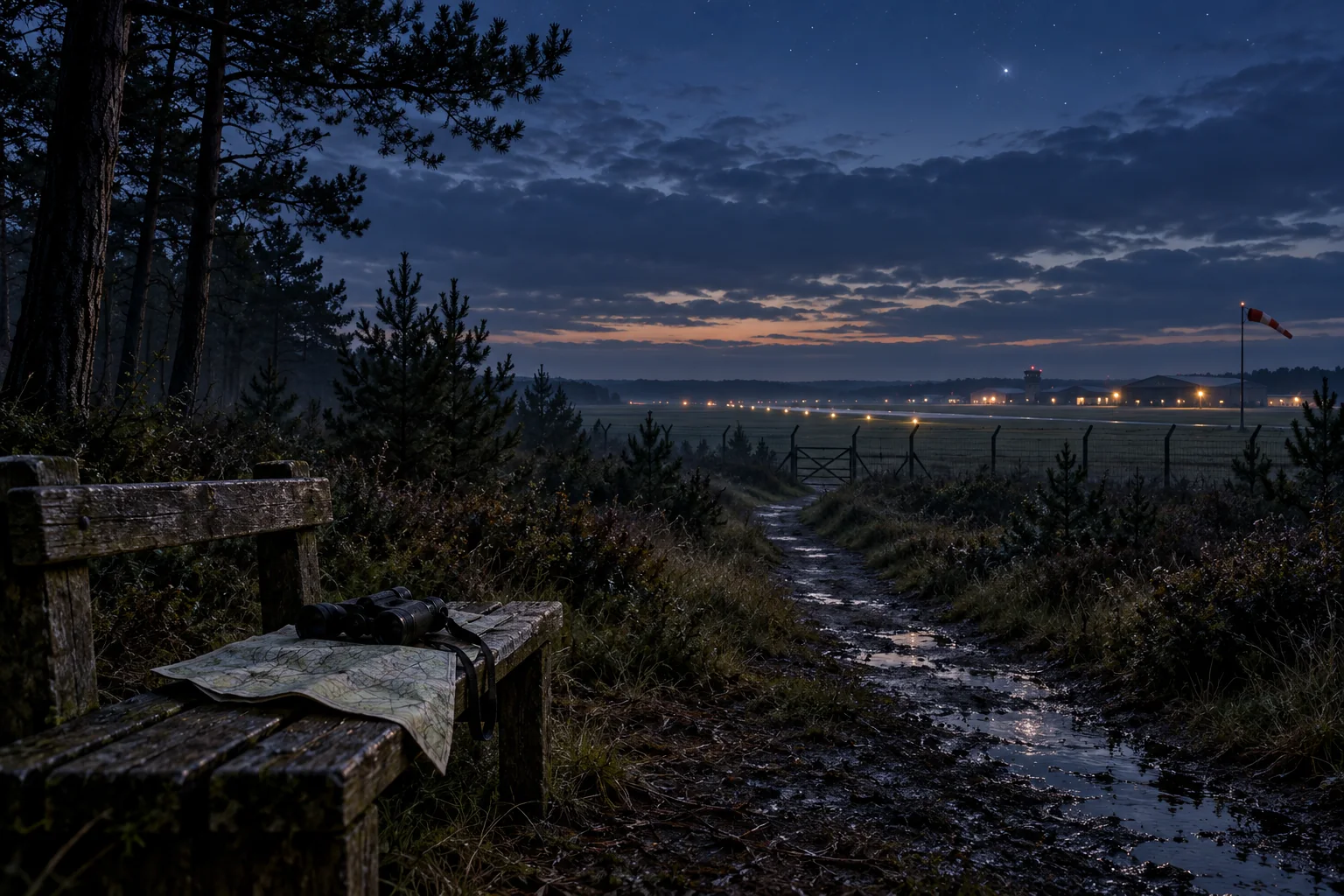
Lakenheath-Bentwaters, 13 to 14 August 1956
Record. The best-known account is Case 2 of the US Condon report, with station names redacted in the published text. The published text, whose station names are removed and which the secondary literature identifies with Lakenheath and Bentwaters, describes ground radar and visual reports by USAF and RAF personnel, a Venom night fighter vectored onto a target, and a second fighter that failed to make contact. [17] This is an episode at RAF stations hosting US units; the Air Ministry's own files on it were not read. [17]
Testimony. Operators reported fast targets that stopped abruptly and moved off in straight legs of 8 to 20 miles; the Venom crew reported a radar lock and a target that got behind the fighter and followed its manoeuvres; ground observers saw small, white, very fast lights. [17]
Best conventional explanation. Anomalous propagation of radar signals and misread lights, possibly meteors. The report calls the propagation evidence "rather uncertain" and rejects an early Perseid explanation. [17]
Strongest objection. The case-writer concludes conventional explanations "certainly cannot be ruled out" but that "the probability that at least one genuine UFO was involved appears to be fairly high". That is the assessment of this case, not the report's overall finding, which was that further UFO study was not justified. In the report a UFO is an unidentified object, not an alien one. [12] A key witness letter was written about 12 years after the night and contains small errors. [17] Verdict: Unresolved.
West Freugh, Wigtownshire, April 1957
Record. Trailer-mounted radars at an RAF bombing range in south-west Scotland tracked unidentified targets in April 1957. The story leaked to the press, led to parliamentary questions, and the Air Ministry told the Joint Intelligence Committee it could not explain four recent incidents. The Air Ministry intelligence report on West Freugh concluded: "It is concluded that the incident was due to the presence of five reflecting objects of unidentified type and origin. It is considered unlikely that they were conventional aircraft, meteorological balloons or charged clouds." The National Archives' guide calls this possibly the closest the Air Ministry came to admitting that some UFOs stayed inexplicable. [12] [38]
Testimony. The evidence is radar plots, not witnesses. We read the conclusion only as quoted in the guide, not the file (AIR 20/9320 and AIR 20/9321).
Best conventional explanation. The Air Ministry itself considered conventional aircraft, balloons and charged clouds unlikely. Radar anomalies of other kinds are the usual remaining proposal, but none is documented in what we read.
Strongest objection. "Unidentified type and origin" is a statement about the intelligence available to a 1957 report, not about aliens. The report was written in the Cold War, when the live worry was foreign aircraft. Verdict: Unresolved, for lack of data and an unread file.
Rendlesham Forest, 26 to 28 December 1980
Record. The MoD's papers are in DEFE 24/1948. Lt Col Charles Halt's memo, "Unexplained Lights", dated 13 January 1981, reached the MoD's DS8 branch in January through an RAF officer, Squadron Leader Donald Moreland; the radar stations at Watton and Neatishead logged nothing unusual, the MoD saw no defence threat and declined to ask for Halt's tape. [26] [19] In 2008 the MoD still described the case as "closed". [1] The case has its own dossier on this site, Rendlesham Forest.
The memo itself. Halt's memo, addressed to the RAF base commander, reports two patrolmen seeing unusual lights near the back gate at about 03:00, a "metallic, triangular object" two to three metres across with a pulsing red light and blue lights below, three ground depressions about 1.5 inches deep and 7 inches across, "Beta/Gamma readings of 0.1 milliroentgens" with peaks in the depressions, and on a later night a red light that broke into five white objects and three star-like objects moving in angular patterns. It is the single most important contemporaneous document and it is carefully hedged in its own words: it reports what was seen, not what it was. It dates the first sighting 27 December, a day later than the date Clarke draws from contemporary records. [39] [40]
Testimony. US airmen saw lights fall into the forest around 03:00 on 26 December; Halt's party followed lights on the 28th. Clarke reports that Jim Penniston later claimed to have approached and touched a landed object, that this conflicts with the recollection of the investigating officer, and that it is inconsistent with the account of a colleague, John Burroughs, whom he describes as saying he only saw lights; we have not read either man's own accounts, and Halt's memo dates the sightings a day later than Clarke's reading of the contemporary records. [40]
Best conventional explanation. A bright fireball over southern England near the time, the Orford Ness lighthouse beam seen through trees, bright stars, animal burrows for the ground marks, and radiation readings judged near background. A Suffolk police log of 26 December recorded that the only lights visible were from the lighthouse. [40] [28]
Strongest objection. Trained airmen reported lights, though their accounts differ; the memo and tape exist; and the MoD's own investigation was, in Clarke's phrase, "half-hearted". In 1985 Admiral of the Fleet Lord Hill-Norton called features of the case "puzzling and disquieting". [40] [28] A case that was barely investigated stays open because nobody tested it, not because it resisted testing. Verdict: Unresolved.
Calvine, Perthshire, 4 August 1990
Record. The published literature cites the MoD papers to DEFE 24/1940 and DEFE 31/180, whose catalogue entries cover 1990 to 1992. By Clarke's account the files hold a briefing for ministers in case the story broke and a poor-quality photocopied drawing, prepared by RAF photographic experts, of a UFO beside a Harrier. [31] [41] [18] The paper original of DEFE 24/1940 is closed until 2076 on the personal-information ground; Clarke says the MoD and the National Archives have refused to unredact the photographer's name for privacy. [13] [18]
Testimony. Two hillwalkers whose identities are still unknown said a large diamond-shaped object hovered silently at around 9 p.m. and then rose. They took six photographs. The negatives went to the Daily Record and have never been found; the only surviving first-generation print was kept by a former RAF press officer and shown to Clarke in 2022. [18]
Best conventional explanation. None has been demonstrated. The Sheffield Hallam photographic analyst Andrew Robinson concluded the object is "definitely in front of the camera" between a fence and a Harrier and ruled out post-production editing, but asked whether it could be a kite or radio-controlled model. Clarke judged it a probable hoax in 2021 and says he is now "convinced" it shows a classified US project. [18]
Strongest objection. No photographer, model-maker or confirming witness has come forward, no Harrier flight record has been found, and the negatives are missing, so the print cannot be authenticated against its source. [18] A photograph can show that something was in front of a lens; it cannot show what it was. Verdict: Unresolved.
Todmorden, West Yorkshire, 28 November 1980
Record. We found no official file on this case that we could read. It is the clearest example here of a testimony-only claim. [42]
Testimony. PC Alan Godfrey was sent at about 5 a.m. to a report of escaped cattle. He says he saw a rotating diamond-shaped craft, his radio failed, a flash followed and he found himself in his car with about 25 minutes unaccounted for. Godfrey's own account, as the channel reports it, is that under hypnosis later he described being in a room with small figures and a tall bearded one. He has maintained that it was a real craft. [42]
Best conventional explanation. The account cannot be tested. As a general note of ours, not from the source, recall under hypnosis cannot verify what happened; misperception, tiredness and expectation are the usual proposals, and none can be shown here. [42]
Strongest objection. A serving constable reported it to his own force, says it cost him his career, and other officers and a bus driver are said to have seen odd lights that morning; that is reported without detail, and we found no primary record. The press linked the case to the unexplained death of a miner, Zigmund Adamski, five months earlier; nothing we read establishes any link. [42] Verdict: Unresolved, on one witness, with no physical evidence.
Inside the Desk: What Officials Wrote
The files are most revealing about the people who kept them. Four documents show the attitudes inside the MoD, in the officials' own words.
- The closure briefing (11 November 2009). The officer wrote that the department should "reduce very significantly the UFO task which is consuming increasing resource, but produces no valuable defence output". It also records that the MoD made no formal approaches to other governments before closing because these "would become public when the relevant UFO files are released and could be viewed by 'ufologists' as evidence of international collaboration and conspiracy". [1] The briefing gives that as its reason for not approaching other governments, which shows how concern about appearances shaped what the department did.
- The desk officer's email (2 June 2009). He judged the release programme "a success for the MoD" but added that a section of ufologists "will choose to believe whatever they believe". [1]
- A Rendlesham officer's memory. The RAF officer who forwarded Halt's report, Squadron Leader Donald Moreland, recalled assuming Halt "was pulling my leg". Another MoD official from DS8 says he does not dismiss the phenomenon but suspects the final explanation will be "something quite mundane". [40] [19]
- The letters. The files carry ordinary people's letters: a schoolchild in Altrincham who drew a flying saucer and wrote "I have the right to know" and was sent "RAF goodies"; a woman in Liverpool whose children were "terrified"; a caller who said he had been "living with an alien in Carlisle". [1]
Read together, the officials do not look like people guarding a secret. They look like a small team that decided, repeatedly, the matter was not their job, and who were anxious about the public reading hidden meaning into that decision.
Claims Tested
Each claim below is graded on the documents that exist, not on how widely it is repeated.
"Churchill ordered a cover-up of a wartime UFO"
Not corroborated. The documented episode is the 28 July 1952 request for a report and a four-cause reply. The wartime story comes from a single third-hand letter of 1999; the MoD told reporters it found no written record, and the Churchill Centre reports that neither the MoD nor the Cabinet Office found one either; we checked the catalogue entry but did not read the file. [22] [23] [34] [35]
"The real files are sealed until the 2080s"
The catalogue facts are verified; the legend is misleading. The dates are real for paper originals, but the redacted copies are open, and the recorded ground for 201 of 205 closed records is third-party personal data. One record cites national security in the alternative, and two extracts cite international relations. The 2026 replacement of two policy-file copies by closed originals is a real change in what the public can read; the catalogue says the complete original replaced the copy but does not say why no new redacted copy is listed. [13] [30] [7]
"The MoD hid Rendlesham"
Contested. The MoD file is open and the Halt memo is in it. What the file shows is not concealment but inattention: radar checks on the wrong dates, no interviews, a decision not to request the tape. [26] [19] [40]
"A UFO crashed at Berwyn and the military took it away"
Contradicted. The 1974 police logs show search parties on the hill and no cordon; a researcher cited by the geological survey traces the cordon story to a 1982 Harrier crash. [14]
"The royal family kept UFO files"
Contested: interest is documented; evidence of any finding is not. The National Archives' guide says Lord Mountbatten encouraged a newspaper's UFO coverage in 1950 and was one of a small group of senior officials who believed UFOs were real and of interplanetary origin. [12] By Clarke's account, Prince Philip's equerry, Air Marshal Sir Peter Horsley, arranged for RAF aircrew sighting reports to be sent to the Palace in the early 1950s; Horsley said his papers went to the Royal Archives, and Clarke saw copies in 2000. In 2017 the Prince's office said "extensive searches have not yielded any papers". The quotations attributed to Prince Philip rest on Horsley's recollection. Interest in the subject is not evidence that anything was found. [43]
"Condign proves UFOs are plasma"
Contested. Condign says plasma is the "most likely" explanation for the unexplained remainder while admitting it "cannot offer certainty". It was not peer-reviewed, and the researcher who obtained it doubts the claim. [11] [24]
"Britain shares UFO data with the United States"
Unresolved. Condign said in 2000 that the MoD had no exchange of sighting reports with other nations. In September 2025 ministers said the department had not taken part in any international UAP grouping since May 2023, and did not answer a follow-up on Five Eyes cooperation beyond referring back. We found no document showing sharing, and no document ruling it out for other periods. [11] [6] [44]
"The MoD closed its UFO desk to hide what it knew"
Contested. The MoD's stated reason was cost and lack of defence value. Clarke argues the closure followed from a conclusion fixed in advance, citing a 1998 minute; that is an inference about intent, and the same documents also show the desk overwhelmed by lantern-driven reports. [2] [24] [1]
The Strongest Case on Each Side
The strongest case that something real remains
- Condign's own caveat. The department's best study "cannot offer certainty of explanation of all UAP phenomena" and rests on witness forms the MoD did not follow up. [11]
- Credible witnesses. Cases such as Lakenheath-Bentwaters and Rendlesham involve trained air and ground crew. A US-funded study judged the probability of "at least one genuine UFO" in 1956 "fairly high". [17]
- Documents that were lost, closed or replaced. The 1951 report was kept to one outside copy and later lost, the Calvine negatives vanished, the Condign original was reported missing, and in 2026 redacted copies of policy files were replaced by closed originals. [11] [18] [33] [7]
- Officials who took it seriously. Lord Hill-Norton wrote in 1985 that Rendlesham's features were "puzzling and disquieting". [28]
The strongest case that nothing real remains
- The explained cases are the best-documented ones. Where the records are rich, as at Berwyn and Cosford, the lights have mundane sources; where they are thin, the cases stay open. That pattern is what the sceptical reading predicts. [14] [15]
- Three official assessments, one conclusion. The 1951 working party (read as quoted by the National Archives), Condign in 2000 and the 2009 briefing each found no evidence of hostile or extraterrestrial activity. Their independence is limited: the later studies knew of the earlier ones, and the 1951 party relied on US sources. [11] [1] [12]
- The closures have a recorded, mundane ground. Privacy accounts for nearly all of the 205 closed records. [13]
- Reports follow culture. Reports jumped from 117 to 609 between 1995 and 1996, which Clarke links to The X-Files and Independence Day, and from 208 to 643 in 2008-09, which the files link partly to lanterns and Clarke partly to publicity. [28] [1] [3]
Both sides are right about their own points. The decisive question is what kind of evidence would settle a case: radar tapes, negatives, physical samples, an unredacted file. For nearly every open British case, that evidence has been lost, never collected or is closed.
Where the UK Stands Now
The government's stated position has been steady since the desk closed in 2009. In a Lords exchange on 30 June 2021, as summarised on TheyWorkForYou, the minister said the MoD holds no reports on unidentified aerial phenomena, has no plans for its own report, and acts on threats backed by evidence; she confirmed that the desk closed in 2009 and that its material went to the National Archives. [45] Written answers in September 2025, as read through a mirror, say much the same: no sighting reported to the department in more than 50 years has indicated a military threat, the department stopped investigating in 2009 and passed its pre-2009 material to the National Archives, and it has not conducted or commissioned studies since. [5] [46] Those statements need scoping. They describe the period since 2009; Condign itself shows the MoD did run a UAP investigation before then, and says it needed to answer an earlier denial that it had. [11]
The earlier parliamentary record shows how little the position has moved. A Lords debate on 18 January 1979, opened by the Earl of Clancarty, asked for an intra-governmental study of UFOs; we read only the opening speeches. The government's closing reply, as quoted by the National Archives, said that "there is nothing to suggest to Her Majesty's Government that such phenomena are alien spacecraft". [25] [12] More than four decades on, the answers are still that nothing has been found and nothing is being studied.
Two things are different. First, the public record is now much larger than in 1979: the National Archives holds the redacted files, and the department's own studies can be read. Second, the United States has begun publishing its own UAP records under a 2026 programme; this site's fifth-batch file covers what those records show and where their limits lie. Nothing in the British record suggests a parallel release.
Nick Pope, who ran the desk in the early 1990s, died in April 2026. [27]
Consequences and what follows
The documented consequences of this record are modest. The desk's closure left the public, police and pilots with no official place to report sightings; the MoD wrote to the Home Office and aviation authorities in 2010 to stop forwarding them, and said reporters should not expect an investigation. [1] Condign itself cost £50,000, according to a 2007 parliamentary answer as reported by Clarke. [24] Whether anything was lost by ending the monitoring is not shown: Condign's own view was that the reports did not "demonstrably provide information useful to Defence Intelligence". [11]
Our recommendations, separate from any legal duty. (1) The National Archives and the MoD should say publicly why the redacted copies of the two policy files were replaced by closed originals, and whether new redacted copies will be published; this costs an explanation and a scanning exercise, and the risk is only to third-party privacy, which redaction already handles. (2) The MoD should publish what it released in 2026, if anything, of Condign's formerly redacted passages, with its own account of what was released, so the single-source report can be checked. (3) Whoever holds the Calvine negatives or the photographers' identities should be asked, with a privacy-safe route, to come forward. None of these is currently required by law as far as we know; we did not research the Freedom of Information position beyond the catalogue's closure grounds.
What would change the conclusion
- A published, substantive account of what is in the closed DI55 policy files, or a replacement redacted copy of the two files withdrawn in 2026.
- Primary release of the radar data and of Condign's unredacted passages, with an official statement of what was released.
- Recovery of the Calvine negatives or the identification of the photographers.
- Any document showing physical evidence held by the MoD, which no record we read suggests exists.
Quick Answers
Does the UK government have UFO files?
Yes. The Ministry of Defence kept them from 1950 to 2009, and they are mostly in the National Archives series DEFE 24. [3] [13]
Are they all released?
Redacted digital copies of about 200 are public. The paper originals are closed until the 2070s to 2090s, and the catalogue gives personal information as the ground for almost all of them. [13]
Did Britain ever find evidence of aliens?
Not in any record we read. Condign (2000) found no evidence of extraterrestrial activity, and in 2009 the MoD told its minister nothing in 50 years suggested it. [11] [1]
What is Project Condign?
A secret Defence Intelligence study of about ten years of UFO reports, finished in December 2000 and released with redactions on 15 May 2006. It concluded the objects posed no threat and that the unexplained remainder was most likely plasma. [11] [29]
Why did the MoD close the UFO desk?
Its stated reason was that the work consumed resources and produced "no valuable defence output". Clarke argues the decision followed a conclusion reached years earlier. [1] [24]
Is Rendlesham really "Britain's Roswell"?
It is Britain's best-known case, involving US airmen at RAF bases. The MoD file is open; the explanations on offer are conventional but disputed. See the full Rendlesham file. [26] [40]
Did Churchill cover up a UFO?
There is no document showing it. Churchill asked for a report in 1952 and was told the sightings had natural or human causes. [22] [23]
What happened at Berwyn Mountain?
A magnitude 3.5 earthquake and a meteor display on the same night. The claimed military cordon was a later Harrier crash. [14]
Is the Calvine photograph real?
An expert found it is a genuine photograph of a real scene with the object in front of the lens, but could not rule out a kite or model. What the object was remains unknown. [18]
Can I report a UFO to the MoD now?
No. The hotline and email address closed in December 2009, and in 2010 the MoD told police and aviation authorities to stop forwarding reports. [1]
Does the UK share UFO data with the US?
Condign said in 2000 there was no exchange of sighting reports; in 2025 ministers said the MoD had not joined any international UAP grouping since May 2023. [11] [6]
How reliable is Nick Pope?
He ran the desk in the early 1990s and wrote about it, so he is a valuable witness to what the department did. He criticised Condign as conclusion-led. Weigh his testimony as that of an informed participant, not as documentary proof. [36] [15]
Method and Limits
This file is dated 13 October 2026, the cutoff for evidence. It was built by reading the primary record where it could be reached and saying where it could not.
Primary records read directly. The National Archives' 2013 research guide to the UFO files (which quotes the 1951 report's conclusion, the 1979 government reply and the 1957 West Freugh conclusion); the National Archives catalogue (read through its public interface for the records cited, and tabulated for the whole DEFE 24 UFO series on 13 October 2026); the National Archives' 2013 press release and highlights guide for the final tranche; Chapters 1, 4 (second half) and 5 of Project Condign Volume 1 in the MoD's released text, with a check of one quotation against the page image; the Condon report's Case 2 text; the Musson paper in full; and, in summary form only, the 2021 Lords exchange (via TheyWorkForYou) and the opening speeches of the 1979 Lords debate.
Not read. The full 1951 working party report (its conclusion is read only as quoted by the National Archives), the West Freugh files, Condign Volumes 2 and 3 and the annexes, Chapters 2 and 3 of Volume 1 beyond a search for key terms, the contents of any DEFE 24 file beyond what the catalogue and the National Archives guides say, the Air Ministry and USAF files on Lakenheath-Bentwaters, the Halt tape, the original scan of the memo (read in transcription), and the unredacted Condign material of 2026. The official Hansard and Parliament written-question pages blocked automated access, so the September 2025 answers were read through a mirror that cites the official URLs; we paraphrase them and quote only one short sentence, which should be checked against the official page.
Where one voice carries a lot. Most narrative detail on the Cosford, Broad Haven, Calvine, royal and 2026 Condign items comes from David Clarke, whose highlights and background guides formed part of the National Archives release and whose books appear in the research guide's bibliography, and who has also argued positions of his own. The National Archives' research guide is an unsigned briefing document whose sourcing overlaps with his published work, so we do not count it as independent of him. [1] [12] His pieces are counted as a single evidence chain, and his account of the June 2026 Condign release rests on his own post and unpublished correspondence. The Todmorden account is the witness's own. We cite press reports where they are the only route and label them.
Where sources disagree. The working party's start is August 1950 in Condign and October in Clarke. Condign's release is 15 May 2006 on the MoD's page, while Clarke's later post speaks of redacted versions posted in 2007. Condign's file reference is given as DEFE 24/3127/1 in Clarke's 2018 list, but the catalogue describes that file as "Air Defence Ground Environment: UFO reports" for 1999 to 2001; a December 2000 policy file (DEFE 24/3356/1, opened to the public in August 2023) may be the intended one. We rely on neither reference. The September 2025 answers carry different dates (4 or 5 September) on different mirrors. [11] [20] [29] [33] [47] [48]
The catalogue tabulation. The count of 457 records is from a keyword search of the series and includes sub-records and extracts; it is not an official file count. The National Archives and Clarke report 209 files by 2013 and a later count of 227 with 2017 additions.
Search and overlap. Existing coverage of the "UK UFO files" is mostly news recap of the 2008 to 2013 releases and single-case pieces. We found none that reports the catalogue-level closure data, Condign's own text, the 2025 answers or the 2026 file changes. We make no claim about search volume, and the search tool used does not return Google rankings.
How labels were set. Verified means a primary record we read establishes it, and for statements about what officials concluded, that the record says so. Contested means credible sources conflict or the explanation is strong but rests on one chain. Unresolved means the evidence cannot settle it. A claim marked contradicted or not corroborated means a document we read contradicts it, or we found nothing that backs it. A document saying "no evidence" is recorded as what the document says, not as proof of absence.
People and images. Witnesses and officials are reported as they gave their accounts. We name no one as lying. The cover image is a designed graphic, not a photograph or a document facsimile.
Evidence Ledger
What the record supports
A working party was set up in 1950, the Air Staff Secretariat ran a UFO desk with Defence Intelligence advice, and the desk and hotline closed in November and December 2009. Sources 21, 3, 1, 12
The National Archives opened ten tranches; the final one was 25 files and 4,400 pages. Our catalogue tabulation found 200 open digital copies in series DEFE 24. Sources 3, 4, 13
One record (DEFE 24/1958) adds a national-security ground in the alternative, and two extracts cite international relations. Sources 13, 30
The catalogue's custodial histories for DEFE 24/3153 and 3155 record the 2017 copies, the later discovery of the originals and the 2026 transfer. Sources 7, 8, 9
The catalogue gives no reason and lists no replacement redacted copy. Clarke says the three DI55 policy files he received in 2018 hold the Condign minutes; we have not read them. Sources 7, 24
Chapter 5 of Volume 1 says so, and recommended that DI55 stop monitoring reports. Source 11
The study calls plasma 'most likely' while admitting it 'cannot offer certainty'; it was not peer-reviewed and the researcher who obtained it doubts the claim. Sources 11, 24
The request is catalogued in PREM 11/855 and printed in Condign's Preface; the National Archives guide quotes the reply's opening and its line that nothing had changed since 1951; the four causes are from the Churchill Centre. Sources 22, 11, 12, 23
The letter is catalogued in DEFE 24/2008/1 (we did not read the file); the no-record finding is reported by the MoD to the press and by the Churchill Centre. Sources 34, 23, 35
Police logs, the geological survey's data and a peer-reviewed paper agree; no meteorite or craft was found. Source 14
Musson read the police logs and cites Roberts (2001) for the 1982 origin. Source 14
The re-entry fits the timing; the helicopter cannot be proved because flight logs no longer exist. The account rests on one researcher's reading of the file and trajectory data. Sources 15, 37
A confession is reported by one researcher; the school sighting that began the wave is not explained by it. Source 16
The Condon report found conventional explanations 'cannot be ruled out' but a genuine unidentified object 'fairly high' in probability; the station files were not read. Source 17
The Air Ministry's own report said they were five reflecting objects of unidentified type and origin, unlikely to be aircraft, balloons or charged clouds; we read the conclusion only as quoted by the National Archives. Sources 12, 38
Conventional explanations exist and conflict with some testimony; the MoD barely investigated. Sources 26, 19, 40
An analyst found a real scene with the object in front of the lens, but a model could not be excluded; negatives and witnesses are missing. Source 18
The account is the witness's own, with hypnotic recall later; no official file was read. Source 42
Interest is reported through Air Marshal Horsley's recollection and Clarke's copies; Prince Philip's office said in 2017 its searches found no papers. Source 43
A single post by one researcher reports it; it rests on correspondence not published in full. Source 10
Condign said in 2000 there was no exchange; ministers said in 2025 the MoD had not joined any international UAP grouping since May 2023. No document shows or rules out sharing for other periods. Sources 11, 6, 44
Condign (2000) and the 2009 closure briefing say so in terms; the 1951 conclusion is read as quoted by the National Archives. This is a statement about those assessments, not about every file. Sources 11, 1, 12
Final Assessment
What the records show. Britain's UFO files are real, largely open and consistent. For 59 years the MoD asked a narrow question, whether anything in British airspace was a threat, and its three assessments, in 1951, 2000 and 2009, answered no. The one exception in the record is more modest than it sounds: in 1957 the Air Ministry reported five unidentified radar objects at West Freugh without saying what they were. None of the documents we could read says that evidence of non-human intelligence was found, held or hidden. [11] [1] [12] [38]
What the cases show. The best-documented cases are best explained by ordinary causes: an earthquake and meteor display at Berwyn, a rocket stage and probably a helicopter at Cosford, lanterns at Tern Hill, in part a hoaxer at Broad Haven. Berwyn rests on a peer-reviewed paper; the others rest on the desk or on one researcher. The cases that stay open, Lakenheath-Bentwaters, West Freugh, Rendlesham, Calvine and Todmorden, stay open because the radar data, negatives, tapes or independent witnesses are missing, not because a file says "alien". [14] [15] [16] [1] [17]
What concealment there is. Documented concealment is narrow and mundane: a 1951 report kept to one outside copy, a Condign study classified until 2006, redactions that remain, lost Calvine negatives, and in 2026 a swap of redacted copies for closed originals that the catalogue does not explain. These are reasons to ask the MoD for fuller answers. They are not evidence of what the files would say. [11] [7] [18]
The strongest defensible answer. No record we could read supports the claim that a non-human intelligence is involved. The record also does not close every case, and the department's own best study admits it cannot explain everything. The label is Contested: not because any document points to aliens, but because the open cases, the unread files and the 2026 file changes prevent a final "no".
Confidence. High that the three assessments and the catalogue say what we report; the contents of the DEFE 24 files themselves were not read. Moderate on the explanations of Berwyn, Cosford and Broad Haven. Low on any conclusion about Rendlesham, Calvine, Todmorden and Lakenheath-Bentwaters. Our conclusion would change if an unredacted DI55 file, radar data or negatives showed physical evidence.
Sources
References and further reading
- 012013The National Archives, Highlights Guide to the tenth and final tranche of UFO files (2013)Official guide to original records
- 022009–2010DEFE 24/2458/1, UFOs: Ministry of Defence policy on sightings (digital copy with redactions), 2009-2010. National Archives catalogue recordOriginal record catalogue entry
- 0321 June 2013The National Archives, press release 'UFO Desk: Closed - Last Tranche of UFO Files Released', 21 June 2013Official press release
- 0420 June 2013David Clarke, 'The End of the UFO Files', 20 June 2013Researcher's account
- 0522 July 2025Written question 69987, 'Unidentified Flying Objects' (Clive Lewis, tabled 22 July 2025), UK ParliamentParliamentary record (read via a mirror citing this page)
- 0622 July 2025Written question 69989, 'Unidentified Flying Objects' (Clive Lewis, tabled 22 July 2025), UK ParliamentParliamentary record (read via a mirror citing this page)
- 071996–1999DEFE 24/3153, UFO policy, 1996-1999 (closed original; custodial history records the 2026 transfer). National Archives catalogue recordOriginal record catalogue entry
- 081996–1999DEFE 24/3153/1, former reference of the redacted copy, destroyed by the Ministry of Defence on transfer of the complete original in 2026. National Archives catalogue recordOriginal record catalogue entry
- 091992–2003DEFE 24/3155, UFO policy, 1992-2003 (closed original). National Archives catalogue recordOriginal record catalogue entry
- 1026 June 2026David Clarke, 'Condign Un-redacted', 26 June 2026 (single source for the 2026 release)Researcher's account
- 11December 2000Unidentified Aerial Phenomena in the UK Air Defence Region, Volume 1 - Main Report (DIS Scientific & Technical Memorandum 55/2/00), December 2000, as released by the Ministry of Defence in 2006 (text read from the Internet Archive copy: Chapters 1, 4 (second half) and 5 in full; Volume 3 Preface and Executive Summary; Chapters 2 and 3 searched only)Original record / primary research
- 122013The National Archives, research guide 'Unidentified Flying Objects (UFOs)' (2013, an unsigned briefing document): history of British government interest, file references and quoted passages from DEFE 44/119, PREM 11/855, AIR 20/9321 and AIR 20/12966Official research guide to original records
- 13Checked 13 October 2026The National Archives Discovery catalogue, series DEFE 24, keyword 'UFO': 457 records read through the catalogue's public interface on 13 October 2026 (our tabulation of closure status and closure grounds)Catalogue data (our tabulation)
- 142006R.M.W. Musson (British Geological Survey), 'The enigmatic Bala earthquake of 23 January 1974', Astronomy & Geophysics 47(5), 2006Peer-reviewed paper
- 1531 March 2023David Clarke, 'Case Closed: 30th anniversary of the Cosford UFO flap' (researcher's account citing DEFE 24/2086/1, DEFE 23/254/1 and DEFE 24/1967/1)Researcher's account
- 1616 June 2024David Clarke, 'Did the village see aliens?' (researcher's account of the 1977 Broad Haven wave)Researcher's account
- 171968Condon Committee (University of Colorado), Scientific Study of Unidentified Flying Objects, 1968: Case 2, summer 1956 radar-visual case (station names redacted in the published text)US government-funded study
- 1812 August 2022David Clarke, 'The Calvine UFO photograph - revealed', 12 August 2022Researcher's account
- 1926 December 2020David Clarke, 'Rendlesham UFOs 40th anniversary: The Man from the Ministry speaks for the first time', 26 December 2020Researcher's account
- 2014 May 2011David Clarke, 'Flying Saucer Working Party' (secret files series)Researcher's account
- 211951DEFE 44/119, 'Unidentified Flying Objects' (DSI/JTIC Report No. 7), 1951. National Archives catalogue recordOriginal record catalogue entry
- 221952–1955PREM 11/855, Prime Minister's request to the Secretary of State for Air about flying saucer reports, 28 July 1952, and subsequent correspondence. National Archives catalogue recordOriginal record catalogue entry
- 23March 2025The Churchill Bulletin 202 (March 2025), article on Churchill and UFOsSpecialist historical society article
- 246 May 2018David Clarke, 'Why Britain's MoD closed the UFO files: exclusive new evidence', 6 May 2018Researcher's account
- 2518 January 1979House of Lords, 'Unidentified Flying Objects', debate of 18 January 1979, HansardParliamentary record (opening speeches read in summary)
- 261992–2002DEFE 24/1948/1, UFO reports of sighting: Rendlesham Forest, December 1980 (digital copy with redactions). National Archives catalogue recordOriginal record catalogue entry
- 27April 2026The Skeptic, 'Remembering Nick Pope, the UK's top UFO expert (1965-2026)', April 2026Obituary / commentary
- 2817 August 2009Associated Press via NBC News, 'Britain's latest UFO files raise new puzzles', 17 August 2009News report
- 2915 May 2006Ministry of Defence Freedom of Information publication page for the UAP report (released 15 May 2006; withheld under FOIA sections 26, 27, 40). UK Government Web ArchiveOfficial publication page
- 301985–1995DEFE 24/1958, UFO policy, 1985-1995 (closed original; national security ground recorded). National Archives catalogue recordOriginal record catalogue entry
- 31August 1990–January 1991DEFE 24/1940/1, UFO reports, August 1990 to January 1991 (digital copy with redactions). National Archives catalogue recordOriginal record catalogue entry
- 32June–December 2000DEFE 24/3154, UFO policy, June-December 2000 (closed original). National Archives catalogue recordOriginal record catalogue entry
- 3311 October 2023David Clarke, 'Lost and Found: Project Condign, the UK MoD's secret UFO study'Researcher's account
- 341999–2000DEFE 24/2008/1, UFO reports, 1999-2000 (digital copy with redactions). National Archives catalogue recordOriginal record catalogue entry
- 354 August 2010Associated Press via NBC News, 'British X-Files reveal secret UFO study', 4 August 2010News report
- 3610 May 2018Fox News (James Rogers), 'UFO mysteries unraveled: how the real-life X-Files emerged from a top secret UK project', 10 May 2018News report
- 37March–June 1993DEFE 24/2086/1, UFO reports sightings, 30/31 March 1993 (digital copy with redactions). National Archives catalogue recordOriginal record catalogue entry
- 381957AIR 20/9320, Air Ministry file of 1957 catalogued under several subject headings including a Parliamentary question on unidentified flying objects. National Archives catalogue recordOriginal record catalogue entry
- 3913 January 1981Lt Col Charles I. Halt, memorandum 'Unexplained Lights' to RAF/CC, 13 January 1981 (US Air Force document released under FOIA; transcription and scan on The Black Vault)Original record (transcription)
- 4031 December 2020David Clarke, 'Rendlesham Forest UFOs' (chronology and document conflicts)Researcher's account
- 411991–1992DEFE 31/180/1, UFO incidents, 1991-1992 (digital copy with redactions). National Archives catalogue recordOriginal record catalogue entry
- 42UndatedHISTORY (UK), 'The Todmorden UFO mystery: a close encounter in West Yorkshire'Television-channel feature (witness's account)
- 432 November 2024David Clarke, 'Close encounters of the royal kind'Researcher's account
- 4429 August 2025Written question 70605, 'Unidentified Flying Objects: Information Sharing' (Clive Lewis, tabled 29 August 2025), UK ParliamentParliamentary record (read via a mirror citing this page)
- 4530 June 2021House of Lords, 'Unidentified Flying Objects' (oral question), 30 June 2021, columns 787-790, Hansard via TheyWorkForYouParliamentary record (read in summary via a mirror)
- 4622 July 2025Written question 69988, 'Unidentified Flying Objects' (Clive Lewis, tabled 22 July 2025), UK ParliamentParliamentary record (read via a mirror citing this page)
- 471999–2001DEFE 24/3127, Air Defence Ground Environment: UFO reports, 1999-2001. National Archives catalogue recordOriginal record catalogue entry
- 48December 2000DEFE 24/3356/1, Unidentified Flying Objects Policy, December 2000 (digital copy with redactions, opened 11 August 2023). National Archives catalogue recordOriginal record catalogue entry
Continue the Chain
The wider UFO record, in Britain and the United States.